


Newsroom·Trans advocacy·Analysis
‘Radically Pro-Transgender’: The Constitutional Case Against NSPM-7
NSPM-7 and the 2026 Counterterrorism Strategy point federal law enforcement at groups it calls "radically pro-transgender."
 Pastora Tori Matthews
On September 25, 2025, the White House issued NSPM-7, a national security memorandum that directs federal law enforcement to “investigate, prosecute, and disrupt” what it calls domestic terrorism and organized political violence. In May 2026, the new U.S. Counterterrorism Strategy told the country whom it had in mind. Its priorities include “violent secular political groups whose ideology is anti-American, radically pro-transgender, and anarchist.”
Read that phrase again, slowly: radically pro-transgender.
Bloom Ministries is a trans-led, disabled-led ministry in Salem, Oregon. We pray, we publish, we help people move somewhere safe, and we say in public that trans people bear the image of God. We have never planned violence and we never will. We are writing because the words in NSPM-7 and the strategy were chosen with care, and words chosen by a government with prosecutors behind it are never only words.
This analysis sets out what NSPM-7 and the Counterterrorism Strategy actually say, what they leave undefined, and five constitutional limits that stand between those words and anyone who serves trans people. It is not legal advice. It is a record, written so that no one has to read these documents alone.
01
What NSPM-7 actually says
NSPM-7 is titled “Countering Domestic Terrorism and Organized Political Violence.” It was published by the White House on September 25, 2025, and appears in the Federal Register at 90 FR 47225. It carries the weight of a presidential directive, and it is addressed to the agencies that investigate, prosecute and tax.
Section 1 of NSPM-7 lists what it calls the “common threads” behind political violence. They include “anti-Americanism, anti-capitalism, and anti-Christianity,” “support for the overthrow of the United States Government,” “extremism on migration, race, and gender,” and “hostility towards those who hold traditional American views on family, religion, and morality.” NSPM-7 never uses the word transgender. It does not need to, because “gender” sits on the list, undefined, beside beliefs that millions of law-abiding Americans hold.
Then NSPM-7 hands out assignments:
- Joint Terrorism Task Forces are to “investigate, prosecute, and disrupt entities and individuals engaged in acts of political violence.”
- The Attorney General “may recommend” that a group “merits designation as a ‘domestic terrorist organization'” when its members’ activities meet the definition of domestic terrorism in 18 U.S.C. § 2331.
- The Treasury is to “identify and disrupt financial networks that fund domestic terrorism and political violence,” and to give banks guidance on filing Suspicious Activity Reports.
- The IRS is to “ensure that no tax-exempt entities are directly or indirectly financing political violence,” and to refer organizations, “and the employees and officers of such organizations,” to the Department of Justice.
- Every federal law enforcement agency is to “question and interrogate” people engaged in “political violence or lawlessness” about who organized and paid for their actions, “prior to adjudication or initiation of a plea agreement.”
One fact matters more than the rest. No federal statute creates a “domestic terrorist organization” designation or attaches a penalty to it. Under NSPM-7 the label is only a recommendation. But a recommendation can open an investigation, a bank inquiry or an IRS referral, and any one of those can cripple a community nonprofit long before a judge looks at the facts.
02
What the Counterterrorism Strategy adds
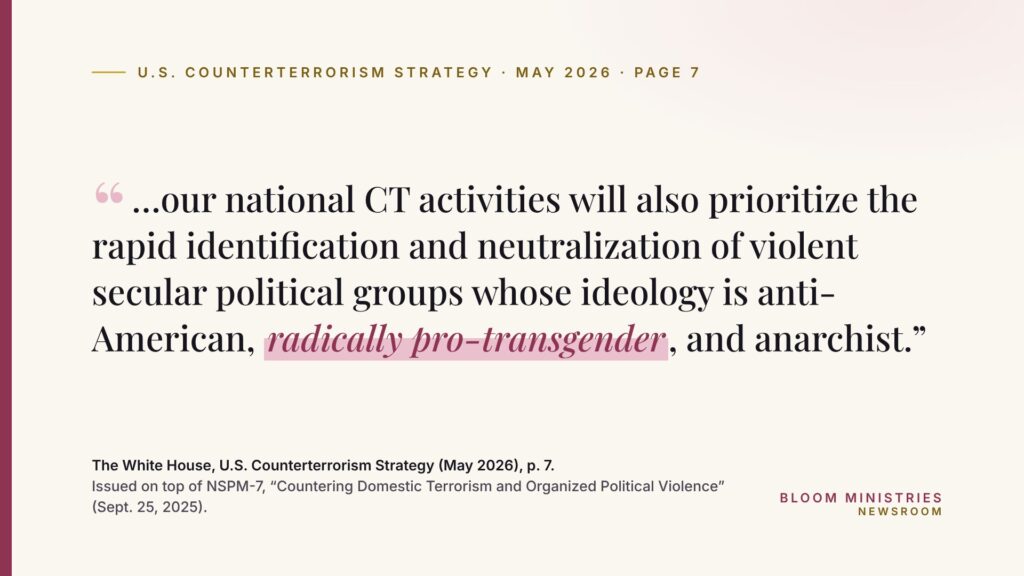
The 2026 U.S. Counterterrorism Strategy, released in May with a foreword signed by President Trump, builds on NSPM-7 and names its targets. Under “Our CT Priorities,” on page 7, it says the country will prioritize “the rapid identification and neutralization of violent secular political groups whose ideology is anti-American, radically pro-transgender, and anarchist.”
The next sentence describes the method: “We will use all the tools constitutionally available to us to map them at home, identify their membership, map their ties to international organizations like Antifa, and use law enforcement tools to cripple them operationally before they can maim or kill the innocent.”
The strategy ties this priority to “the assassination of Charlie Kirk by a radical who espoused extreme transgender ideologies.” We condemn that killing, and every act of political violence, without reservation. Violence against any person is a sin and a crime, and the law already has every tool it needs to punish it.
That is exactly why the rest of the sentence deserves a close reading. If the target is violence, the word “violent” does all the work, and a list of beliefs adds nothing a prosecutor needs. A list of beliefs does one thing well: it tells investigators where to look. The strategy also promises to use only the tools “constitutionally available,” and we take the government at its word. This analysis is about where those constitutional limits lie.
03
The question NSPM-7 cannot answer
Who decides what “radically pro-transgender” means?
The Counterterrorism Strategy does not define it. NSPM-7 does not use the phrase at all, and its own “extremism on … gender” is never defined either. No statute defines these terms, no regulation sets a standard of evidence, and neither document describes notice, a hearing or an appeal for a group that believes it has been wrongly placed in the frame.
So we ask plainly. Bloom helps trans people relocate when a state becomes unsafe for them. We publish plain-language guides to health care, housing and legal rights. Our faith community affirms that trans lives are holy, and we advocate, in public and within the law, for equal protection.
Is that radical? Neither document says, which leaves the answer to whoever holds the file.
The same silence runs through NSPM-7’s list of “common threads.” Nothing in NSPM-7 explains what separates “extremism on … gender” from an ordinary sermon, a lobbying visit or a newsletter. When the words that open a file have no definition, the only real limit left is the Constitution.
04
Five constitutional limits on NSPM-7

The Constitution does not wait for a government to define its terms. It limits what any directive can do, however it is worded. Here are five limits that apply to NSPM-7 and the strategy, each grounded in Supreme Court precedent.
1. Vague terms cannot be the basis for punishment
The Supreme Court has long held that vague laws offend due process. In Grayned v. City of Rockford (1972), it explained that a vague law “impermissibly delegates basic policy matters to policemen, judges, and juries for resolution on an ad hoc and subjective basis.” The danger is sharpest where speech is involved, because vague rules teach people to stay silent in order to stay safe.
NSPM-7 is a directive, not a criminal statute, so this doctrine bites at the moment its words are used to investigate, charge or penalize someone. “Radically pro-transgender” and “extremism on … gender” have no floor and no ceiling. Any case built on them would meet the vagueness doctrine head on.
2. The government cannot pick a side on a viewpoint
Viewpoint discrimination is among the clearest wrongs in First Amendment law. In Rosenberger v. Rector and Visitors of the University of Virginia (1995), the Court held that the government may not single out a speaker’s particular opinion for disfavored treatment.
Look at how NSPM-7 is built. One side of a public argument appears as a thread of terrorism: “extremism on … gender.” The other side appears as a group to be protected: “those who hold traditional American views on family, religion, and morality.” The Counterterrorism Strategy names “pro-transgender” as a marker and never names its opposite. A directive that sorts beliefs this way invites the viewpoint discrimination the First Amendment forbids.
3. Advocacy is protected unless it incites imminent lawless action
In Brandenburg v. Ohio (1969), the Supreme Court held that even fierce advocacy is protected unless it is “directed to inciting or producing imminent lawless action and is likely to incite or produce such action.” That is the line between speech and crime, and it is set high on purpose.
Preaching that trans people are beloved does not cross it. Publishing a guide to changing the name on a driver’s license does not cross it. Helping a family move out of a hostile state does not cross it. Neither NSPM-7 nor the strategy mentions Brandenburg, and any attempt to treat belief as a stand-in for incitement would run straight into it.
4. Membership lists and donors are protected
The strategy promises to “identify their membership,” and NSPM-7 aims at funding. In NAACP v. Alabama (1958), a unanimous Court refused to let Alabama force the NAACP to hand over its membership list, because exposure would chill the freedom to associate. That case protected civil rights members facing hostility, and its lesson has not aged.
The Court applied the same principle to donors in Americans for Prosperity Foundation v. Bonta (2021). It struck down California’s demand for charities’ major-donor lists because the rule created “an unnecessary risk of chilling” and was not narrowly tailored.
Pressure on banks has its own limit. In National Rifle Association of America v. Vullo (2024), a unanimous Court held that “a government official cannot coerce a private party to punish or suppress disfavored speech on her behalf.” A bank pressed to drop a nonprofit because of its views is exactly that kind of private party, and Suspicious Activity Report guidance under NSPM-7 cannot be used as a back door around the First Amendment.
5. Due process and equal protection bind the federal government
The Fifth Amendment guarantees due process, and in Bolling v. Sharpe (1954) the Court held that it also carries equal protection against the federal government. A process that can place a group under suspicion with no notice, no hearing and no defined standard raises serious due process concerns.
When the marker for suspicion is support for one group of people, equal protection applies too. At the very least, government action that singles out a group must be rationally related to a legitimate purpose. Treating support for trans people as a sign of domestic terrorism fails that test, because support is not violence and the law already punishes violence.
05
Where NSPM-7 stands in court
As of this writing, we know of no court that has ruled on whether NSPM-7 itself is constitutional. It is, however, already being tested in two federal cases.
In United States v. Sant, in federal court in Minnesota, a defendant charged in connection with opposition to immigration enforcement asked in August 2026 for discovery on whether his prosecution grew out of viewpoint-based targeting under NSPM-7. FIRE, the Cato Institute and the Society for the Rule of Law filed a friend-of-the-court brief urging the court to order more disclosure.
In September 2026, Common Cause and a Minneapolis resident sued the Department of Homeland Security, the Justice Department, the FBI and other agencies in federal court in Washington, D.C., over the treatment of people who observe and record federal officers. NPR reported that the complaint cites NSPM-7 and the Justice Department memo that carries it out.
Outside the courts, more than 3,700 nonprofits and charities condemned NSPM-7, according to the ACLU. The ACLU has urged governors and mayors to refuse voluntary cooperation, including data sharing, with any effort under NSPM-7 to target nonprofits and charities.
06
Who NSPM-7 puts in the frame
There are about 2.1 million transgender adults in the United States, according to the Williams Institute at UCLA. Around them stands a wide circle of people and organizations that the strategy’s language could reach:
- trans-led nonprofits like Bloom Ministries
- affirming congregations and the clergy who serve them
- clinics that provide gender-affirming care
- legal aid groups that help with name and gender marker changes
- campus groups and local advocacy organizations
- the donors, volunteers and board members who keep all of them running
The strategy says the government will “identify their membership,” and NSPM-7 points the Treasury and the IRS at money. Read together, the two documents put donors, board members and volunteers inside the frame, not only staff. That is why an undefined phrase in a strategy document matters to someone who gives a few dollars a month to a trans nonprofit.
07
What Bloom is doing

Bloom Ministries is not going underground. We are not changing our mission, our name, or a single word of what we believe about trans people. We are taking NSPM-7 seriously as a legal and practical matter, and we recommend the same steps to anyone who may be affected.
For organizations
- Keep clean records. Board minutes, program records, financial statements and donor receipts. A clear paper trail is the best answer to a false description of your work.
- Know your counsel. If you do not already have a civil rights or nonprofit attorney, find one now, before you need one. The ACLU, Lambda Legal and Advocates for Trans Equality are good places to start.
- Hold your mission steady. Changing your purpose under pressure hands the pressure its victory. Keep doing the documented work you exist to do.
- Stay connected. Isolation is what this kind of pressure counts on. Coalitions make it much harder to single anyone out.
For individuals
- You have the right to remain silent when federal agents ask you questions, and the right to speak with a lawyer first. Use both. Lying to a federal agent is itself a crime, so silence is safer than a guess.
- Know what “membership” means here. Being a donor, volunteer, board member or public supporter of a trans organization could draw attention under NSPM-7. That is not a reason to step away. It is a reason to know your rights.
- If you are in danger, reach out. Bloom’s crisis support page lists help you can reach today, and our trans relocation help exists for the moment when staying put is no longer safe.
08
The longer view
Governments have turned the language of security against movements for dignity before. The FBI’s COINTELPRO program spied on and worked to disrupt civil rights organizations from the 1950s into the 1970s, and a Senate committee later documented it in detail. The organizations that endured kept their records clean, their lawyers close and their purpose unchanged.
NSPM-7 is, before anything else, an argument about words, and we have written before about how language is used to erase dignity. A government that can attach the word “terrorism” to the word “transgender” without defining either one is testing how much the public will accept. Our answer is to read carefully, say plainly what the documents do, and refuse to let a label stand in for evidence.
Bloom Ministries is not a terrorist organization. We are a ministry. We serve trans, disabled and marginalized people, as we have from the day we began, and we will keep serving them in the open, under the full protection of the Constitution. The Constitution has no exception for people a government finds inconvenient. Neither does the love of God.
09
Frequently Asked Questions
NSPM-7 is National Security Presidential Memorandum 7, “Countering Domestic Terrorism and Organized Political Violence,” issued by the White House on September 25, 2025. It directs the Justice Department, the Treasury, the IRS and federal law enforcement to investigate and disrupt what it calls domestic terrorism and organized political violence, including the people and money behind it.
Not by name. NSPM-7 lists “extremism on migration, race, and gender” among the “common threads” of political violence. The May 2026 Counterterrorism Strategy, which builds on it, is the document that names “radically pro-transgender” groups as a priority.
The strategy does not define it, and neither does any statute or regulation. It appears on page 7 in a priority on “violent secular political groups whose ideology is anti-American, radically pro-transgender, and anarchist.” That missing definition is at the center of the constitutional concerns in this analysis.
No federal statute creates a “domestic terrorist organization” designation or attaches penalties to it. NSPM-7 says the Attorney General “may recommend” such a designation. A label like that can still lead to investigations, bank scrutiny and IRS referrals, which is why the First and Fifth Amendment limits matter.
NSPM-7 directs the Treasury and the IRS to look at funding, and the strategy speaks of identifying membership. The Supreme Court has protected donor and member privacy in NAACP v. Alabama (1958) and Americans for Prosperity Foundation v. Bonta (2021). Giving to a lawful charity is protected association, not a crime.
Stay calm, be polite, and say you will not answer questions without a lawyer. You have the right to remain silent and the right to counsel. Do not guess or lie, because a false statement to a federal agent is a crime. Then contact an attorney and, if you are part of an organization, its leadership.
As of early October 2026, we know of no court ruling on whether NSPM-7 itself is constitutional. It is at issue in United States v. Sant in Minnesota and in a September 2026 Common Cause lawsuit in Washington, D.C.
Call or text 988, the Suicide and Crisis Lifeline. Trans Lifeline is at 877-565-8860 in the U.S. and 877-330-6366 in Canada, and the Trevor Project is at 1-866-488-7386 or text START to 678-678. Bloom’s crisis support page lists more.
Sovereignty over Servitude. 🌸
Support this work
Everything Bloom publishes is free to read and free to share.
Bloom Ministries is a registered 501(c)(3) in Salem, Oregon. Monthly giving is what lets us say yes before the money is in hand.
Keep reading
 Colorado Legislature · 17 November 2026Supreme Court Turns Away Challenge to Colorado’s Misgendering Rules
 Trans advocacy · 16 November 2026Australia’s Top Research Body Backs Puberty Blockers as an Option
 Trans advocacy · 16 November 2026Online Passport Pilot: What Trans and Disabled Applicants Need to Know
