The Alarms Still Go Off: A 9/11 Remembrance at Twenty-Five Years
I was a senior in high school when the first plane hit. Every year since, my alarms ring at 8:46, 9:03, 9:37, and 10:03. This is why I still stop.
 Pastora Tori Matthews
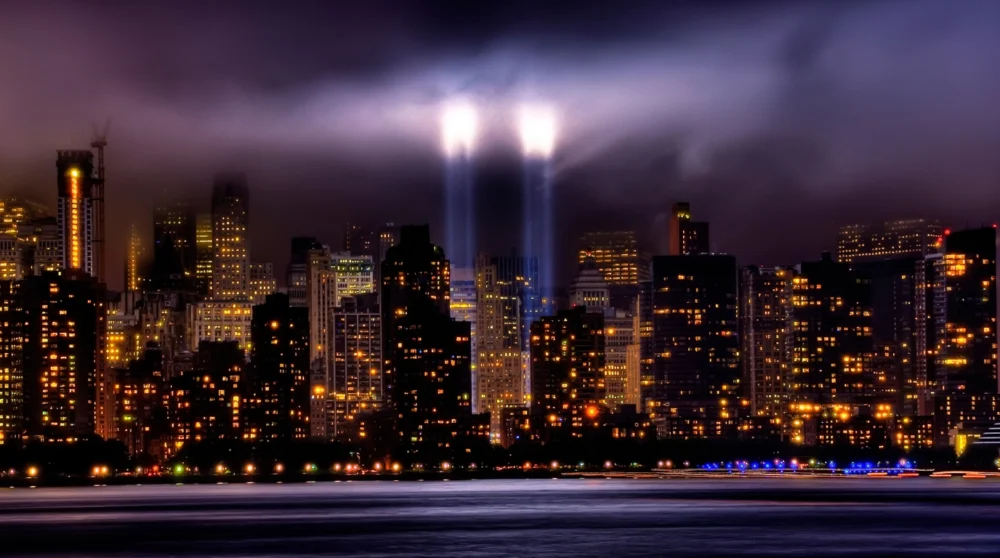
Twenty-five years. Two thousand nine hundred seventy-seven names. The lights still rise.
The first alarm goes off at 8:46 in the morning.
I stop whatever I’m doing. It doesn’t matter where I am or who I’m with. I bow my head and I pray for the people who were on American Airlines Flight 11, for the people on floors 93 through 99 of the North Tower who never knew what hit them, and for the people on the floors above who did. Then I go back to my day until 9:03, when the second alarm rings and I do it again. Then 9:37. Then 10:03. Four alarms, four prayers, four moments of silence, every September 11 for twenty-five years.
People have laughed at me for this. In 2020, when the world had shut down and golf courses were one of the only places you could still be outside with other human beings, I was on a course with an early tee time when the alarms started. The group got irritated. I asked for a little respect, took a knee, and prayed for the dead anyway. I’d do it again. I will do it again next year.
This is a 9/11 remembrance written by someone who has never once let the day pass unmarked. I want to tell you why, because the why is the whole point.
01
The Classroom
I was a senior in high school on September 11, 2001. I was in AP Literature—or some writing class, the name has faded but nothing else has—when word came that a plane had hit the World Trade Center. Someone turned on the television. We watched for ninety minutes.
I want to be honest about that room. Most of the kids around me didn’t understand what they were looking at. They were seventeen. They weren’t cruel; they just weren’t there yet. I was crying and I couldn’t stop, and I remember feeling very alone in that.
Then the camera pushed in on the upper floors, and someone near me asked what those things were falling from the windows. Chairs? Filing cabinets?
“No,” I said. “They’re jumping.”
I knew it before I said it and I’ve never been able to unknow it. Those were people. They had climbed out onto the sills of a building a quarter-mile in the sky because the heat and smoke behind them had become unsurvivable, and they had done the math, and the math had one answer. An estimated two hundred people fell or jumped from the towers that morning. The New York City medical examiner has never classified a single one of those deaths as a suicide. Every one is a homicide. They didn’t choose to die. That choice was made for them at 8:46 and 9:03 by men with box cutters, and the only thing left to the people on those ledges was how.
I grew up on the East Coast, in a place dense enough that everyone knew someone in New York. I had friends whose parents didn’t come home from the World Trade Center. I had friends whose fathers were firefighters and cops and paramedics who spent the next months on the pile. In the years since, I’ve sat down with some of them and asked them to tell me about it, and they have, and I carry those conversations too.
I was seventeen and I understood, watching those windows, that this was the most important thing that would happen in my lifetime. Twenty-five years later I still think that’s true.
02
What Happened, Plainly
A 9/11 remembrance that gets soft on the facts isn’t remembrance. It’s decoration. So here is what happened, in order, with nothing rounded off.
Nineteen men affiliated with al-Qaeda boarded four transcontinental flights out of Boston, Newark, and Washington Dulles. They chose those flights on purpose: long routes to California meant full fuel tanks. American Airlines Flight 11 left Boston at 7:59 a.m. carrying 76 passengers and 11 crew, plus five hijackers, and 76,400 pounds of jet fuel. At 8:19, a flight attendant named Betty Ong got through to American’s reservations line and, for twenty-five minutes, calmly told the ground what was happening in her cabin while men who had already killed were on the other side of the cockpit door. At 8:24 the lead hijacker, meaning to speak to the passengers, keyed the wrong switch and told Boston air traffic control instead: “We have some planes.”
At 8:46:40, Flight 11 struck the North Tower of the World Trade Center between the 93rd and 99th floors.
United Airlines Flight 175 had left Boston at 8:15 with 51 passengers, 9 crew, and five hijackers. Passengers called home. A man named Peter Hanson reached his father and described the hijackers stabbing crew and spraying something into the cabin. His two-year-old daughter Christine was in the seat beside him. She was the youngest person killed that day. At 9:03:02, Flight 175 hit the South Tower between floors 77 and 85, live, on every television on earth. The room I was sitting in went silent.
American Airlines Flight 77 left Dulles at 8:20 with 53 passengers, 6 crew, and five hijackers. Its hijackers switched off the transponder so radar couldn’t follow it, swung it back toward Washington, and brought it in so low over Arlington that it clipped light poles on the highway. At 9:37 it hit the western wall of the Pentagon at ground level and drove 310 feet into the building in under a second. One hundred twenty-five people inside and fifty-nine on the plane died.
United Airlines Flight 93 left Newark at 8:42, twenty-five minutes late because of ground traffic. That delay is the reason the U.S. Capitol, the plane’s likely target, is still standing. By the time the hijackers took the cockpit at 9:28, the towers had already been hit, and the passengers and crew, making thirty-seven phone calls from the back of the plane, found out. They took a vote. Todd Beamer, Mark Bingham, Tom Burnett, Jeremy Glick, and others charged the cockpit at 9:57. The hijacker at the controls rolled the plane to throw them off their feet. It didn’t work. At 10:03:11 he put the aircraft into a field outside Shanksville, Pennsylvania, rather than let the passengers take it back. Forty people died. Not one person on the ground did.
A lot of people still believe Flight 93 was shot down. It wasn’t. The order authorizing military pilots to fire on hijacked airliners came more than ten minutes after the plane was already in the ground, and the 9/11 Commission went through the radar, the cockpit voice recorder, and the wreckage and found no evidence of anything but what the passengers themselves did. Those forty people brought that plane down. It is the only one of the four hijackings that failed, and it failed because ordinary Americans on a Tuesday morning decided they would rather die fighting than die sitting.
The South Tower collapsed at 9:59, fifty-six minutes after it was hit. The North Tower collapsed at 10:28. Seven World Trade Center, gutted by debris and burning unchecked for seven hours because the water mains were gone, came down at 5:21 that evening. By 12:15 p.m., for the first time in the history of American aviation, there was not a single civilian aircraft in the sky over the United States.
Two thousand nine hundred seventy-seven people were murdered. 2,753 in New York. 184 at the Pentagon. 40 in that Pennsylvania field. They came from more than ninety countries. The youngest was two. The oldest was eighty-five. Among them: 343 members of the New York City Fire Department, 37 Port Authority police officers, 23 New York City police officers, and 8 private paramedics and EMTs who ran into the buildings while everyone else was running out.
The men who did this belonged to al-Qaeda. The plot was directed by Osama bin Laden and planned by Khalid Sheikh Mohammed. Their ideology was a violent, totalitarian extremism that claimed Islam’s name and was rejected by the overwhelming majority of the world’s Muslims, including the Muslims who died in the towers that morning and the ones who ran toward them. I’ll come back to that, because a real 9/11 remembrance can’t skip it in either direction.
03
The People, Not the Numbers
Numbers don’t bleed. People do. Let me give you a few.
Father Mychal Judge, a Franciscan friar and FDNY chaplain, was killed by debris in the lobby of the North Tower while ministering to the wounded and the frightened. Firefighters carried his body out and laid it before the altar of a church across the street. He is Victim 0001 on the medical examiner’s list. He was also, as his closest friends have said publicly for years, a gay man who spent his life with the homeless, the addicted, and people dying of AIDS at a time when almost no one else in his church would sit in the room with them.
Welles Crowther was twenty-four, an equities trader on the 104th floor of the South Tower, a volunteer firefighter back home in Nyack. Survivors from the 78th-floor sky lobby, where the plane had hit and the injured lay in the dark, described a young man with a red bandana over his face who appeared out of the smoke, carried a woman down fifteen flights on his back, went back up, and led another group down. Then he went up again. His body was found in March 2002 in the lobby, alongside firefighters. He’d saved at least a dozen people and he was on his way to save more.
Rick Rescorla, head of security for Morgan Stanley, had spent years drilling the firm’s 2,700 employees on evacuation because he was certain the towers would be hit again after the 1993 bombing. When the first plane struck the North Tower, the building’s announcement told everyone in the South Tower to stay at their desks. Rescorla ignored it, grabbed a bullhorn, and marched every Morgan Stanley employee down the stairs, singing Cornish and Welsh songs to keep them calm. All but a handful of his people lived. He went back in for stragglers and didn’t come out.
Abe Zelmanowitz worked on the 27th floor of the North Tower for Empire Blue Cross Blue Shield. His friend and coworker Ed Beyea was quadriplegic and used a wheelchair, and he couldn’t get down the stairs without help that hadn’t arrived yet. Abe stayed with him. A fire captain named Billy Burke found them and stayed too. All three died when the tower came down. In the same building, forty-two floors up, a Port Authority employee named John Abruzzo, also quadriplegic, was strapped into an evacuation chair by ten of his coworkers and carried down sixty-nine flights of stairs over ninety minutes. They got out minutes before the collapse. He lived.
I want you to hold those two stories side by side, because Bloom exists for people like Ed Beyea and John Abruzzo. One of them lived because ten people refused to leave him. One of them died because the building had no plan for him, and the two men who loved him refused to leave him either. After 9/11, the engineering and fire-safety codes changed: wider stairwells, better fireproofing, backup water for sprinklers, and evacuation planning that finally treated disabled people as people who would need to get out. It took a mass grave to get there. That’s a truth a 9/11 remembrance has to hold.
Mohammad Salman Hamdani was twenty-three, a Pakistani-born New Yorker, a police cadet, an EMT, a lab researcher, and a Muslim. He saw the smoke on his way to work and went toward it. For months after, because of his name and his faith, some treated him as a suspect. Then his remains were found at Ground Zero beside his medical bag. He was buried with full NYPD honors, and his name is written into federal law as an example of an American who gave his life for his country.
Mark Bingham was thirty-one, six-foot-four, a rugby player, a public relations executive, and a gay man who called his mother from Flight 93 and then helped storm the cockpit. His mother spent the rest of her life making sure people knew both halves of that sentence.
Betty Ong. Peter and Christine Hanson. Todd Beamer, who finished the Lord’s Prayer with a phone operator and said “Let’s roll.” The 343. The two-year-old. The eighty-five-year-old. Two thousand nine hundred seventy-seven names, read aloud every year by people whose voices break on the last syllable.
04
The Dying Didn’t Stop
The people who died on September 11, 2001 were not the last people 9/11 killed. That’s the part of this 9/11 remembrance most of the country has never absorbed.
When the towers came down they didn’t just fall. They pulverized. Concrete, asbestos, glass, lead, jet fuel, and the bodies of the dead were ground into a dust that hung over lower Manhattan for months. An estimated 400,000 people breathed it: firefighters, cops, ironworkers, volunteers who drove in from Ohio and Texas, residents, schoolchildren, office workers who went back to their desks because they were told the air was safe.
It wasn’t. This week New York City released more than 170,000 pages of internal records showing that officials at the time misled the public about the air quality at Ground Zero. People went back to work in a cloud that was killing them, and the people who should have stopped them said it was fine.
The World Trade Center Health Program, the federal program that monitors and treats responders and survivors, was caring for 145,275 people as of June 30 of this year. More than 57,000 of them have been certified with a 9/11-related cancer. More than 9,000 people have died of 9/11-related illness in the twenty-five years since the attacks; the Victim Compensation Fund puts the number closer to 10,000. Read that again. More people have now died from breathing the dust than died in the attack itself.
The FDNY lost 343 members on the day. Its own twenty-five-year health report, released two weeks ago, counts more than 600 members who have died since from illnesses tied to the rescue and recovery. The department is still adding names to its memorial wall every September. Doctors found 461 new cancers in FDNY members in the past year alone. The average member in the program is sixty-four years old, and one in four of the ones with cancer has had more than one.
At the memorial ceremony this year, for the first time, a seventh moment of silence was added. For the dead who died later.
And there is one more number I need you to carry. As of last month, the New York City medical examiner has identified 1,654 of the 2,753 people killed at the World Trade Center. Nearly 1,100, about forty percent, have never had a single fragment of their remains identified. Their families buried empty coffins. The medical examiner’s office has kept a lab running for twenty-five years, working through more than 20,000 fragments of bone, and in August they identified a woman using a genetic-genealogy technique that did not exist when she died. Earlier this year, the mother of another victim, a woman in her thirties who died in the South Tower, asked the lead scientist whether he’d find her daughter before she herself passed. He couldn’t promise. He’s still working.
Never forget is not a slogan. It’s a lab in Manhattan that hasn’t turned the lights off in a quarter century.
05
What Came After
I need to tell you about the days after, because I have lived forty-some years on this earth and I have never, before or since, felt what this country felt in the second half of September 2001.
People lined up for hours to give blood that hospitals couldn’t even use, because there weren’t enough survivors to give it to. Flags went up on every porch, every overpass, every pickup truck. Candles burned on stoops in cities where people didn’t know their neighbors’ names. Strangers held each other on sidewalks. Members of Congress stood on the Capitol steps and sang. For a few weeks there was no red and no blue. There was just us, and we were grieving, and we were kind to each other in the grief.
This country was an experiment. Nobody had tried it before: a nation held together not by blood or a crown but by a written argument that ordinary people could govern themselves and owed each other something for the privilege. Most days the argument is loud and ugly. For a few weeks in September 2001 it went quiet and simply worked. People held doors. People waved an apology when they cut you off on the highway. People looked at strangers and saw fellow citizens first. I don’t want to romanticize grief; nobody should have to die for us to treat each other decently. But I saw what this country is capable of when it remembers what it’s for, and I have spent twenty-five years refusing to accept that it only shows up after a funeral.
My own family made the memorial a discipline. Every September 11 for years, my children were late to school because we went to the citywide 9/11 memorial first, and I did whatever the organizers needed: setup, donations, carrying things, standing where they told me to stand. My kids grew up understanding that some mornings, remembrance comes before everything else on the calendar. I’d do it the same way again.
Then came the rest of it, and a truthful 9/11 remembrance has to hold that too.
The wars that followed took more American lives than the attack. Brown University’s Costs of War project counts 7,057 U.S. service members killed in the post-9/11 wars, and in a 2021 study estimated that more than 30,000 active-duty personnel and veterans of those wars had died by suicide, over four times the combat toll. Veterans of those wars are in every community Bloom serves. Some are disabled. Some are trans. Some are still trying to understand what the war they fought had to do with the morning that started it. I don’t have a clean answer for them. I have a chair, a phone that gets answered, and a promise not to look away.
And the backlash came fast. Four days after the attack, in Mesa, Arizona, a Sikh gas-station owner named Balbir Singh Sodhi was shot dead while planting flowers outside his store, by a man who told people he wanted to kill “towel-heads.” Balbir had emptied his wallet into a 9/11 relief fund earlier that week. The FBI recorded 28 anti-Muslim hate crimes in the United States in the year 2000 and 481 in 2001. Kids whose parents came from the wrong country got beaten up in American schools that fall. That’s part of the record. It happened to people who had nothing to do with the plot and everything to do with what the plotters wanted: an America that turned on itself.
06
What a 9/11 Remembrance Owes the Dead
I’ll tell you what worries me at twenty-five years.
It isn’t that people don’t know the date. It’s that the day is being quietly sanded down. I’ve watched the language in some places drift from “attacked by al-Qaeda” to “a tragedy that occurred,” from nineteen named men with a named ideology to something like weather that happened to us. That is a lie by omission, and the dead deserve better. The 9/11 Commission named the perpetrators, their network, their financiers, and the specific violent doctrine that drove them. So should we. You cannot honor Betty Ong by pretending no one killed her.
But I’ve also watched the opposite erasure, and it’s just as much a betrayal of the day. The erasure that takes nineteen men and nearly two billion people and calls them the same thing. That forgets Salman Hamdani running toward the smoke. That forgets the Muslim families who buried their own dead from the towers. That does exactly what bin Laden hoped the attacks would do, which was to make Americans see each other as enemies. He wanted a war between whole peoples. Balbir Singh Sodhi’s murderer handed him one, in miniature, four days later.
Remembrance done right refuses both. It names the killers precisely: al-Qaeda, its leadership, its doctrine. And it names the victims precisely, all of them, including the ones whose faith or country of birth made them targets twice. Anything less is picking which dead to keep.
07
Why a Faith Community Marks This Day
Bloom is a small, faith-rooted nonprofit that exists for transgender, disabled, and marginalized people. Someone might reasonably ask why our pastor is writing three thousand words of 9/11 remembrance.
Here’s why. Every person we serve knows something about a day that split their life in two. They know about the phone call, the diagnosis, the door that closed, the morning the ground gave out. They know what it is to have people around them who don’t understand why they’re still crying. And they know, better than most, what happens when a country decides that fear is a good enough reason to stop seeing certain people as people.
We also know grief doesn’t keep the calendar’s schedule. The families still waiting on the medical examiner know it. The firefighter with his third cancer knows it. The veteran who came home to a country that had moved on knows it. The truth of 9/11 is that the dying didn’t stop on the day, and neither did the loving. People are still getting phone calls, still burying, still lighting candles, still showing up at memorials at 8:46 in the morning with their kids in tow.
If you are one of the people for whom this week is unbearable, if the anniversary reopens something, if you lost someone, if you were there, if you served, if the footage still finds you at night, Bloom’s crisis support page has resources, and our door is open. You do not have to carry it alone. You never did.
08
The Alarms
So here is what I’m asking.
Set the alarms. Four of them: 8:46, 9:03, 9:37, 10:03. Wherever you are next September 11, stop. Bow your head. You don’t have to pray if praying isn’t yours. Just be still for a minute and hold in your mind one name—Betty Ong, Ed Beyea, Welles Crowther, Christine Hanson, Salman Hamdani, Mark Bingham, Mychal Judge—or a name you carry that no one else knows. Let the people around you be irritated if they want to be. Kneel anyway. That is what 9/11 remembrance looks like in my house, and it costs four minutes a year.
Teach your children. Tell them the truth: who did it, why they did it, who died, who ran in, who is still dying, who is still waiting for a phone call from a lab in Manhattan. Don’t soften it. They can handle more than we think, and a country that hands its children a blurry story about a sad day is a country that has already begun to forget.
Twenty-five years ago I sat in a classroom and watched people step off a windowsill into the sky, and I understood that they knew exactly what was coming. I have never stopped seeing them. I don’t want to. They are the reason the alarm goes off, and the alarm is the reason I remember, and remembering is the last thing any of us can still do for them.
The first alarm goes off at 8:46.
I stop.
I pray.
I remember.
Support this work
Everything Bloom publishes is free to read and free to share.
Bloom Ministries is a registered 501(c)(3) in Salem, Oregon. Monthly giving is what lets us say yes before the money is in hand.