

Newsroom·Tennessee Legislature·News
Tennessee Hospital to Fix Accessible Parking and Pay $25,000
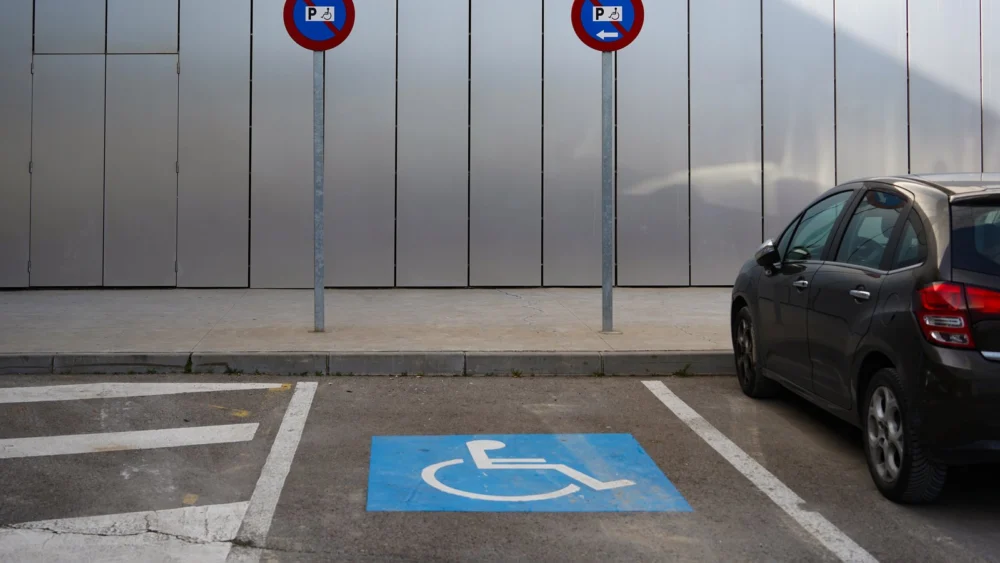
A man with a mobility disability, visiting his hospitalized wife several times a day, found the accessible parking farther from the entrance than other spaces. Under a federal settlement, the Tennessee hospital will fix it and pay $25,000.
 Pastora Tori Matthews
In September 2023, a man with a mobility disability went to Cumberland Medical Center in Crossville, Tennessee, to be with his wife in the hospital. He came several times a day. He reported that the accessible parking spaces were farther from the main entrance than the other spaces, so he had to walk farther than he should have.
On Thursday, November 19, 2026, the U.S. Attorney’s Office for the Middle District of Tennessee announced that the hospital has agreed to fix its accessible parking and pay $25,000 to resolve allegations under the Americans with Disabilities Act. Federal prosecutors will monitor the hospital for three years to make sure it follows through.
Following this story: ADA accommodation failures. Every Bloom report on it is listed here, newest first.
-
Tennessee Hospital to Fix Accessible Parking and Pay $25,000
-
After Her Stroke, She Asked to Work From Home. Osmose Said No.
-
No Diagnosis Needed to Ask for More Leave, Appeals Court Rules
-
Disability Claim Survives in University of Michigan AI Misconduct Case
-
Justice Department Sues Lyft Over Riders With Service Animals
01
What the settlement requires
According to the release from U.S. Attorney Braden H. Boucek’s office, Cumberland Medical Center agreed to make changes to provide “the required number of accessible car and van parking spaces and access aisles.” It also agreed to put its accessible parking “along the shortest accessible routes to the facility entrances they serve.”
The agreement “remains in effect for three years.” During that time, the U.S. Attorney’s Office “will monitor compliance.” Assistant U.S. Attorney Ellen Bowden McIntyre and paralegal Elisabete Lopes handled the investigation.
The release doesn’t say how many spaces will be added or moved, when the work must be finished, or whether signs will change. It doesn’t link to the agreement itself, so those details aren’t public yet. Bloom will report them if they’re released.
02
Where the $25,000 goes
The money is split two ways. Twenty thousand dollars is a civil penalty paid to the government. The other $5,000 goes “to compensate the complainant,” the husband whose visits started the case.
The release doesn’t name him, and Bloom won’t either. He did what the law invites every disabled person to do: he told the government what happened, and the government acted.
03
How one husband’s hospital visits became an ADA complaint
Most ADA cases don’t begin with a lawyer. They begin with an ordinary day that goes wrong. This one began with a husband who wanted to be at his wife’s bedside, more than once a day, and found that the accessible parking meant for people like him put him farther from the door than the spaces meant for everyone else.
He didn’t let it go. He filed a complaint with the federal government. The United States then conducted a site survey at the hospital in 2025 and, the release says, identified alleged accessibility deficiencies in the parking areas serving eight parts of the campus.
The release also says the hospital cooperated throughout and wanted to improve compliance without litigation. The fix came through an agreement rather than a court order.
04
The eight parking areas in the survey
The survey’s findings reached far beyond the main entrance. The release lists the parking areas serving these parts of Cumberland Medical Center:
- the main entrance
- the Maternity Center
- Day Surgery
- the Hyperbaric and Wound Clinic
- the Admitting/Outpatient Clinic
- the Diagnostic Center
- the Cancer Center
- Cumberland Medical Plaza
Read that list slowly. It’s where people go for cancer care, for wound care, for surgery and for the birth of a baby. These are doors that patients with disabilities, and the families who love them, walk through again and again, often sick, tired or afraid.
05
Allegations, not a finding
Bloom reports the record as it stands. The release says the claims are “allegations only, and there has been no determination of liability.” There’s no finding that Cumberland Medical Center broke the law, and no court has ruled that it did.
What the hospital did do is agree to change its accessible parking, pay a civil penalty, compensate the man who complained and accept three years of federal monitoring. That’s a real commitment, and it’s one the public can now hold the hospital to.
06
What the law requires for accessible parking at hospitals
The release puts the duty plainly. A “public accommodation, including hospitals,” must “remove barriers to access when readily achievable” and make sure “covered alterations are accessible to the maximum extent feasible.”
The technical rules for accessible parking live in the 2010 ADA Standards for Accessible Design. For most lots, a table sets the minimum. A lot with 101 to 150 spaces needs at least five accessible spaces. A lot with 501 to 1,000 spaces needs 2 percent of the total.
Hospitals are held to more. Section 208.2.1 of the Standards says: “Ten percent of patient and visitor parking spaces provided to serve hospital outpatient facilities shall comply with 502.” Section 502 is the part of the Standards that sets the width, aisles, surface and signs of an accessible space.
The U.S. Access Board’s guide to parking explains that the 10 percent rule covers hospital units that provide regular or continuing treatment without an overnight stay. Doctors’ offices and independent clinics that aren’t in hospitals follow the ordinary table instead.
07
Rehab and physical therapy: 20 percent accessible parking
Some places need even more accessible parking. Rehabilitation facilities that specialize in conditions affecting mobility, and outpatient physical therapy facilities, must make 20 percent of patient and visitor spaces accessible.
The Standards’ advisory note describes who those conditions include. It lists people who use a brace, cane, crutch, prosthetic device, wheelchair or powered mobility aid. It names arthritic, neurological and orthopedic conditions that severely limit walking, respiratory diseases that may require portable oxygen, and cardiac conditions that impose significant functional limitations.
That list is worth carrying with you. A mobility disability isn’t only a wheelchair. It’s the neighbor with a heart condition, the grandmother on oxygen, the veteran with a prosthetic leg. Every one of them is counting the steps from the car to the door.
08
Van accessible spaces and access aisles
At least one of every six accessible parking spaces must be van accessible. That rule appears both in Section 208.2.4 of the Standards and on the Justice Department’s accessible parking page.
The measurements matter because people need room to get out of a car or down a ramp. A car space must be at least 96 inches wide, and a van space at least 132 inches wide, each with an access aisle beside it. An aisle must be at least 60 inches wide and run the full length of the space. A van space may instead be 96 inches wide if its aisle is 96 inches wide.
Van spaces, their aisles and the drive to them need 98 inches of vertical clearance, which matters in garages. Aisles must be marked to discourage parking in them, and they must sit level with the space, with slopes no steeper than 1:48. Every accessible parking space needs a sign with the International Symbol of Accessibility, mounted at least 60 inches above the ground, and van accessible spaces must say “van accessible.”
09
Accessible parking belongs on the shortest route
This is the heart of the Crossville complaint. Section 208.3.1 of the Standards says accessible spaces that serve a building “shall be located on the shortest accessible route from parking to an entrance.” Where a lot serves more than one accessible entrance, the accessible parking must be spread among those entrances.
The Access Board’s guide adds something many people don’t know: “A maximum travel distance is not specified in the Standards.” The rule is relative. Accessible parking must sit on the shortest accessible route compared with the other spaces in the same lot. Sometimes, the guide says, that means putting accessible parking closest to an entrance ramp rather than the doors themselves.
That’s why the husband’s complaint was so clear. He didn’t have to prove the walk was long by some fixed measure. He reported that the accessible spaces were farther from the main entrance than other spaces. Under the Standards, that comparison is the whole point.
10
Every lot counts its own accessible parking
A hospital campus is rarely one parking lot. The guide says the minimum number of accessible parking spaces “must be determined separately for each parking facility.” A garage and a surface lot are counted separately, and so are lots separated by streets or roadways.
That matters for a campus like Cumberland Medical Center, where the survey found alleged problems in parking areas serving eight different parts of the campus. A hospital can’t meet the rule by crowding all of its accessible parking in front of one door while the cancer center or the wound clinic goes without.
11
Old lots, new paint: when accessible parking rules apply
Hospitals often point out that their lots were built long ago. The law has an answer for that, too. Under the Justice Department’s regulation at 28 CFR 36.304, a business that serves the public must remove barriers in existing buildings where removal is readily achievable, meaning easy to do without much difficulty or expense. The regulation’s own examples include creating designated accessible parking spaces.
The same regulation sets priorities, and parking comes first: “First, a public accommodation should take measures to provide access to a place of public accommodation from public sidewalks, parking, or public transportation.”
When a lot is changed, a stricter rule applies. 28 CFR 36.402 says alterations made after January 26, 1992, must make the altered parts accessible “to the maximum extent feasible.” The Access Board’s guide says resurfacing or resealing a lot counts as an alteration. Patching potholes or repainting the existing stripes for a few spaces is normally maintenance.
12
A short timeline
- January 26, 1992: alterations to businesses that serve the public after this date must be accessible to the maximum extent feasible, under 28 CFR 36.402.
- March 15, 2012: from this date, existing elements that don’t meet the 1991 Standards must be brought up to the 2010 Standards where removal is readily achievable, under 28 CFR 36.304.
- September 2023: a man with a mobility disability, visiting his hospitalized wife several times a day, finds the accessible spaces farther from the main entrance than other spaces.
- 2025: the United States surveys the hospital and identifies alleged deficiencies in eight parking areas.
- November 19, 2026: the U.S. Attorney’s Office announces the settlement: parking fixes, a $20,000 civil penalty and $5,000 for the complainant.
- The next three years: the U.S. Attorney’s Office monitors compliance.
13
What happens next
The work now moves to the hospital’s lots. Cumberland Medical Center has agreed to provide the required number of car and van spaces and aisles, and to move accessible parking onto the shortest accessible routes. Because the agreement hasn’t been published, the timetable for that work isn’t public.
For three years, federal prosecutors will monitor compliance. That turns the hospital’s promise into an obligation the U.S. Attorney’s Office can check. If you visit the Crossville campus and find accessible parking that still sits out of place, you can report it through the same channels listed below.
14
What you can do if accessible parking fails you
Here’s a short checklist, built from the rules above:
- Count the spaces. At a hospital outpatient entrance, accessible parking should make up 10 percent of patient and visitor spaces. At a rehab or outpatient physical therapy facility, it’s 20 percent.
- Compare the walk. Accessible spaces should sit on the shortest accessible route to the entrance they serve, compared with other spaces in that lot.
- Look for the aisle. Each accessible parking space needs a marked access aisle at least 60 inches wide, and at least one of every six accessible spaces must be van accessible.
- Check the sign. Each space needs the International Symbol of Accessibility, and van spaces must say “van accessible.”
- Write it down. Note the date, the time, the entrance and what you saw, and take photos if it’s safe to do so.
- Ask first, if you’re able. A hospital’s patient relations office can sometimes fix a problem quickly.
- File an ADA complaint if nothing changes, using the steps below.
15
How to file an ADA complaint
The release gives three ways to report an accessible parking problem like this one. You can visit ada.gov, call the Justice Department’s ADA Information Line at 800-514-0301 (voice) or 800-514-0383 (TTY), or email ada.complaint@usdoj.gov. ADA.gov’s own pages now list the TTY line as 1-833-610-1264, so if one TTY number doesn’t connect, try the other.
On its File a Complaint page, the Justice Department says complaints about a business that serves the public, such as a doctor’s office, go to its Civil Rights Division. You can file online, or mail the ADA Complaint Form to the Civil Rights Division at 950 Pennsylvania Avenue, NW, Washington, DC 20530. Workplace complaints go to the EEOC, airline complaints to the Department of Transportation and housing complaints to HUD.
Be ready to wait. The department says its review “can take up to three months,” and it’s candid: “Unfortunately, we cannot investigate every complaint.” It may refer your ADA complaint to its ADA Mediation Program, which it describes as confidential and voluntary. Even when it doesn’t act, the department says, complaints help it spot problems that affect many people.
16
Why a parking space is a civil right
It would be easy to call this a story about paint and signs. It isn’t. For many disabled people, an accessible parking space is where a hospital visit begins. For someone whose legs, lungs or heart won’t carry them far, the distance between the car and the door can decide whether they make it to a loved one’s bedside at all.
The Americans with Disabilities Act was never a favor. It’s a promise that disabled people get to go where everyone else goes, on the same terms. The Justice Department’s own regulation names parking among the first barriers a business should remove. When accessible parking is pushed farther away, the message is plain: you can come in, but you’ll pay for it in pain and time.
One husband refused to accept that message. He reported what happened, and more than three years later, the hospital has agreed to change. That’s how civil rights move in real life: one person, one complaint, one parking lot at a time.
17
What Bloom is doing
Bloom’s newsroom follows ADA failures as they’re reported and resolved, from a stroke survivor who was denied telework to an ambulance company’s $2.2 million settlement over its no-beard policy to a Wisconsin judge’s ruling for voters with print disabilities. Every report in the series is listed in the box near the top of this page. You can also learn about Bloom’s disability advocacy.
If a story like this one stirs up your own memories of being turned away or worn down, you don’t have to carry that alone. Bloom’s crisis support page lists people you can reach right now. And if you’re the one keeping watch at a hospital bedside, Faith in Bloom offers pastoral care with no condition attached.
This reporting stays free because readers keep it that way. A monthly gift keeps Bloom on stories like this one for the long haul, and a one-time gift helps too.
18
Frequently Asked Questions
It agreed to provide the required number of accessible car and van parking spaces and access aisles, and to place accessible spaces along the shortest accessible routes to the entrances they serve. The agreement lasts three years, with federal monitoring.
No. The U.S. Attorney’s Office says the claims are allegations only and that there has been no determination of liability.
The release says $20,000 is a civil penalty paid to the government and $5,000 compensates the man who complained.
Under the 2010 ADA Standards, 10 percent of patient and visitor spaces serving hospital outpatient facilities must be accessible parking spaces. Rehabilitation facilities for conditions affecting mobility and outpatient physical therapy facilities need 20 percent.
At least one of every six. Van spaces also need a wide access aisle and 98 inches of vertical clearance.
On the shortest accessible route to the entrance it serves, compared with other spaces in the same lot. The Standards don’t set a maximum walking distance.
Visit ada.gov, call the ADA Information Line at 800-514-0301 (voice), or email ada.complaint@usdoj.gov. The release lists 800-514-0383 for TTY, and ADA.gov lists 1-833-610-1264.
Sovereignty over Servitude. 🌸
Support this work
Everything Bloom publishes is free to read and free to share.
Bloom Ministries is a registered 501(c)(3) in Salem, Oregon. Monthly giving is what lets us say yes before the money is in hand.
Keep reading
 Wisconsin Legislature · 20 November 2026Madison Prosecutor Won’t Charge Officer Who Killed Corey Ruiz
 Legislation · 20 November 2026Labor Department Makes It Easier to Classify Workers as Contractors
 Maine Legislature · 20 November 2026Judge Orders ICE to Free 18-Year-Old Seized Without a Warrant in Maine
