
Daily Offering · 25 November 2026 · St. Catherine of Alexandria
Daily Offering: November 25, 2026 | The Body of Blessed Catherine
Most of what is told about the Blessed Catherine is to said to be rejected as “inventions, pure and simple” as even the Catholic Encyclopedia claims. It then takes the single marvel this morning’s Collect is built on, the body of blessed Catherine carried…
The order of this offering
Before the readings
The Word
Offering and Canon
I
Opening Address
Most of what is told about the Blessed Catherine is to said to be rejected as “inventions, pure and simple” as even the Catholic Encyclopedia claims. It then takes the single marvel this morning’s Collect is built on, the body of blessed Catherine carried to Sinai, and reports that the pilgrims who actually went there never mentioned it. The Church kept the feast anyway. Stay for the Collect and watch what it does with that.
Welcome to Bloom’s Daily Offering for Wednesday, November 25, 2026, the feast of St. Catherine of Alexandria, Virgin and Martyr, a feast of the third class in red, with no commemoration and nothing displaced. The Gloria is said and the Creed is not, the Preface is the Common Preface, and there is no vigil and no octave. Tomorrow is St. Sylvester, Abbot.
Bloom offers this Mass in the Independent Catholic tradition, from the 1962 Roman Rite, and is not affiliated with or recognized by the Roman Catholic Church. We say that at the door every morning, because honesty is the first thing a church owes the people who walk in.
If you have ever been asked to tell the whole thing again, in the right order, to somebody who would decide afterwards whether to act on it, the Collect this morning is yours.
II
A Word on Today’s Propers
This is a repeat day and it is said here plainly. The Introit, the Gradual and the Gospel are from the Common of a Virgin Martyr, and all three have been printed in this archive before.
The Introit was opened on St. Cecilia, November 22, 2025, which took the shame in it as its whole subject, and printed again on this same feast last year. The Gradual was printed last year and again on St. Lucy, December 13, 2025. The Gospel of the ten virgins has been printed four times here and opened at length on August 12, 2026 and on November 16, 2026.
The Epistle is the same lesson from Ecclesiasticus that last year’s post preached entire, counting the twelve perils and finding six of them to be mouths. It is printed today and it is not preached. Every proper is printed here on a repeat day; the repeating governs what is opened, not what is read.
What is left is the Collect and the Secret, which belong to Catherine and to nobody else. They were printed here once, last year, and the Collect was not opened; last year’s post gave it one sentence in passing, that the prayer spends its first half on a mountain and its second half asking to arrive somewhere. That sentence is correct and it is where today starts. The Collect is the fresh ground, and so is the English it has been wearing.
III
Introit
English
And I spoke of thy testimonies before kings: and I was not ashamed. I meditated also on thy commandments, which I loved.
Ps. 118:1. Blessed are the undefiled in the way, who walk in the law of the Lord.
Glory be to the Father, and to the Son, and to the Holy Ghost. As it was in the beginning, is now, and ever shall be, world without end. Amen.
And I spoke of thy testimonies before kings: and I was not ashamed. I meditated also on thy commandments, which I loved.
Latin
Loquébar de testimóniis tuis in conspéctu regum, et non confundébar: et meditábar in mandátis tuis, quæ diléxi nimis.
Ps. 118:1. Beáti immaculáti in via: qui ámbulant in lege Dómini.
Glória Patri…
Loquébar de testimóniis tuis in conspéctu regum, et non confundébar: et meditábar in mandátis tuis, quæ diléxi nimis.
IV
Collect
(℣. marks what the priest says. ℟. marks the answer of the server and the people.)
English
Let us pray.
O God, Who didst give the law to Moses on the summit of Mount Sinai, and in that same place didst wondrously lay the body of blessed Catherine, Thy Virgin and Martyr, by the hands of Thy holy Angels: grant, we beseech Thee, that by her merits and intercession we may be able to come to the mountain which is Christ. Who livest and reignest with God the Father in the unity of the Holy Ghost, God, world without end. Amen.
℟. Amen.
Latin
Deus, qui dedísti legem Móysi in summitáte montis Sínai, et in eódem loco per sanctos Angelos tuos corpus beátæ Catharínæ Vírginis et Mártyris tuæ mirabíliter collocásti: præsta, quǽsumus; ut, ejus méritis et intercessióne, ad montem, qui Christus est, perveníre valeámus.
Qui tecum…
V
Epistle
Ecclesiasticus 51:1-8, 51:12 (The Lesson runs to the end of the eighth verse and then passes over three verses to take the twelfth as its close.)
English
Lesson from the book of Wisdom.
I will give glory to thee, O Lord, O King, and I will praise thee, O God my Saviour. I will give glory to thy name: for thou hast been a helper and protector to me, and hast preserved my body from destruction, from the snare of an unjust tongue, and from the lips of them that forge lies, and in the sight of them that stood by, thou hast been my helper.
And thou hast delivered me, according to the multitude of the mercy of thy name, from them that did roar, prepared to devour, out of the hands of them that sought my life, and from the gates of afflictions, which compassed me about: from the oppression of the flame which surrounded me, and in the midst of the fire I was not burnt: from the depth of the belly of hell, and from an unclean tongue, and from lying words, from an unjust king, and from a slanderous tongue.
My soul shall praise the Lord even to death. How thou deliverest them that wait for thee, O Lord, and savest them out of the hands of the nations.
Latin
Léctio libri Sapiéntiæ.
Confitébor tibi, Dómine, Rex, et collaudábo te Deum, Salvatórem meum. Confitébor nómini tuo: quóniam adjútor et protéctor factus es mihi, et liberásti corpus meum a perditióne, a láqueo línguæ iníquæ et a lábiis operántium mendácium, et in conspéctu astántium factus es mihi adjutor.
Et liberásti me secúndum multitúdinem misericórdiæ nóminis tui a rugiéntibus, præparátis ad escam, de mánibus quæréntium ánimam meam, et de portis tribulatiónum, quæ circumdedérunt me: a pressúra flammæ, quæ circúmdedit me, et in médio ignis non sum æstuáta: de altitúdine ventris ínferi, et a lingua coinquináta, et a verbo mendácii, a rege iníquo, et a lingua injústa.
Laudábit usque ad mortem ánima mea Dóminum: quóniam éruis sustinéntes te, et líberas eos de mánibus géntium, Dómine, Deus noster.
VI
Gradual
Psalm 44:8; Psalm 44:15-16 (The response and the versicle are the two halves of one verse, and the versicle stops three words short of its end. The Alleluia verse joins the fifteenth verse to the opening words of the sixteenth and stops there.)
English
Thou hast loved justice, and hated iniquity.
℣. Therefore God, thy God, hath anointed thee with the oil of gladness. Alleluia, alleluia.
℣. After her shall virgins be brought to the King: her neighbours shall be brought to thee with gladness. Alleluia.
Latin
Dilexísti justítiam, et odísti iniquitátem.
℣. Proptérea unxit te Deus, Deus tuus, óleo lætítiæ. Allelúja, allelúja.
℣. Adducéntur Regi Vírgines post eam: próximæ ejus afferéntur tibi in lætítia. Allelúja.
VII
Gospel
English
Continuation ☩ of the holy Gospel according to St. Matthew.
At that time Jesus spoke this parable to His disciples: Then shall the kingdom of heaven be like to ten virgins, who taking their lamps went out to meet the bridegroom and the bride. And five of them were foolish, and five wise. But the five foolish, having taken their lamps, did not take oil with them: but the wise took oil in their vessels with the lamps. And the bridegroom tarrying, they all slumbered and slept.
And at midnight there was a cry made: Behold the bridegroom cometh, go ye forth to meet him. Then all those virgins arose and trimmed their lamps. And the foolish said to the wise: Give us of your oil, for our lamps are gone out. The wise answered, saying: Lest perhaps there be not enough for us and for you, go ye rather to them that sell, and buy for yourselves.
Now whilst they went to buy, the bridegroom came: and they that were ready, went in with him to the marriage, and the door was shut. But at last come also the other virgins, saying: Lord, Lord, open to us. But he answering said: Amen I say to you, I know you not. Watch ye therefore, because you know not the day nor the hour.
Latin
Sequéntia ☩ sancti Evangélii secúndum Matthǽum.
In illo témpore: Dixit Jesus discípulis suis parábolam hanc: Símile erit regnum coelórum decem virgínibus: quæ, accipiéntes lámpades suas, exiérunt óbviam sponso et sponsæ. Quinque autem ex eis erant fátuæ, et quinque prudéntes: sed quinque fátuæ, accéptis lampádibus, non sumpsérunt óleum secum: prudéntes vero accepérunt óleum in vasis suis cum lampádibus. Moram autem faciénte sponso, dormitavérunt omnes et dormiérunt.
Média autem nocte clamor factus est: Ecce, sponsus venit, exíte óbviam ei. Tunc surrexérunt omnes vírgines íllæ, et ornavérunt lámpades suas. Fátuæ autem sapiéntibus dixérunt: Date nobis de óleo vestro: quia lámpades nostræ exstinguúntur. Respondérunt prudéntes, dicéntes: Ne forte non suffíciat nobis et vobis, ite pótius ad vendéntes, et émite vobis.
Dum autem irent émere, venit sponsus: et quæ parátæ erant, intravérunt cum eo ad núptias, et clausa est jánua. Novíssime vero véniunt et réliquæ vírgines, dicéntes: Dómine, Dómine, áperi nobis. At ille respóndens, ait: Amen, dico vobis, néscio vos. Vigiláte ítaque, quia nescítis diem neque horam.

The Offering
Daily Homily | The Body of Blessed Catherine
Nothing that she did. Read the prayer for its finite verbs and they are all God’s. Dedísti, thou gavest, second person singular, the law to Moses. Collocásti, thou didst lay, second person singular again,…
What does the Collect claim about her?
Nothing that she did. Read the prayer for its finite verbs and they are all God’s. Dedísti, thou gavest, second person singular, the law to Moses. Collocásti, thou didst lay, second person singular again, and what it lays is corpus beátæ Catharínæ, the body of blessed Catherine.
The angels are not agents either. Per sanctos Angelos tuos is a prepositional phrase of instrument, through Thy holy Angels, the same grammar you would use for a tool.
Catherine herself appears twice in the whole sentence: once in the genitive, inside the phrase the body of blessed Catherine, and once in the ablative, ejus méritis et intercessióne. She is never the subject of a verb in her own prayer. The one time she is in the accusative, the case of the thing a verb is done to, she is the body of blessed Catherine and the verb is God’s.
Now set that beside what is told about her. The Catholic Encyclopedia’s article on St. Catherine relates the Acts in full: at eighteen she went to the Emperor Maximinus and “upbraided him for his cruelty,” she out-argued the scholars he summoned until several of them “declared themselves Christians and were at once put to death,” the empress and the head of the troops came to her dungeon and were converted, and the wheel she was condemned to die on “was miraculously destroyed” at her touch.
Verbs, every one of them, and all hers. The Collect keeps none of it. Out of a legend made almost entirely of what she said and did, the Church’s prayer for her feast selects the body of blessed Catherine, lying still, being carried.
Where is the body of blessed Catherine?
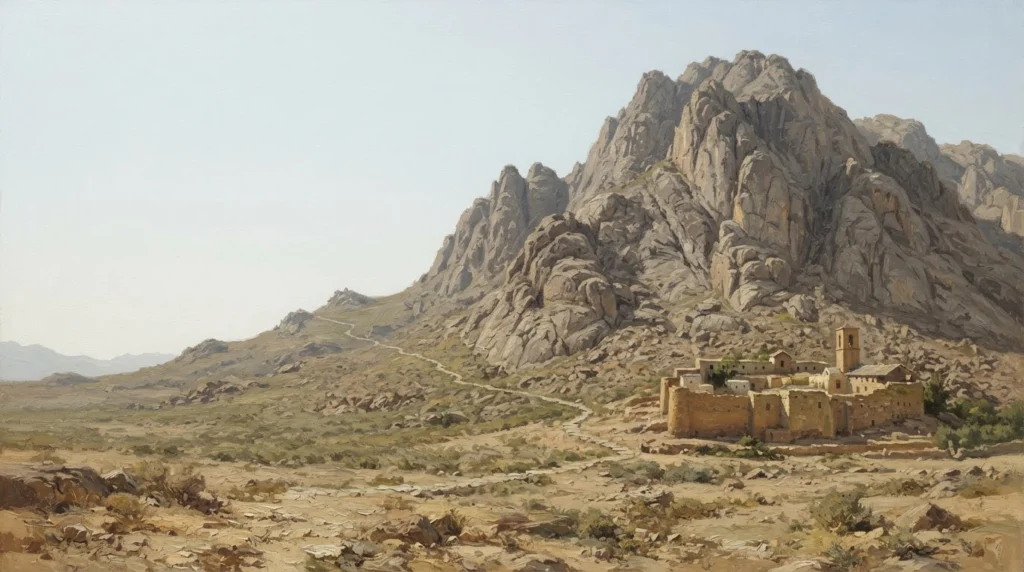
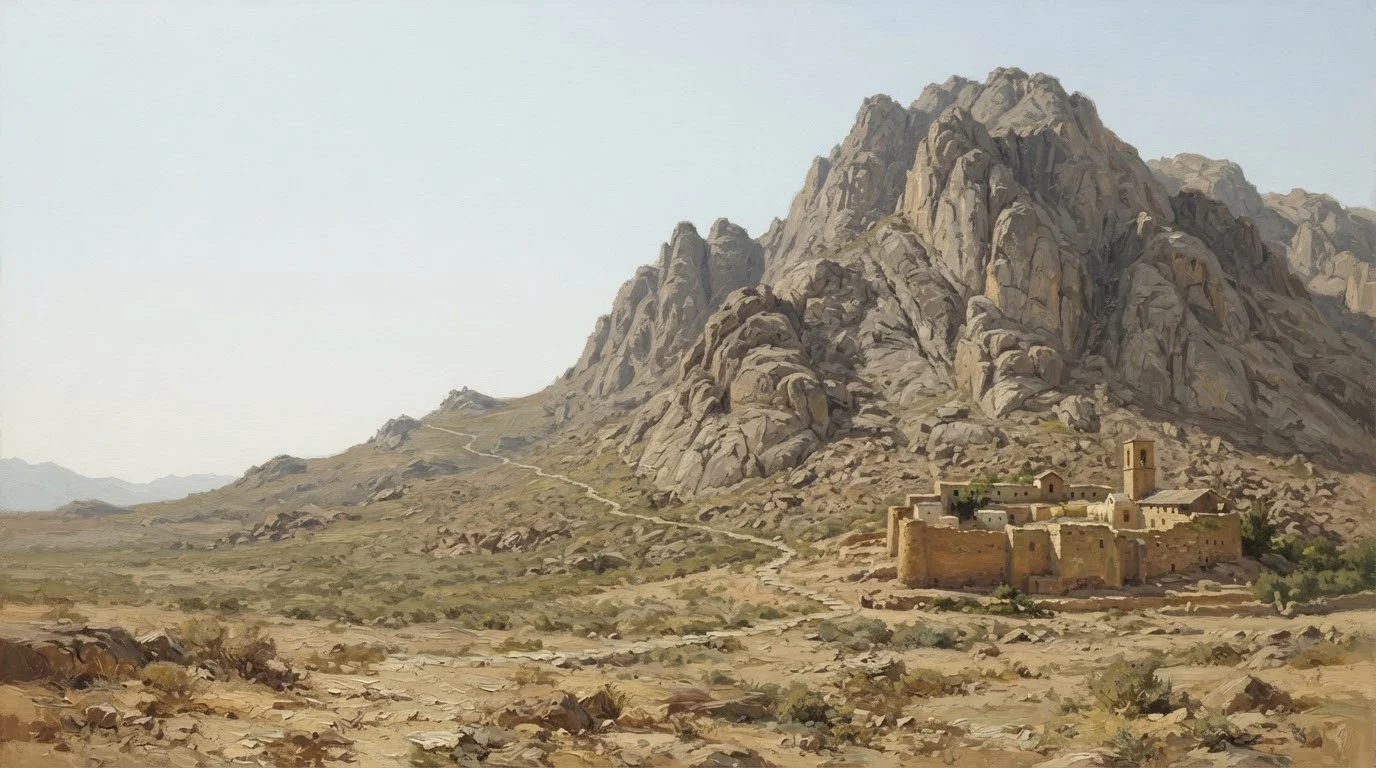
On the summit of the same mountain where the law was given to Moses, according to this prayer, and nowhere at all according to the pilgrims. The Latin names the place twice and then names it a third time without saying so. In summitáte montis Sínai, on the summit of Mount Sinai. In eódem loco, in that same place. And at the end, ad montem, qui Christus est, to the mountain which is Christ.
One noun, three times. A mountain where a law was handed down, a mountain where the body of blessed Catherine was laid, and a mountain which turns out to be a person.
The English this archive printed last year broke the third one, calling it “that towering eminence which is Christ.” An eminence is a height, and a height is something you are measured against. Montem is a place you arrive at, and the Missal uses the same word for all three. It is printed today as the Missal has it, and the change is set out in the questions below.
Then read what the Encyclopedia does with the one claim this prayer rests on. “Although all these texts mention the miraculous translations of the saint’s body to Mount Sinai, the itineraries of the ancient pilgrims who visited Sinai do not contain the slightest allusion to it.” People went there. They wrote down what they saw. None of them mentions it.
So the single assertion the Collect makes about the body of blessed Catherine is the one assertion the Church’s own reference work says has no witness behind it. The prayer rests its whole geography on the body of blessed Catherine. And it still asks. It asks ejus méritis et intercessióne, by her merits and her intercession. That phrase claims a relation: that she is alive in God and can be asked, and that what she is before God counts for the people who ask her.
Then it asks one thing for us, and the verb is the point. Perveníre valeámus. Not that we may come, but that we may be able to come. Even the ability is being requested.
What has the demand for proof grown?
People who stopped asking because they could not produce the paperwork. The teaching on trial this morning is that a request has to stand on a record that holds up, and its devout form, which is the worse one, is that you must be able to give the account before you are entitled to make the request.
Run it against its crop inside the Church’s own history. It has grown people who learned that a relic was spurious or a story invented and quietly stopped praying altogether, as though the asking had been resting on the documentation the whole time. It has grown the examination at the rail, where a person who cannot phrase what they believe is sent away to learn to phrase it.
It has grown the counsel that an offering counts when it is made deliberately and in words, which lands hardest on the people furthest into an illness. And it has grown parish offices where help waits behind a history, told again, to a new person, with the dates.
That last one is not an occasional failure. For disabled people it is a standing condition. What falls on them more constantly than on anyone else is the requirement to narrate: to say it again, to a fresh assessor, in the right words, with the chronology intact, and to have the need treated as real only once the telling has been judged adequate. The account becomes the thing that is assessed, and the body it is about waits outside the room.
The Collect does not work that way. It names the body of blessed Catherine, states where God put it, and makes its request on that footing. No speech is entered into evidence. No account is required of the body of blessed Catherine, and the account the legend supplies is precisely the one her own prayer declines to use.
That is not an oversight in the prayer. Whoever wrote it had the whole legend available and left every sentence of it out, and what remains is a place, a pair of hands, and the body of blessed Catherine.
None of this recommends credulity, and none of it says the record does not matter. The sentence calling most of this saint’s story an invention is printed in the Church’s own encyclopedia, and the feast is kept in the Church’s own missal, and those two facts are not in competition. What the prayer refuses is the idea that one of them is the foundation of the other.
How does a hedge-layer prove a hedge?
By the hedge, three winters on, which anybody can walk up to and lean on. There is a story told about a hedge-layer working a boundary along a lane in a wet January, laying the stubs over at an angle, driving his stakes, weaving the binders along the top. The agent for the estate wanted a method statement before he would release the money: the angle of every cut, the spacing of the stakes, why that pleacher went over and the one beside it came out.
The man could not give it. Forty years at it and he could not say in words why the billhook went where it went. He said what he always said, which was to come back in three winters and lean on it. The agent wrote “no specification provided” and paid him at the lower rate.
He had cut deeper than the agent liked, too, and lost that season’s growth to get the regrowth he wanted, which looked to an office like damage. Three winters later the hedge was stockproof the whole four hundred yards and the lane walkers could see it from the road.
Nobody had to take his word. He was not working quietly, either: he was stood in a lane in full view of the village for eleven days. What he could not do was produce the account on demand, in the form demanded, to the man holding the cheque.
The body of blessed Catherine is in that position in this prayer, and the prayer pays anyway. It does not ask the body of blessed Catherine for a specification. It says where the work was done and who did it, and then it asks for something.
Does this make the record not matter?
No, and this Mass is the proof, because it prints a text in which she speaks. The Introit has her before kings. Loquébar de testimóniis tuis in conspéctu regum, et non confundébar, I spoke of thy testimonies before kings, and I was not ashamed. The Encyclopedia records that for centuries theologians, apologists and preachers asked this saint to “impart eloquence to their words” before they wrote or preached.
The Church has not struck the speeches from the record, and has not stopped asking her for speech. It is the same page. And on that same page the one prayer written for her and for nobody else leaves the speeches out, requires none of them of us, and rests on none of them.
That is a Church that can keep a story and tell the truth about it at the same time. The record is kept honestly, in the encyclopedia, where anyone may read that the pilgrims said nothing. The asking is not built on it. It is built on the body of blessed Catherine, lying where the prayer says God laid it, and on the merits and intercession of the woman whose body it is.
You came in without the account. The Collect does not ask you for one. It says where God laid the body of blessed Catherine, and then it asks that we be made able to arrive, which is a request for strength and not an instruction to climb. Whatever is carrying the body of blessed Catherine up that mountain is the same thing that is being asked to carry you.
↑ The order resumes below.
IX
Secret
English
Receive, O Lord, the gifts which we offer on the solemnity of blessed Catherine, Thy Virgin and Martyr: by whose patronage we trust to be delivered. Through our Lord Jesus Christ, Thy Son, Who liveth and reigneth with Thee in the unity of the Holy Ghost, God, world without end. Amen.
℟. Amen.
Latin
Súscipe, Dómine, múnera, quæ in beátæ Catharínæ Vírginis et Mártyris tuæ sollemnitáte deférimus: cujus nos confídimus patrocínio liberári.
Per Dominum…
X
The Holding
If you believe, hold this. The only thing this prayer says about the body of blessed Catherine is where God laid it, and the only thing it asks for you is that you be made able to arrive.
English
May Almighty God bless you: the Father, ☩ the Son, and the Holy Ghost.
℟. Amen.
Latin
Benedícat vos omnípotens Deus, Pater, et Fílius, ☩ et Spíritus Sanctus.
℟. Amen.
If that language is not yours, take this much. When somebody will not act on what you need until you have told it again in the right words, the requirement belongs to them and not to the need. You are allowed to be believed before you are articulate.
A virgin and martyr whose feast the Latin Church and the Oriental churches both keep on 25 November, and who, in the Catholic Encyclopedia’s own words, “for almost six centuries was the object of a very popular devotion.” The Acts say she was of noble birth, learned in the sciences, and eighteen when she confronted the Emperor Maximinus, that she defeated the scholars he summoned, and that she was condemned to the wheel and beheaded. She was ranked with St. Margaret and St. Barbara among the fourteen Holy Helpers, and became the patroness of young maidens, of female students and, because of the wheel, of wheelwrights.
The Collect says God laid it there by the hands of His angels, and the Church’s own reference work says nobody who went there ever mentioned it. The Catholic Encyclopedia puts it this directly: “Although all these texts mention the miraculous translations of the saint’s body to Mount Sinai, the itineraries of the ancient pilgrims who visited Sinai do not contain the slightest allusion to it.” It adds that the Benedictine editor of Bossuet declared the tradition behind Bossuet’s panegyric “to be in a great measure false,” and that her feast disappeared from the Breviary of Paris at about that time. The feast is kept in the 1962 Missal, and this post prints both the prayer and that paragraph.
Because the Missal’s Latin says ad montem, qui Christus est, and montem is the same noun the prayer has already used in in summitáte montis Sínai and pointed back to in in eódem loco. The English served by our calendar source renders it “that towering eminence which is Christ,” which is a defensible paraphrase, but it turns the third place into a height and loses the one word the prayer has been repeating. This archive printed that paraphrase last year without opening it. Today the Collect is set to the Missal’s Latin and its register restored, and the change is stated here rather than made quietly.
Because loquébar and confundébar are both imperfect, which is a past tense, and the Douay-Rheims of Psalm 118:46 gives them as “And I spoke of thy testimonies before kings: and I was not ashamed.” The English our calendar source serves reads “I will speak of Your decrees before kings without being ashamed,” which moves the speaking into the future and turns the second verb into a participle. Both previous printings of this antiphon in this archive used the Douay, and today’s follows them.
Because this project will not present a text as new when it is not. Ecclesiasticus 51 was preached entire on this same feast last year, which counted the twelve perils in it and found six of them to be mouths. The Gospel of the ten virgins is in the same position after August 12, 2026 and November 16, 2026, and the Introit after November 22, 2025. All are printed in full, because every proper is printed here, and none is opened today. The Collect and the Secret are proper to Catherine and the Collect has not been opened before.
Not on a third-class feast. The 1962 Code of Rubrics lists the Creed at number 475 for Sundays, first-class feasts and votive Masses, second-class feasts of the Lord and of Our Lady, the three surviving octaves, and the birthdays of the apostles and evangelists. Number 476 then says it is not said “in festive and votive Masses of the 3rd and 4th class.” Today is a third-class feast, so the Gloria is said and the Creed is not.
Because red is the colour the Roman Rite gives to the feasts of martyrs, and this is a martyr’s feast. It is the same reason three of today’s propers come from the Common of a Virgin Martyr rather than from the Common of Virgins alone. The Mass names her twice in its own prayers as Vírginis et Mártyris tuæ, Thy Virgin and Martyr, once in the Collect and once in the Secret.
No. The argument here is about what a request is allowed to rest on, and it survives translation. If somebody will not act on your need until you have narrated it to their satisfaction, notice that two different things are being assessed: the need, and your performance in describing it. People who describe things well get help; people who are tired, or in pain, or who were never taught the vocabulary, get less, and that is a defect in the procedure rather than in them. You are welcome to take that much and leave the rest, and you are welcome here either way.
Faith in Bloom is the daily liturgical work of Bloom Ministries, a 501(c)(3) nonprofit, and it is free to read and always will be. If it has been worth something to you and you are able, you can give once or give monthly below. Sending a post to one person who needs it does real work too.
Propers for the feast of St. Catherine of Alexandria, Virgin and Martyr, are taken from the 1962 Roman Missal, in the Missal’s Latin and in English. Scripture is quoted from the Douay-Rheims Bible. The historical notes are drawn from the Catholic Encyclopedia’s article on St. Catherine of Alexandria, and the rubrical note on the Creed from the 1962 Code of Rubrics, numbers 475 and 476. The English of the Collect and of the Secret has been set to the Missal’s Latin where the served translation departed from it, in particular ad montem, qui Christus est, printed here as “to the mountain which is Christ,” and each change is stated in the questions above.
The liturgical spine of Faith in Bloom is The New Marian Missal for Daily Mass by Sylvester P. Juergens, S.M., S.T.D., Regina Press, Imprimatur 1961. Faith in Bloom is offered by Bloom Ministries in the Independent Catholic tradition and is not affiliated with or recognized by the Roman Catholic Church.
