
Sunday Mass · 8 November 2026 · V Sunday after Epiphany
Sunday Mass: November 8, 2026 | Suffer Both to Grow
Somewhere this week, someone made up their mind that you were the weeds in their field. If you are honest, you may have made up your mind about someone too. In today’s Gospel Christ tells of servants with exactly that plan, to go out…
The order of this offering
Before the readings
Offering and Canon
I
Opening Address
Somewhere this week, someone made up their mind that you were the weeds in their field. If you are honest, you may have made up your mind about someone too. In today’s Gospel Christ tells of servants with exactly that plan, to go out and pull up the weeds, and of a master who says no: Suffer both to grow until the harvest.
Welcome to Bloom’s Sunday Mass for the Fifth Sunday after Epiphany, Sunday, November 8, 2026. It is a Sunday of the second class, in green. The Gloria and the Creed are said, the Preface is the Preface of the Most Holy Trinity, and the Four Holy Crowned Martyrs, whose day this is, give way to the Sunday.
Bloom offers this Mass in the Independent Catholic tradition, from the 1962 Roman Rite, and is not affiliated with or recognized by the Roman Catholic Church. We say it at the door every Sunday, because honesty is the first thing a church owes the people who walk in.
However this week left you, glad, grieving, numb or simply worn out, you are welcome here. You do not have to have sorted anyone into the right pile, least of all yourself, to belong at this Mass.
II
A Word on Today’s Propers
This Mass is the Fifth Sunday after Epiphany, a Sunday that never came round this winter, because Septuagesima came on February 1, before it could be said. The Missal takes it up now instead. Its Collect, Epistle, Gospel, Secret and Postcommunion are printed here for the first time. Its chants, the Introit, Gradual, Offertory and Communion, belong to the XXIII Sunday after Pentecost: they were first printed here on Sunday, November 16, 2025, and most recently on Friday.
Each repeated chant was checked against those printings one at a time. The Introit and Gradual match Friday’s word for word, and the Communion matches 2025’s. The Offertory changes one word: 2025 printed Lord, hear my voice, and this Mass reads Lord, hear my prayer, as the Alleluia verse has all this week, because the Missal’s Latin is exáudi oratiónem meam. Every proper is printed in full, in Latin and English, as a Sunday Mass reads everything. The homily stays with the Gospel, the parable of the wheat and the cockle, and with the master’s answer to his servants: suffer both to grow.
III
Prayers at the Foot of the Altar
(Psalm 42, Judica me, and the Confiteor are said here, at the foot of the altar, from the Missal.)
The Mass begins with the only sorting a Christian is ever asked to do, and it is of your own field, not your neighbour’s. In the Confiteor each of us strikes the breast and says mea culpa, through my fault, and the only faults confessed are the speaker’s own.
IV
Introit
Jeremias 29:11-12, 14; Psalm 84:2
English
The Lord saith: I think thoughts of peace, and not of affliction: you shall call upon Me, and I will hear you; and I will bring back your captivity from all places.
Ps. 84:2. Lord, Thou hast blessed Thy land: Thou hast turned away the captivity of Jacob.
Glory be to the Father, and to the Son, and to the Holy Ghost. As it was in the beginning, is now, and ever shall be, world without end. Amen.
The Lord saith: I think thoughts of peace, and not of affliction: you shall call upon Me, and I will hear you; and I will bring back your captivity from all places.
Latin
Dicit Dóminus: Ego cógito cogitatiónes pacis, et non afflictiónis: invocábitis me, et ego exáudiam vos: et redúcam captivitátem vestram de cunctis locis.
Ps. 84:2. Benedixísti, Dómine, terram tuam: avertísti captivitátem Jacob.
Glória Patri…
Dicit Dóminus: Ego cógito cogitatiónes pacis, et non afflictiónis: invocábitis me, et ego exáudiam vos: et redúcam captivitátem vestram de cunctis locis.
V
The Kyrie and the Gloria
(The Kyrie and the Gloria are said here, from the Missal.)
Mercy is asked nine times before a single word of praise. Then the Gloria sings of peace on earth to men of good will, and on this Sunday that peace is exactly what the master in the Gospel refuses to let his servants tear up.
VI
Collect
(℣. marks what the priest says. ℟. marks the answer of the server and the people.)
English
℣. The Lord be with you.
℟. And with thy spirit.
Let us pray.
O Lord, we beseech Thee to keep Thy household continually under Thy mercy: that as it leaneth only upon the hope of Thy heavenly grace, so it may always be protected by Thy mighty power. Through our Lord.
℟. Amen.
Latin
℣. Dóminus vobíscum.
℟. Et cum spíritu tuo.
Orémus.
Famíliam tuam, quǽsumus, Dómine, contínua pietáte custódi: ut, quæ in sola spe grátiæ cœléstis innítitur, tua semper protectióne muniátur. Per Dóminum…
℟. Amen.
VII
Epistle
English
Lesson from the Epistle of blessed Paul the Apostle to the Colossians.
Brethren: Put ye on, as the elect of God, holy, and beloved, the bowels of mercy, benignity, humility, modesty, patience: bearing with one another, and forgiving one another, if any have a complaint against another: even as the Lord hath forgiven you, so do you also.
But above all these things have charity, which is the bond of perfection: and let the peace of Christ rejoice in your hearts, wherein also you are called in one body: and be ye thankful.
Let the word of Christ dwell in you abundantly, in all wisdom: teaching and admonishing one another in psalms, hymns, and spiritual canticles, singing in grace in your hearts to God. All whatsoever you do in word or in work, do all in the name of the Lord Jesus Christ, giving thanks to God and the Father by Him.
℟. Thanks be to God.
Latin
Léctio Epístolæ beáti Pauli Apóstoli ad Colossénses.
Fratres: Indúite vos sicut elécti Dei, sancti et dilécti, víscera misericórdiæ, benignitátem, humilitátem, modéstiam, patiéntiam: supportántes ínvicem, et donántes vobismetípsis, si quis advérsus áliquem habet querélam: sicut et Dóminus donávit vobis, ita et vos.
Super ómnia autem hæc caritátem habéte, quod est vínculum perfectiónis: et pax Christi exsúltet in córdibus vestris, in qua et vocáti estis in uno córpore: et grati estóte.
Verbum Christi hábitet in vobis abundánter, in omni sapiéntia, docéntes et commonéntes vosmetípsos psalmis, hymnis et cánticis spirituálibus, in grátia cantántes in córdibus vestris Deo. Omne, quodcúmque fácitis in verbo aut in ópere, ómnia in nómine Dómini Jesu Christi, grátias agéntes Deo et Patri per ipsum.
℟. Deo gratias.
VIII
Gradual and Alleluia
English
Thou hast saved us, O Lord, from them that afflict us: and hast put them to shame that hate us.
℣. In God shall we glory all the day long: and in Thy name we will give praise for ever.
Alleluia, alleluia. ℣. Out of the depths I have cried to Thee, O Lord: Lord, hear my prayer. Alleluia.
Latin
Liberásti nos, Dómine, ex affligéntibus nos: et eos, qui nos odérunt, confudísti.
℣. In Deo laudábimur tota die, et in nómine tuo confitébimur in sǽcula.
Allelúja, allelúja. ℣. De profúndis clamávi ad te, Dómine: Dómine, exáudi oratiónem meam. Allelúja.
IX
Gospel
English
℣. The Lord be with you.
℟. And with thy spirit.
℣. Continuation ☩ of the holy Gospel according to Matthew.
℟. Glory be to Thee, O Lord.
At that time, Jesus spoke this parable to the multitudes: The kingdom of heaven is likened to a man that sowed good seeds in his field. But while men were asleep, his enemy came and oversowed cockle among the wheat and went his way. And when the blade was sprung up, and had brought forth fruit, then appeared also the cockle.
And the servants of the goodman of the house coming said to him: Sir, didst thou not sow good seed in thy field? whence then hath it cockle? And he said to them: An enemy hath done this. And the servants said to him: Wilt thou that we go and gather it up?
And he said: No, lest perhaps gathering up the cockle, you root up the wheat also together with it. Suffer both to grow until the harvest, and in the time of the harvest I will say to the reapers: Gather up first the cockle, and bind it into bundles to burn, but the wheat gather ye into my barn.
℟. Praise be to Thee, O Christ.
Latin
℣. Dóminus vobíscum.
℟. Et cum spíritu tuo.
℣. Sequéntia ☩ sancti Evangélii secúndum Matthǽum.
℟. Gloria tibi, Domine.
In illo témpore: Dixit Jesus turbis parábolam hanc: Símile factum est regnum cœlórum hómini, qui seminávit bonum semen in agro suo. Cum autem dormírent hómines, venit inimícus ejus, et superseminávit zizánia in médio trítici, et ábiit. Cum autem crevísset herba et fructum fecísset, tunc apparuérunt et zizánia.
Accedéntes autem servi patrisfamílias, dixérunt ei: Dómine, nonne bonum semen seminásti in agro tuo? Unde ergo habet zizánia? Et ait illis: Inimícus homo hoc fecit. Servi autem dixérunt ei: Vis, imus, et collígimus ea?
Et ait: Non: ne forte colligéntes zizánia eradicétis simul cum eis et tríticum. Sínite utráque créscere usque ad messem, et in témpore messis dicam messóribus: Collígite primum zizánia, et alligáte ea in fascículos ad comburéndum, tríticum autem congregáte in hórreum meum.
℟. Laus tibi, Christe.
This Gospel is printed here for the first time. Many Bibles call the weed in it tares; the Douay calls it cockle, and the Latin calls it zizania. It is the reading the homily keeps.

The Offering
Sunday Homily | Suffer Both to Grow
Today’s parable is short, and it turns on one refusal. A man sows good seed. While everyone sleeps, an enemy sows cockle among the wheat. When the blades come up, so does the cockle,…
Why does the master say, suffer both to grow?
Today’s parable is short, and it turns on one refusal. A man sows good seed. While everyone sleeps, an enemy sows cockle among the wheat. When the blades come up, so does the cockle, and the servants come with a plan: Wilt thou that we go and gather it up?
The master’s answer is one word, No, and then a reason: lest perhaps gathering up the cockle, you root up the wheat also together with it. And then the sentence the whole parable is built to deliver: Suffer both to grow until the harvest.
Suffer is the old English word for allow. In the Latin the verb is Sinite, let them be: Sinite utraque crescere usque ad messem, let both of them grow, all the way to the harvest. It is not a shrug. It is an order, given by the one who owns the field.
The servants are not wicked men. They are zealous, and their zeal is aimed at something real: the cockle is really there, and an enemy really sowed it. Their mistake is not about whether evil exists. It is about whose hands are fit to pull it up, and when.
And they did one thing right. Before anyone touched the field, they came to the master and asked. Whatever else the servants got wrong, they did not act on their zeal alone. They brought it to the one whose field it was, and when he said no, they listened. Every Christian argument about who belongs ought to begin there: with a question put to God, and a willingness to hear His answer, even when the answer is No.
The parable even tells us why their hands are not fit. The cockle appeared only when the blade was sprung up, and had brought forth fruit. Until the fruit came, the cockle did not show itself, and by the time it did, the roots had grown together. Pull up one, the master says, and you root up the wheat with it.
So the master says suffer both to grow, because uprooting would do more harm to his wheat than the cockle ever could. His patience is not weakness. It is care for every good thing growing in a field where good and bad are tangled together.
Where did the cockle come from?
Before the servants ask what to do, they ask something harder: Sir, didst thou not sow good seed in thy field? whence then hath it cockle? It is the oldest question there is, and many of us have asked it this week, about our country, our churches and our own lives. If God is good, where did this come from?
The master does not blame the soil, and he does not blame his servants. An enemy hath done this. God sowed good seed. Whatever has choked your field, it was not planted by the One who made you, and it was not planted because you deserved it.
The parable adds one more detail, quietly: it happened while men were asleep. The enemy works in the dark and is gone before morning. If something was sown in your life while you were too trusting, too tired or too hurt to stop it, the Gospel does not hold you guilty for the sowing.
It asks only one thing of you: do not let the enemy make you into a reaper. The answer to cockle in the field is not a scorched field.
Today’s Collect prays for people in exactly that place. It asks God to keep us continually under Thy mercy, and it gives the reason in plain words: we lean only upon the hope of Thy heavenly grace.
We do not lean on our own vigilance, which failed while we slept, or on our skill at telling wheat from cockle. Only on grace. A field with an enemy in it is still God’s field, and He is tending it, one night and one morning at a time.
That is the first good news of this Sunday. The weeds are real, and they are not the last word. The field still belongs to the one who sowed wheat in it, and He has not given up on His crop.
Who is wheat and who is cockle?
Here is the hard part. Every one of us would like to be a servant in this story, standing at the edge of the field and pointing. The Church’s own teaching draws the line somewhere else. In its document Memory and Reconciliation, prepared for the Jubilee of 2000, the International Theological Commission quoted the Church’s own teaching: In everyone, the weeds of sin will still be mixed with the good wheat of the Gospel until the end of time.
In everyone. The wheat and the cockle grow in the same field because they grow in the same person, in you and in me. The hand that reaches for a neighbour’s weeds belongs to someone whose own field is mixed.
St. Cyprian of Carthage met this temptation in the third century. After a persecution, Novatian’s party wanted the church shut for good against the lapsed, the Christians who had given way under threat. Writing to a fellow bishop, Antonianus, in his fifty-first letter, Cyprian wondered that some are so obstinate as to think that repentance is not to be granted to the lapsed. He called it a swelling of arrogance and an oblivion of humility and gentleness for anyone to think that he can discern the tares from the wheat. That, he wrote, is something the Lord did not even grant to the apostles.
What makes the letter worth hearing is that Cyprian had been strict himself, and its heading says he writes to explain his own change of opinion about the lapsed. With his fellow bishops he settled on what he called wholesome moderation, so that neither should hope of communion and peace be wholly denied to the lapsed, lest they should fail still more through desperation. A bishop changed his mind toward mercy, and wrote down why.
Some of you know exactly what it is to be treated as the cockle. If a church has made up its mind that you are a weed to be pulled, because you are gay, or trans, or because your life does not match what somebody expected, hear what the master says to every servant with a hoe in hand: No. That power is not theirs over you, and it is not yours over them either.
The same is true of the field we share as a country. Bloom does not support or oppose any candidate or party, but after an election it is easy to start sorting neighbours into wheat and cockle by how they voted. Here too the master’s answer holds. Whoever you think is wrong, you are not the reaper, and the harvest is not yours to call.
What did a Pope confess in 2000?
On the First Sunday of Lent in the year 2000, the twelfth of March, Pope John Paul II led a liturgy that the Vatican calls the Day for Pardon. One after another, the Church confessed kinds of sin Christians had committed, and after each confession A lamp is lit before the Crucifix.
There were seven confessions in all: sins in general; sins committed in the service of truth; sins that harmed the unity of the Body of Christ; sins against the people of Israel; sins against love, peace, the rights of peoples, and respect for cultures and religions; sins against the dignity of women and the unity of the human race; and sins against the fundamental rights of the person.
Each was opened by a representative of the Roman Curia. After each came the Kyrie, the same Kyrie we said at the start of this Mass, and one more lamp was lit. The printed order of service tells us what was said and done; it does not describe the faces in the church, and neither will I.
The second confession was for sins committed in the service of truth. It admitted that men of the Church have sometimes used methods not in keeping with the Gospel while serving the truth. Then the Pope prayed, and confessed that in certain periods of history Christians have at times given in to intolerance and have not been faithful to the great commandment of love.
That is the servants’ plan from today’s Gospel, confessed aloud by the Church itself: Christians who had tried to pull up the cockle with their own hands, by force, and called it zeal. The Day for Pardon was a church admitting, late and in public, what the master had said from the start: suffer both to grow. In his homily that day, John Paul II gave the appeal behind it in one line: Let us forgive and ask forgiveness!
At the end, the order of the liturgy directs that the Pope embraces and kisses the Crucifix, and it gives the reason: as a sign of penance and veneration. The man holding the highest office in his church embraced the cross and asked for mercy. If a church at the height of its power can admit it pulled at the field with the wrong hands, so can each of us.
How do we live in a mixed field?
Paul’s letter today tells us what to wear while we wait for the harvest. Put on, he says, as the elect of God, holy, and beloved, the bowels of mercy, benignity, humility, modesty, patience. In the Latin the verb is Induite, the word for getting dressed. Mercy and patience are not moods you wait to feel; they are clothes you put on in the morning.
Then he spells out the work: Bearing with one another, and forgiving one another, if any have a complaint against another. Bearing with is what wheat does in a mixed field. It does not pretend the cockle is wheat, and it does not try to pull it up. It keeps growing, and it leaves the harvest to the one who owns the field.
One word of care, because this teaching has been misused. Bearing with one another does not mean staying where you are being harmed. If someone is hurting you, getting yourself to safety is not uprooting anyone; it is wisdom, and Christ does not ask you to stand still in harm’s way. The parable forbids taking God’s judgment into our own hands, not keeping ourselves safe.
So here is one thing for this week. Think of one person you have quietly filed under cockle, a relative, a coworker, a neighbour whose politics wore you out. Pray for that person once a day until next Sunday, in plain words, asking God to bring the wheat in them to harvest. You do not have to agree with them; you only have to put down the hoe.
Take today’s Communion verse with you when you pray: all things whatsoever you ask when you pray, believe that you shall receive. Ask for that person’s good, and believe that God is already at work in their field, as He is in yours.
And above all these things have charity, which is the bond of perfection. Charity is what holds a mixed field together until the harvest, and it is the one thing no enemy can sow.
Paul ends that verse with three plain words: be ye thankful. Gratitude may be the hardest thing to put on in a divided week, and the most useful. Someone busy giving thanks for the wheat in their own field has far less time for inspecting a neighbour’s.
Wheat grows best in company. If you would like people around you who will bear with you while you grow, the Bloom Network is free to join, and the daily Offering can be in your inbox each morning from the Faith in Bloom page, a little water for the week between Sundays.
If none of this is yours as faith, keep the plain version: you are not anyone’s weed, and you are not the judge of anyone else’s worth either. Put down the hoe, and let people grow.
The harvest is coming, and it belongs to God. He knows His wheat, and He has been patient with every one of us. Suffer both to grow, He says, and that patience includes you.
↑ The order resumes below.
XI
The Creed
(The Nicene Creed is said here, after the sermon, from the Missal.)
We say it together, every voice at the same pace. People who would agree about very little else this week stand inside the same words for a few minutes, and that is not nothing.
XII
Offertory
English
℣. The Lord be with you.
℟. And with thy spirit.
Let us pray.
Out of the depths I have cried to Thee, O Lord: Lord, hear my prayer. Out of the depths I have cried to Thee, O Lord.
Latin
℣. Dóminus vobíscum.
℟. Et cum spíritu tuo.
Orémus.
De profúndis clamávi ad te, Dómine: Dómine, exáudi oratiónem meam: de profúndis clamávi ad te, Dómine.
XIII
Secret
English
We offer Thee, O Lord, this sacrifice of atonement: that Thou wouldst mercifully absolve our sins and direct our faltering hearts. Through our Lord.
℣. World without end.
℟. Amen.
Latin
Hóstias tibi, Dómine, placatiónis offérimus: ut et delícta nostra miserátus absólvas, et nutántia corda tu dírigas. Per Dóminum…
℣. Per omnia saecula saeculorum.
℟. Amen.
XIV
The Canon and Consecration
(The Preface of the Most Holy Trinity is said aloud here, as on Sundays, followed by the Sanctus and the Canon of the Mass, all from the Missal. Every prayer of the Canon is said silently.)
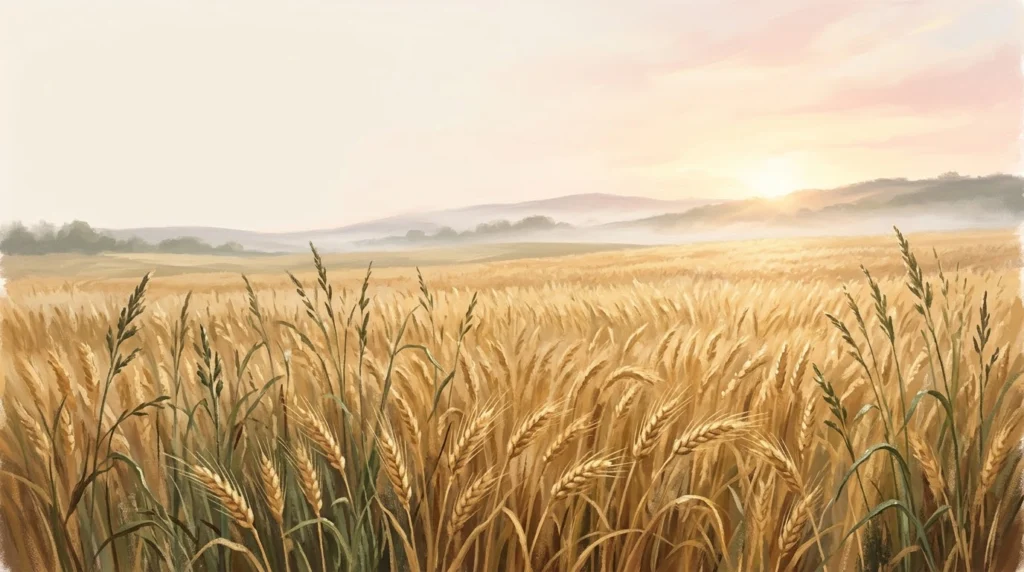
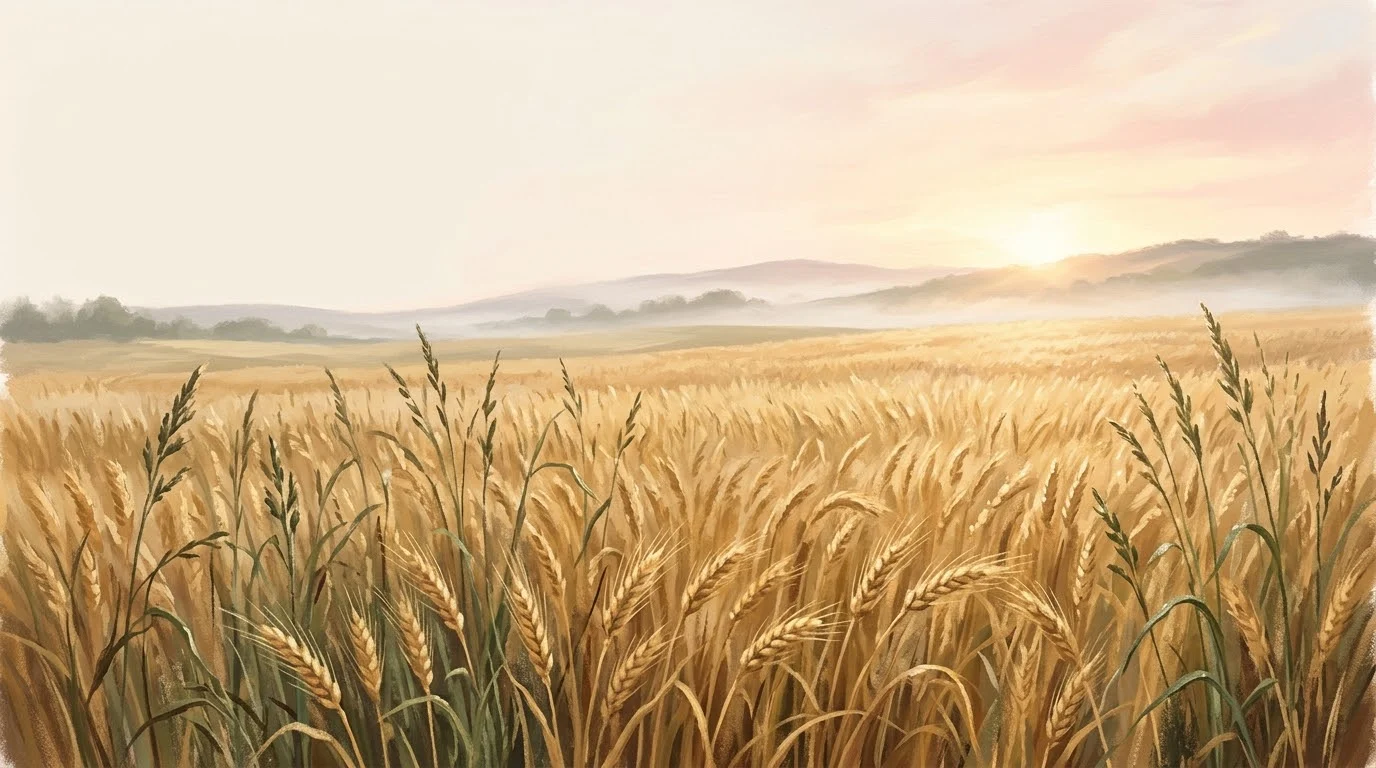
Wheat is what bread is made of. In the silence of the Canon the Church offers bread from grain that once stood in a field like the one in today’s Gospel, grown up beside everything else that grew there, and asks God to make it holy.
None of it waits on whether you feel ready. The harvest is God’s work, and so is this.
XV
Act of Spiritual Communion
(Said by all who are not receiving sacramentally.)
My Jesus, I believe that Thou art present in the Most Holy Sacrament. I love Thee above all things and I desire to receive Thee into my soul. Since I cannot now receive Thee sacramentally, come at least spiritually into my heart. I embrace Thee as if Thou wert already there, and I unite myself wholly to Thee. Never permit me to be separated from Thee.
If you are joining from a hospital bed, a night shift or a body that could not get to church today, this prayer is a full welcome, not a consolation prize.
XVI
Communion
English
Amen I say to you, all things whatsoever you ask when you pray, believe that you shall receive, and it shall be done to you.
Latin
Amen, dico vobis, quidquid orántes pétitis, crédite, quia accipiétis, et fiet vobis.
XVII
Postcommunion
English
℣. The Lord be with you.
℟. And with thy spirit.
Let us pray.
We pray Thee, almighty God, that we may obtain that salvation whose pledge we have received in this divine sacrament. Through our Lord.
℟. Amen.
Latin
℣. Dóminus vobíscum.
℟. Et cum spíritu tuo.
Orémus.
Quǽsumus, omnípotens Deus: ut illíus salutáris capiámus efféctum, cujus per hæc mystéria pignus accépimus. Per Dóminum…
℟. Amen.
XVIII
The Closing Blessing
Go out into a mixed field this week. You will not be asked to sort it. You will be asked to bear with it, to put on mercy and patience in the morning, and to be wheat in it.
The Introit sang it at the start: I think thoughts of peace, and not of affliction. God’s patience with the field is not indifference. It is peace, held out until every grain of wheat is safe, and you are one of them.
Whether or not any of the theology is yours, take the plain version with you: do not treat anyone as a weed, do not let anyone treat you as one, and let people grow.
English
℣. The Lord be with you.
℟. And with thy spirit.
℣. Go, the Mass is ended.
℟. Thanks be to God.
May Almighty God bless you: the Father, ☩ the Son, and the Holy Ghost.
℟. Amen.
Latin
℣. Dóminus vobíscum.
℟. Et cum spíritu tuo.
℣. Ite, Missa est.
℟. Deo gratias.
Benedícat vos omnípotens Deus, Pater, et Fílius, ☩ et Spíritus Sanctus.
℟. Amen.
XIX
Frequently Asked Questions
It is the master’s answer in Matt 13:30 when his servants want to pull up the weeds: Suffer both to grow until the harvest. Suffer is old English for allow, and the Latin is Sinite utraque crescere, let both grow. The master forbids uprooting because the weeds showed themselves only when the plants bore fruit, and pulling them would root up the wheat with them. Judgment belongs to the harvest, and the harvest belongs to God.
It is the parable in Matt 13:24-30, often called the parable of the wheat and tares. A man sows good seed, an enemy sows weeds among it at night, and when the servants offer to pull them up, the master tells them to let both grow until the harvest, when the reapers will separate them. The Douay Bible calls the weed cockle; the Latin word is zizania.
Because this year Septuagesima came on February 1, before the season after Epiphany reached its Fifth Sunday. The 1962 Missal takes that Sunday up in November instead, before the last Sunday after Pentecost. Its Collect, Epistle, Gospel, Secret and Postcommunion are its own, and its chants are those of the XXIII Sunday after Pentecost.
The master says only, An enemy hath done this. The parable’s point is that the weeds were not sown by the owner of the field: God sows good seed, and evil comes from elsewhere, while men were asleep. The same chapter goes on to explain the parable, but today’s Gospel stops at the master’s command to let both grow until the harvest.
On 12 March 2000, the First Sunday of Lent, Pope John Paul II led a liturgy in which the Church confessed sins committed by Christians across history, including sins committed in the service of truth. The prayer admitted that men of the Church have sometimes used methods not in keeping with the Gospel while serving the truth, and in his homily the Pope said, Let us forgive and ask forgiveness!
No. Colossians 3:13 asks Christians to bear with and forgive one another, and the parable forbids taking God’s judgment into our own hands. Neither asks anyone to stay in harm’s way. Getting yourself or someone else to safety is wisdom, not uprooting, and forgiveness never requires remaining in danger. If you are not safe, reach out to someone you trust or to local help today.
No. Bloom Ministries does not support or oppose any candidate or political party, before an election or after it. We ask every reader to treat neighbours who voted differently as fellow wheat in a mixed field, to pray for everyone who holds office, and to leave final judgment to God.
Because it is true, and honesty comes first. Bloom Ministries offers this liturgy in the Independent Catholic tradition, using the 1962 Roman Rite, and it is neither part of nor recognized by the Roman Catholic Church. Old Catholic and Anglo-Catholic communities have described themselves this way for well over a century.
It is a prayer said by anyone who cannot receive the sacrament in person, asking Christ to come spiritually into the soul instead. It is meant for people who are sick, working, travelling or otherwise kept away, and it is a full welcome rather than a lesser substitute.
No. The plain version works for anyone: do not treat anyone as a weed, do not let anyone treat you as one, and give people time to grow. Faith in Bloom offers the liturgy to anyone and asks nothing of you in exchange.
Faith in Bloom is the daily liturgical work of Bloom Ministries, a 501(c)(3) nonprofit, and it is free to read and always will be. If it has been worth something to you and you are able, you can give once or give monthly below. Sending a post to one person who needs it does real work too.
Propers for the Fifth Sunday after Epiphany are taken from the 1962 Roman Missal, in the Missal’s Latin and in English. Scripture is quoted from the Douay-Rheims Bible.
The liturgical spine of Faith in Bloom is The New Marian Missal for Daily Mass by Sylvester P. Juergens, S.M., S.T.D., Regina Press, Imprimatur 1961. Faith in Bloom is offered by Bloom Ministries in the Independent Catholic tradition and is not affiliated with or recognized by the Roman Catholic Church.
