
Daily Offering · 20 July 2026 · St. Jerome Emiliani
Daily Offering: July 20, 2026 | Father of Orphans and the Poor
A father of orphans and the poor — that’s what heaven chose one former soldier to become, and it’s worth carrying into this morning before anything else is said. Beloved, grace and peace to you: however you arrive here, tired or hopeful, certain or…
The order of this offering
Before the readings
Offering and Canon
I
Opening Address
A father of orphans and the poor — that’s what heaven chose one former soldier to become, and it’s worth carrying into this morning before anything else is said. Beloved, grace and peace to you: however you arrive here, tired or hopeful, certain or doubting, welcomed elsewhere or shut out elsewhere. Bloom is not a room you have to earn your way into. Sit with us a moment, offered today in the spirit of a low Mass — Word, prayer, and offering, without pretense to more than that.
II
Introit
(Lamentations 2:11; Ps. 112:1)
My very heart is poured out upon the earth, for the ruin of the daughter of my people, when the children and the infants fainted away in the streets of the city. Praise the Lord, the verse answers, ye children: praise ye the name of the Lord.
III
Collect
(Adapted from the day’s confirmed theme — see note below)
O God, who didst choose blessed Jerome to be a father to orphans and to the poor, filling him with the spirit of adoption by which we are made children of the Father: grant, we beseech Thee, that following his example of charity, we too may come at last to the inheritance he now enjoys. Through our Lord…
IV
Epistle
Isaiah 58:7-11, Douay-Rheims
Deal thy bread to the hungry, and bring the needy and the harbourless into thy house: when thou shalt see one naked, cover him, and despise not thy own flesh. Then shall thy light break forth as the morning, and thy health shall speedily arise, and thy justice shall go before thy face, and the glory of the Lord shall gather thee up. Then shalt thou call, and the Lord shall hear: thou shalt cry, and he shall say: Here I am. If thou wilt take away the chain out of the midst of thee, and cease to stretch out the finger, and to speak that which profiteth not. If thou pour out thy soul to the hungry, and satisfy the afflicted soul, thy light shall rise up in darkness, and thy darkness shall be as the noonday. And the Lord will give thee rest continually, and will fill thy soul with brightness, and deliver thy bones, and thou shalt be like a watered garden, and like a fountain of water whose waters shall not fail.
V
Gospel
Matthew 19:13-21, Douay-Rheims
At that time, they presented to Jesus little children, that He should impose hands upon them and pray. And the disciples rebuked them. But Jesus said to them: Suffer the little children, and forbid them not to come to Me: for the kingdom of heaven is for such. And when He had imposed hands upon them, He departed from thence. And behold one came and said to Him: Good master, what good shall I do that I may have life everlasting? Who said to him: Why askest thou Me concerning good? One is good, God. But if thou wilt enter into life, keep the commandments. He said to Him: Which? And Jesus said: Thou shalt do no murder, Thou shalt not commit adultery, Thou shalt not steal, Thou shalt not bear false witness. Honour thy father and thy mother: and, Thou shalt love thy neighbour as thyself. The young man saith to him: All these have I kept from my youth, what is yet wanting to me? Jesus saith to him: If thou wilt be perfect, go sell what thou hast, and give to the poor, and thou shalt have treasure in heaven: and come, follow Me.
The Offering (Homily)
Daily Homily | Father of Orphans and the Poor
Two scenes, placed right next to each other in Matthew’s Gospel, and today’s feast exists at exactly the point where they meet. First: parents bring their children to Jesus, and the disciples — meaning…
Two scenes, placed right next to each other in Matthew’s Gospel, and today’s feast exists at exactly the point where they meet. First: parents bring their children to Jesus, and the disciples — meaning well, probably trying to protect His time — turn them away. Jesus overrules them immediately. “Suffer the little children… to come to Me: for the kingdom of heaven is for such.” Then, almost in the same breath, a wealthy young man asks what he still lacks, and Jesus tells him plainly: sell what you have, give it to the poor, and come, follow Me.
Most people read those as two separate stories. St. Jerome Emiliani’s life is what happens when someone reads them as one instruction.
He wasn’t born into poverty or obscurity. He was Venetian nobility, a soldier, a man with rank and a future mapped out for him. Captured and imprisoned during a siege, he had the kind of conversion that could have stayed private — a promise made in a dungeon, a debt he could have paid quietly once he was free. Instead, he did what the rich young man in today’s Gospel couldn’t bring himself to do. He gave it up. Not metaphorically — actually. He walked away from wealth and rank to spend the rest of his life doing exactly what the first scene in today’s Gospel describes: making room for children the world had already decided it didn’t have time for.
Venice in his era had no shortage of them. Plague and famine left orphans in the streets by the hundreds. Jerome didn’t found a policy. He built homes, one at a time, and filled them with kids nobody else was coming to collect. He died from the plague himself, having caught it while burying the dead — a detail worth sitting with, since it means the same crisis that orphaned so many of the children he raised is the one that eventually took him too.
Isaiah’s reading today names exactly what this looks like when it’s done right: “deal thy bread to the hungry, and bring the needy and the harbourless into thy house.” Not admire the needy from a distance. Bring them into your house. That’s a much more specific, costly instruction than most people want it to be, and it’s precisely what Jerome did, literally, with actual buildings and actual children — the same love in deed and truth we sat with just two days ago, aimed this time at children instead of the sick and dying.
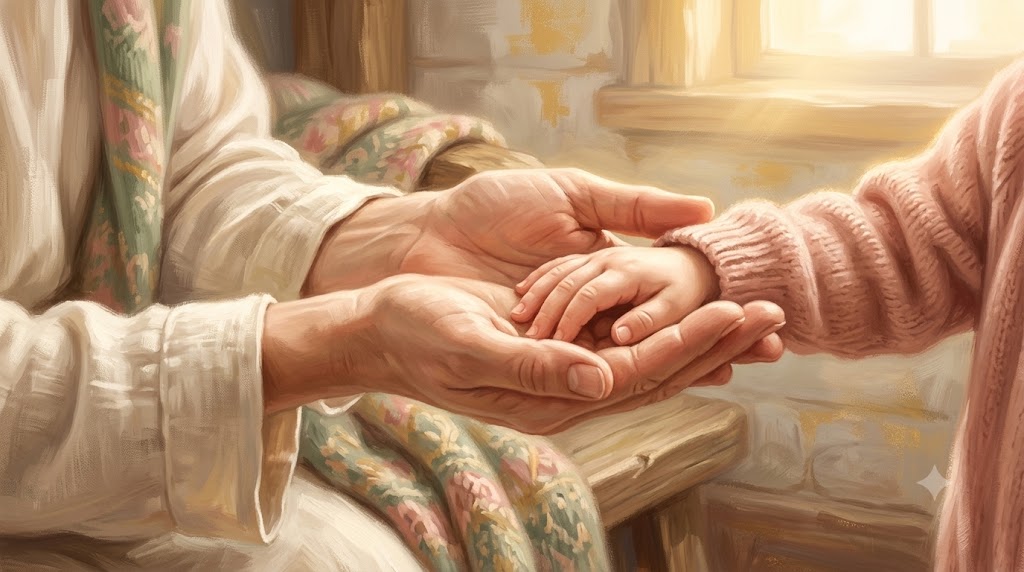
This matters enormously for anyone who has ever built a family out of people who weren’t born to you. Found family — chosen family — isn’t a modern invention or a consolation prize for people whose biological families failed them. It’s the exact shape of holiness Jerome Emiliani is remembered for. A father of orphans, the Church calls him, not because he fathered them by blood, but because he did what the word actually means: he made room, he brought them in, and he stayed.
Some people know exactly why a family like that matters, for a very specific reason: they were only ever welcome in their family, or their parish, on the condition that they hid or changed the truest thing about themselves. The moment that stopped being possible, the welcome stopped too. That is precisely what Jesus is refusing to allow in today’s Gospel — a welcome with a hidden asterisk attached. “Suffer the little children to come unto Me” has no condition folded into it at all.
If you are raising a child that isn’t “yours” by any legal or biological measure — a niece, a foster placement, a friend’s kid who just needed somewhere safe to land, a whole community of people who call you their chosen parent though you never signed anything — today’s feast is yours specifically. The kingdom of heaven, Jesus says, belongs to the ones who get welcomed in exactly this way. Not the ones with the right paperwork. The ones somebody actually brought inside, no conditions attached.
↑ The order resumes below.
VII
Secret
Receive, O Lord, this small offering made in memory of a man who gave up wealth and rank to bring the abandoned into his own home, and grant that we may find in our own lives the same courage to make room.
VIII
The Holding
(Benediction — two readings, one truth)
For those who hold this in faith: Lord, You told Your disciples not to turn the children away, and Jerome spent his whole life making sure none were. Give that same instinct to everyone raising a child who isn’t theirs by blood — the courage to bring them fully inside, and the trust that this is exactly the kingdom You described. Amen.
For those still finding their footing: If you’ve built family out of people who chose each other rather than people bound by blood, that was never a lesser kind of family. It’s the specific kind a Church has kept a feast day for, five hundred years running.
IX
Frequently Asked Questions
Epistle and Gospel text: Douay-Rheims Bible, Bishop Challoner revision — the standard English scripture translation used across traditional hand missals. Collect (adapted from the day’s confirmed liturgical theme) and liturgical structure: the Missale Romanum (1962), feast of St. Jerome Emiliani, Confessor (Mass “Effúsum”), with commemoration of St. Margaret, Virgin and Martyr, following The New Marian Missal for Daily Mass by Sylvester P. Juergens, S.M., S.T.D. (Regina Press, Imprimatur 1961).
Faith in Bloom offers this reflection in the spirit of the traditional Roman Rite — a daily offering, not a Mass — welcoming all people, of every faith background, into the shelter of the Word.
