
Daily Offering · 8 October 2026 · St. Bridget of Sweden
Daily Offering: October 8, 2026 | The Pearl of Great Price
Welcome to Bloom’s Daily Offering for Thursday, October 8, 2026, the feast of St. Bridget of Sweden, widow, third class, in white, with a commemoration of Ss. Sergius, Bacchus, Marcellus and Apuleius, martyrs. The Gloria is said, there is no Creed, and the Preface…
The order of this offering
Before the readings
The Word
Offering and Canon
I
Opening Address
Welcome to Bloom’s Daily Offering for Thursday, October 8, 2026, the feast of St. Bridget of Sweden, widow, third class, in white, with a commemoration of Ss. Sergius, Bacchus, Marcellus and Apuleius, martyrs. The Gloria is said, there is no Creed, and the Preface is the Common Preface. At the centre of today’s Gospel stands a merchant who finds one pearl of great price and sells everything he owns to have it.
St. Bridget was born about 1303, the daughter of Birger Persson, governor and provincial judge of Uppland. Married at thirteen, she raised eight children and was widowed in 1344. She founded the Order of St. Saviour, whose house at Vadstena was endowed in 1346, then went to Rome in 1349 and remained there until her death on 23 July 1373. Boniface IX canonized her on 7 October 1391.
So the Church gives a widow’s feast an Epistle about widows, and sets beside it the parable of the pearl of great price. The two readings were chosen for her, and they fit.
Wherever you are, you are welcome here. If you are older than you expected to be, and more alone than you planned to be, today’s Epistle was written about you before it was written about anyone else. Stay with us. The pearl of great price is not a prize for the people who had it easy.
II
A Word on Today’s Propers
Most of this Mass comes from the Common of Holy Women, and this archive has prayed it before. The Gospel of the pearl of great price was printed in full on November 19, 2025 and again on August 21, 2026, when we stayed with the treasure in the field and with who does the sorting on the shore.
The Epistle from 1 Timothy 5, the Collect and the commemoration are new here today. Every proper is printed in full this morning, in Latin and English, and the homily stays with the picture we have not yet spent a morning inside: the pearl of great price.
III
Introit
English
I know, O Lord, that Thy judgments are equity: and in Thy truth Thou hast humbled me. Pierce Thou my flesh with Thy fear: for I am afraid of Thy judgments. Ps. 118:1. Blessed are the undefiled in the way, who walk in the law of the Lord. Glory be to the Father, and to the Son, and to the Holy Ghost. As it was in the beginning, is now, and ever shall be, world without end. Amen. I know, O Lord, that Thy judgments are equity: and in Thy truth Thou hast humbled me. Pierce Thou my flesh with Thy fear: for I am afraid of Thy judgments.
Latin
Cognóvi, Dómine, quia ǽquitas judícia tua, et in veritáte tua humiliásti me: confíge timóre tuo carnes meas, a mandátis tuis tímui. Ps. 118:1. Beáti immaculáti in via: qui ámbulant in lege Dómini. Glória Patri… Cognóvi, Dómine, quia ǽquitas judícia tua, et in veritáte tua humiliásti me: confíge timóre tuo carnes meas, a mandátis tuis tímui.
IV
Collect
Let us pray.
English
O Lord our God, Who through Thine only-begotten Son didst reveal heavenly secrets to blessed Bridget: grant, through her kind intercession, that we Thy servants may rejoice and be glad in the revelation of Thine eternal glory. Through the same Christ our Lord. Amen.
Latin
Dómine, Deus noster, qui beátæ Birgíttæ per Fílium tuum unigénitum secreta cœléstia revelásti: ipsíus pia intercessióne da nobis, fámulis tuis; in revelatióne sempitérna glóriæ tuæ gaudére lætántes. Per eúndem…
V
The Commemoration
Commemoration of Ss. Sergius, Bacchus, Marcellus and Apuleius, Martyrs.
English
May the blessed merits of Thy holy Martyrs Sergius, Bacchus, Marcellus and Apuleius continually benefit us, O Lord, and make us ever fervent in Thy love. Through our Lord. Amen.
Latin
Sanctórum Martyrum tuórum nos, Dómine, Sérgii, Bacchi, Marcélli et Apuléji beáta mérita prosequántur: et tuo semper fáciant amóre fervéntes. Per Dóminum…
VI
Epistle
English
Lesson from the Epistle of blessed Paul the Apostle to Timothy. Dearly beloved: Honour widows, that are widows indeed. But if any widow have children, or grandchildren, let her learn first to govern her own house, and to make a return of duty to her parents: for this is acceptable before God. But she that is a widow indeed, and desolate, let her trust in God, and continue in supplications and prayers night and day. For she that liveth in pleasures, is dead while she is living. And this give in charge, that they may be blameless. But if any man have not care of his own, and especially of those of his house, he hath denied the faith, and is worse than an infidel. Let a widow be chosen of no less than threescore years of age, who hath been the wife of one husband. Having testimony for her good works, if she have brought up children, if she have received to harbour, if she have washed the saints’ feet, if she have ministered to them that suffer tribulation, if she have diligently followed every good work.
Latin
Léctio Epístolæ beáti Pauli Apóstoli ad Timótheum. Caríssime: Víduas honóra, quæ vere víduæ sunt. Si qua autem vídua fílios aut nepótes habet, discat primum domum suam régere, et mútuam vicem réddere paréntibus: hoc enim accéptum est coram Deo. Quæ autem vere vídua est et desoláta, speret in Deum, et instet obsecratiónibus et oratiónibus nocte ac die. Nam quæ in delíciis est, vivens mórtua est. Et hoc prǽcipe, ut irreprehensíbiles sint. Si quis autem suórum, et máxime domesticórum curam non habet, fidem negávit, et est infidéli detérior. Vídua eligátur non minus sexagínta annórum, quæ fúerit uníus viri uxor, in opéribus bonis testimónium habens, si fílios educávit, si hospítio recépit, si sanctórum pedes lavit, si tribulatiónem patiéntibus subministrávit, si omne opus bonum subsecúta est.
VII
Gradual
English
Grace is poured abroad in thy lips: therefore hath God blessed thee for ever. ℣. Because of truth and meekness and justice: and thy right hand shall conduct thee wonderfully. Alleluia, alleluia. ℣. With thy comeliness and thy beauty set out, proceed prosperously, and reign. Alleluia.
Latin
Diffúsa est grátia in labiis tuis: proptérea benedíxit te Deus in ætérnum. ℣. Propter veritátem et mansuetúdinem et justítiam: et dedúcet te mirabíliter déxtera tua. Allelúja, allelúja. ℣. Spécie tua et pulchritúdine tua inténde, próspere procéde et regna. Allelúja.
VIII
Gospel
English
Continuation of the holy Gospel according to Matthew. At that time, Jesus spoke this parable to His disciples: The kingdom of heaven is like unto a treasure hidden in a field. Which a man having found, hid it, and for joy thereof goeth, and selleth all that he hath, and buyeth that field. Again the kingdom of heaven is like to a merchant seeking good pearls. Who when he had found one pearl of great price, went his way, and sold all that he had, and bought it. Again the kingdom of heaven is like to a net cast into the sea, and gathering together of all kind of fishes. Which, when it was filled, they drew out, and sitting by the shore, they chose out the good into vessels, but the bad they cast forth. So shall it be at the end of the world. The angels shall go out, and shall separate the wicked from among the just. And shall cast them into the furnace of fire: there shall be weeping and gnashing of teeth. Have ye understood all these things? They say to him: Yes. He said unto them: Therefore every scribe instructed in the kingdom of heaven, is like to a man that is a householder, who bringeth forth out of his treasure new things and old.
Latin
Sequéntia ☩ sancti Evangélii secúndum Matthǽum. In illo témpore: Dixit Jesus discípulis suis parábolam hanc: Símile est regnum cœlórum thesáuro abscóndito in agro: quem qui invénit homo, abscóndit, et præ gáudio illíus vadit, et vendit univérsa, quæ habet, et emit agrum illum. Íterum símile est regnum cœlórum hómini negotiatóri, quærénti bonas margarítas. Invénta autem una pretiósa margaríta, ábiit, et véndidit ómnia, quæ hábuit, et emit eam. Íterum símile est regnum cœlórum sagénæ missæ in mare et ex omni génere píscium congregánti. Quam, cum impléta esset, educéntes, et secus litus sedéntes, elegérunt bonos in vasa, malos autem foras misérunt. Sic erit in consummatióne sǽculi: exíbunt Angeli, et separábunt malos de médio justórum, et mittent eos in camínum ignis: ibi erit fletus et stridor déntium. Intellexístis hæc ómnia? Dicunt ei: Etiam. Ait illis: Ideo omnis scriba doctus in regno cœlórum símilis est hómini patrifamílias, qui profert de thesáuro suo nova et vétera.

The Offering
Daily Homily | The Pearl of Great Price
The pearl of great price is the kingdom of heaven, and the verse says something stranger than we usually hear. Christ does not say the kingdom is like a pearl. He says the kingdom…
What is the pearl of great price?
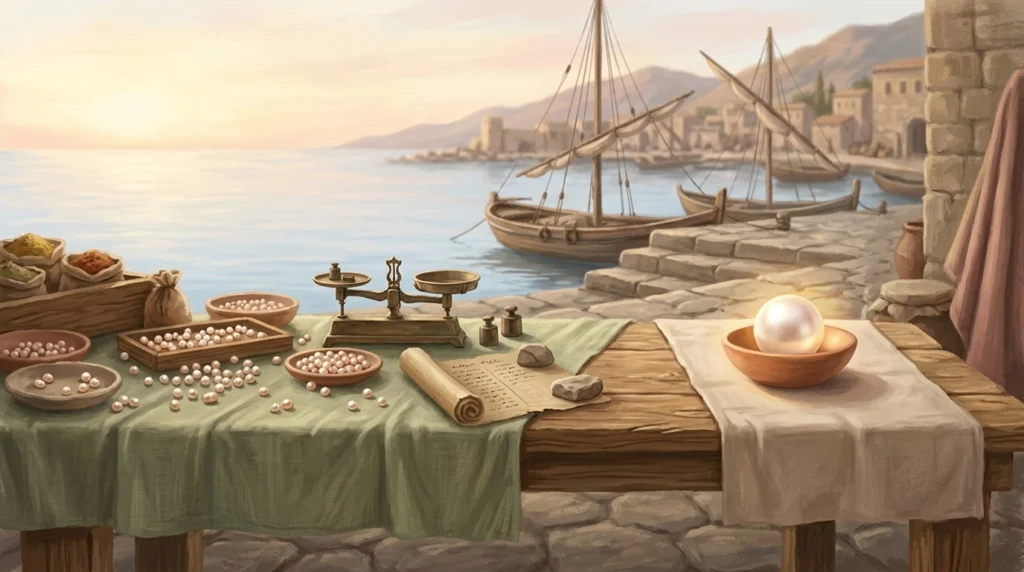
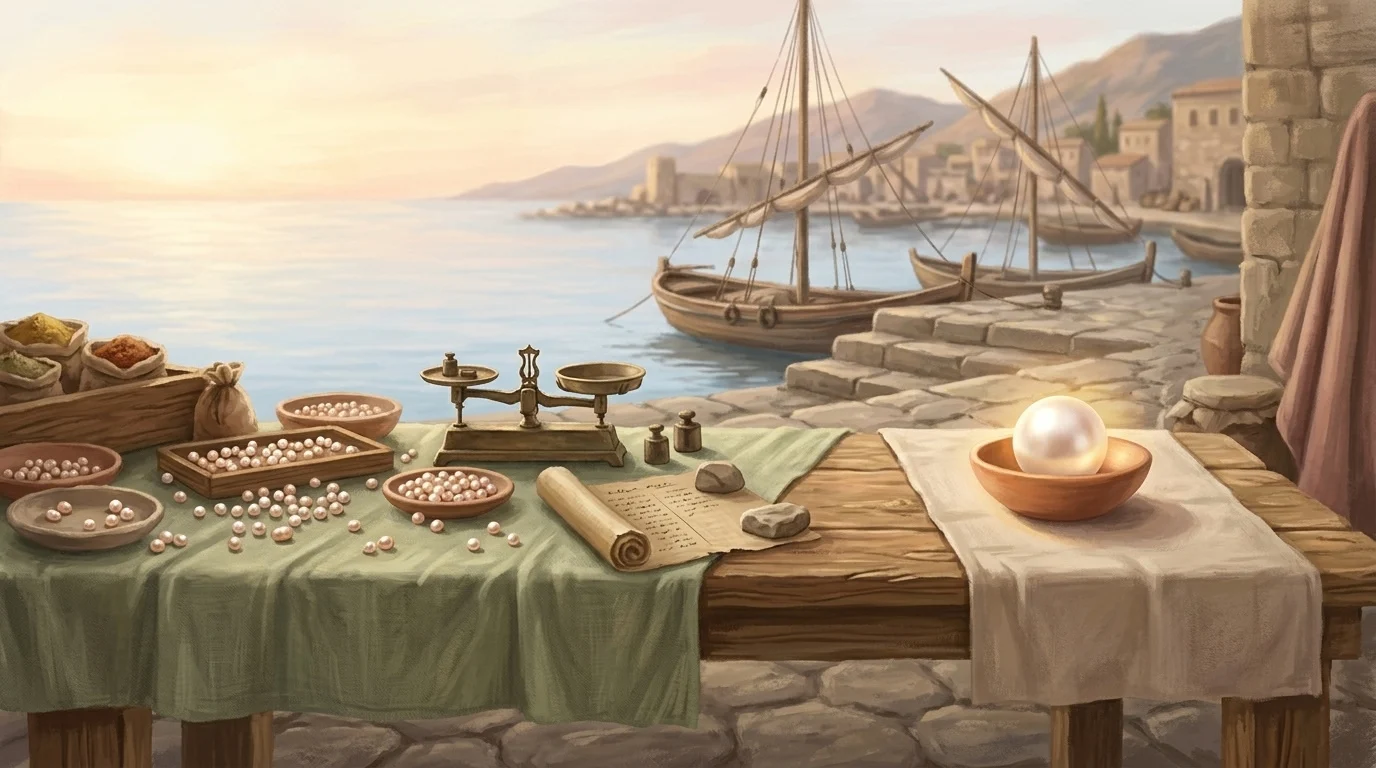
The pearl of great price is the kingdom of heaven, and the verse says something stranger than we usually hear. Christ does not say the kingdom is like a pearl. He says the kingdom of heaven is like to a merchant seeking good pearls. The comparison is to the whole scene: a man who knows pearls, a search, a find, and a sale.
That matters, because most of us were taught this parable as a price list. The pearl of great price is heaven, heaven costs everything, so pay up. Read the verse again and the merchant is not paying a fee at a gate. He is a professional who has handled good pearls all his working life, and one morning he finds the pearl of great price.
The Latin makes the turn plain. He goes out seeking bonas margaritas, good pearls, plural. He finds una pretiosa margarita, one precious pearl. A lifetime of many good things narrows, inside a single sentence, to one thing worth all of them, and that narrowing is the pearl of great price.
Christ honours the search for the pearl of great price. He could have told of a man who tripped over a pearl in the road. He chose a seeker. If you have spent years going from church to church, or from no church to some church and back again, picking up what was offered and setting it down, this verse does not call you restless. It calls you a merchant who knows what a good pearl looks like, and who will know the pearl of great price when it comes.
Why did the merchant sell everything?
He sold everything for the pearl of great price because he was glad, not because he was told to. The twin parable just before it says so about the treasure in the field: for joy thereof goeth, and selleth all that he hath. Joy comes first in that sentence and the selling follows. The pearl of great price is not bought with grief.
There is a shift of tense in the Douay worth hearing slowly. The man with the treasure goeth, selleth, buyeth, all in the present, happening while you listen. The merchant went his way, and sold all that he had, and bought it, all in the past. The Latin keeps the same contrast, vadit and vendit for the one, abiit and vendidit for the other.
Hold the two side by side and you have two ways people come to God. Some stumble on the pearl of great price on an ordinary Tuesday and are still selling as they hear this. Others made the trade years ago and are living on the far side of it, with the pearl of great price already theirs. Both are in the kingdom, and neither is ahead.
Here is the reading that has done real harm. It says the pearl of great price costs whatever you most fear losing, and that the fear proves it is the right price. Preachers have used this verse to tell people that God wants the very thing they cannot imagine living without, handed over in dread, as an entrance fee.
The parable of the pearl says the opposite. The merchant gives up what he has because he has found what he wants, and no one in the story is made to surrender something they love for something they dread. Test the reading by what it grows. A teaching that produces people afraid of God’s joy has misread a parable whose whole engine is joy.
What a pearl was worth to Rome
To hear the pearl of great price the way the first listeners heard it, you need to know what a single great pearl could be worth. Pliny the Elder, writing in the first century, tells a story that is human before it is about jewellery.
Cleopatra, Pliny says, owned the two largest pearls in history. She wagered Mark Antony that she could spend ten million sesterces on one dinner. When the night came she took one pearl from her ear, dropped it into vinegar, and when it had dissolved she drank it. The judge of the bet, Lucius Plancus, stopped her before she could do the same to the second.
A classicist named B. L. Ullman tested the story in 1957 and found that a whole pearl takes hours to dissolve in vinegar, so it probably did not happen quite the way Pliny tells it. But the story survived because its readers believed the premise. One pearl could carry a bet of ten million sesterces.
Set that beside the merchant and the two stories face each other. The queen of Egypt owned a pearl of great price and destroyed it to win an argument over dinner. The merchant owned everything else and gave it all up to keep one. Same object, opposite hands. Christ chose the second story for the pearl of great price.
That is the question underneath the pearl of great price, and it has nothing to do with jewellery. Everyone treats something as their pearl of great price. The only question is whether we spend it to win, or give up everything else to keep it, and whether what we call our pearl of great price would really survive the sale of the rest.
Who are the widows indeed today?
Now the Epistle, chosen for a widow’s feast and badly used. Paul tells Timothy to honour widows that are widows indeed, and then defines the term himself: she that is a widow indeed, and desolate. Desolata in the Latin, left alone. Paul’s category is not a ranking. It is a woman with no one left to support her.
The word honour here includes money. A few verses later in the same chapter Paul says that elders who rule well are worthy of double honour, and gives the reason: the labourer is worthy of his reward. Just before that, he tells families who can support their own widows to do it, and let not the church be charged, so that there may be sufficient for them that are widows indeed. This is a budget, and a budget is where a church shows its pearl of great price.
So the harmful reading falls apart on its own terms. This passage has been read as a test of women: one husband, children brought up, sixty years of age, no pleasures. As if the Church were grading wives. It is the qualifying list for a support roll in one first-century congregation, written by a pastor trying to make a small fund last, and it ranks no one’s soul.
Even the line about she that liveth in pleasures is not policing anyone’s private life. It sits directly after the word desolate, and it marks the difference between a widow left with nothing and a widow living in comfort. It is a means test. The money is the point, and the money is supposed to reach the person with no one.
So who are the widows indeed in our congregations now? Paul’s own definition answers: the people who have no one. Among older people today, LGBTQ elders meet that definition more often than most. SAGE reports that LGBT older adults are twice as likely as their heterosexual peers to live alone, and half as likely to have a life partner.
Many lost partners in years when the law had no word for what they had lost. Paul’s word for that person is not a problem to be managed or a cost to be contained. It is desolata, and his instruction about her is one word long. Honour.
Where a church keeps its pearl
Put the Gospel and the Epistle side by side and they ask one question about the pearl of great price from two directions. The merchant shows what a person does on finding the pearl of great price: he sells everything else. Paul shows what a congregation does with what it has: it spends it first on the person who has no one.
A church’s budget will tell you what it believes the pearl of great price is. If the money goes to the building and the brand and nothing reaches the desolate, the parable has been heard as a story about jewellery. If an eighty-year-old who lives alone is fed, visited, driven to the doctor and named at the altar, the pearl of great price has been understood.
That is also what the pearl of great price looked like in Bridget’s life. She had a great deal to keep, and she spent the second half of her life founding a house and living a charitable life in a city far from home. On her feast the Church reads her the widow’s list and the pearl of great price, and asks us to do the same arithmetic.
One word of care, because this Epistle borrows the language of burden. Let not the church be charged is easy to hear as a complaint about the people who need help. Read it the other way round: Paul is guarding the fund so that it is there for the one who needs it most. Needing support is not being a burden. In Paul’s own vocabulary it is being owed honour.
If none of the theology is yours, the arithmetic still holds. Look at where your money and your hours actually go, and you will learn what you treat as the pearl of great price. Then look at who near you lives alone, and decide whether they are on your list.
↑ The order resumes below.
X
Secret
English
May the service of Thy holy people be acceptable to Thee, O Lord, and honourable to Thy Saints, through whose merits we know that we have received help in trouble. Through our Lord. Amen.
Latin
Accépta tibi sit, Dómine, sacrátæ plebis oblátio pro tuórum honóre Sanctórum: quorum se méritis de tribulatióne percepísse cognóscit auxílium. Per Dóminum…
Commemoration of Ss. Sergius, Bacchus, Marcellus and Apuleius, Martyrs.
English
By the worthy prayer of Thy Saints, we beseech Thee, O Lord, may this victim, fitting for sacrifice, cause Thy Majesty to be appeased in us. Through our Lord. Amen.
Latin
Majestátem tuam nobis, Dómine, quǽsumus, hæc hóstia reddat immolánda placátam, tuórum digna postulatióne Sanctórum. Per Dóminum…
XI
The Holding
If you believe, hold this. The pearl of great price was never a fee you had to pay before God would let you in. It is joy, found, and everything else rearranges itself around it.
Go and spend something today on someone who has no one. May Almighty God bless you, the Father, and the Son, and the Holy Ghost. Amen.
If that language is not yours, take the plain half. Decide what your pearl of great price is, and let your calendar and your bank statement agree with you. Then find one person who lives alone, and make them less alone this week.
XII
Frequently Asked Questions
It is the phrase from Matthew 13:46, where a merchant who has been seeking good pearls finds one pearl of great price, goes and sells all that he had, and buys it. Christ likens the kingdom of heaven to that whole scene: a search, a recognition and a glad exchange. The pearl of great price is not a fee for admission. It is the thing worth everything else, found by someone who knew how to look.
Matthew 13:44-52 is a cluster of short parables about the kingdom of heaven: a treasure found in a field, a merchant and one pearl of great price, a net that gathers every kind of fish, and a scribe who brings things out of his storeroom. Together they say the kingdom is found with joy, gathers widely, and leaves the final sorting to the end of the age and to God’s angels rather than to us.
No. The parable of the pearl uses money because money is how people show what they value, but its subject is the kingdom of heaven. The merchant sells what he had because he has found what he wants, and the twin parable of the treasure says the selling comes for joy. Read as a price list, the parable of the pearl turns grace into a transaction, which is the one thing the story is built to refuse.
1 Timothy 5 tells a congregation how to support the widow indeed, and desolate, meaning the woman with no one left to provide for her. The qualifications in verses 9 and 10 belong to an enrolment list for that support, and later in the same chapter Paul ties honour to wages. 1 Timothy 5 is a budget instruction, not a ranking of women’s worth, and it demotes no one who married twice, had no children, or was widowed young.
No. Paul’s word for what a congregation owes the person with no one is honour, not pity, and he arranges the money so that it reaches her first. Needing help is not a failure or a debt. A church that makes people feel like a burden for being alone has the passage backwards.
St. Bridget of Sweden was born about 1303, married at thirteen, raised eight children and was widowed in 1344. She founded the Order of St. Saviour, whose house at Vadstena was endowed in 1346, and lived in Rome from 1349 until her death on 23 July 1373. Her Revelations were in great repute in the Middle Ages, and Boniface IX canonized her on 7 October 1391. The 1962 calendar keeps her feast today, October 8, in the third class.
Because the Mass of the 1962 Missal is prayed in Latin, and the English is its translation. Every proper today carries both, so you can follow the Missal’s own words or read them in English. The language switch on the page lets you choose English, Latin, or both side by side, like a hand missal.
No. St. Bridget has neither in the 1962 calendar. Only seven vigils survived the reforms of 1955 and only three octaves, Christmas, Easter and Pentecost, and October 8 is not the eve of any of the seven. Today is simply the feast of St. Bridget of Sweden, with a commemoration of four martyrs.
No. The parable works as a question anyone can answer: what do you treat as worth everything, and does the way you spend your days agree? Paul’s instruction works without belief too, because any community can decide to spend first on the people who have no one. Faith in Bloom offers the liturgy to anyone, with nothing asked in return.
Faith in Bloom is the daily liturgical work of Bloom Ministries, a 501(c)(3) nonprofit, and it is free to read and always will be. If it has been worth something to you and you are able, you can give once or give monthly below. Sending a post to one person who needs it does real work too.
Propers for the feast of St. Bridget of Sweden are taken from the 1962 Roman Missal, in the Missal’s Latin and in English. Scripture is quoted from the Douay-Rheims Bible. Biographical detail is drawn from the Catholic Encyclopedia.
The liturgical spine of Faith in Bloom is The New Marian Missal for Daily Mass by Sylvester P. Juergens, S.M., S.T.D., Regina Press, Imprimatur 1961. Faith in Bloom is offered by Bloom Ministries in the Independent Catholic tradition and is not affiliated with or recognized by the Roman Catholic Church.
