
Daily Offering · 28 September 2026 · St. Wenceslaus
Daily Offering: September 28, 2026 | A Cup of Cold Water
Welcome to Bloom’s Daily Offering for Monday, September 28, 2026, the feast of St. Wenceslaus, Duke and Martyr, a feast of the third class. His Gospel opens with a sword laid through the middle of a family and closes on a cup of cold…
The order of this offering
Before the readings
The Word
Offering and Canon
I
Opening Address
Welcome to Bloom’s Daily Offering for Monday, September 28, 2026, the feast of St. Wenceslaus, Duke and Martyr, a feast of the third class. His Gospel opens with a sword laid through the middle of a family and closes on a cup of cold water handed to one small person. The Church reads them together without apology. We are going to stay with the second one, because the first one has been done to people quite enough.
Wherever you are, you are welcome here. If you came into this Monday out of a family that no longer has a chair with your name on it, you are in the right room, and nothing this morning is going to tell you that this was arranged for your good. What today’s Gospel puts in your hands at the end of it is small and it is doable: a cup of cold water, in that exact phrase, and a promise attached to it that is out of all proportion to the size of the thing.
II
A Word on Today’s Propers
Today is a feast and not a ferial continuation. The Collect is Wenceslaus’s own and stands first; the feria of the eighteenth week after Pentecost sits behind the feast and is not commemorated, because a third-class feast does not commemorate a fourth-class feria. There is nothing displaced and nothing transferred.
The Mass is drawn largely from the Common of a Martyr, and one part of it has been here twice already. The Lesson, Wisdom 10:10-14, was printed in full on the feast of St. Louis in August and again two days later on the feast of St. Joseph Calasanctius. This would be its third printing inside five weeks, so it stands below as a citation and a link rather than as a third copy. That is this ministry’s own rule: print a text four times and it has stopped being reverence.
The Lesson carries a textual difference worth having even unprinted. The Vulgate’s subject at Wisdom 10:10 is feminine, Haec, reaching back to Wisdom herself in the verse before, which is why the Douay reads she conducted the just and she went down with him into the pit. The Missal’s own incipit hands that work to the Lord instead. Both are before us, and the archive prints the Douay.
The Introit, the Collect, the Gospel and the Secret have not been here before. The Gradual’s psalm was printed a week ago on the feast of St. Matthew and is printed again in full today, with a different verse after it, because a Gradual is short and the second printing rule reaches the readings rather than the antiphons.
III
Introit
Ps 20:2-3
In thy strength, O Lord, the king shall joy; and in thy salvation he shall rejoice exceedingly. Thou hast given him his heart’s desire.
Ps 20:4
For thou hast prevented him with blessings of sweetness: thou hast set on his head a crown of precious stones.
Glory be to the Father, and to the Son, and to the Holy Ghost. As it was in the beginning, is now, and ever shall be, world without end. Amen.
In thy strength, O Lord, the king shall joy; and in thy salvation he shall rejoice exceedingly. Thou hast given him his heart’s desire.
IV
Collect
O God, Who through the palm of martyrdom didst transport blessed Wenceslaus from an earthly dominion unto heavenly glory: by his prayers keep us from all harm, and grant us to rejoice in his fellowship. Through our Lord Jesus Christ, Thy Son, Who liveth and reigneth with Thee in the unity of the Holy Ghost, God, world without end. Amen.
V
Epistle
Wisdom conducting the just man through his brother’s anger, standing by him among people who cheated him, staying with him when he was sold and going down into the pit with him, and leaving him not in his chains. Printed in full in August, and again two days after that.
VI
Gradual
Ps 111:1-2
Blessed is the man that feareth the Lord: he shall delight exceedingly in his commandments. His seed shall be mighty upon earth: the generation of the righteous shall be blessed. Alleluia, alleluia.
Ps 20:4
Thou hast set on his head, O Lord, a crown of precious stones. Alleluia.
VII
Gospel
At that time, Jesus said to his disciples: Do not think that I came to send peace upon earth: I came not to send peace, but the sword.
For I came to set a man at variance against his father, and the daughter against her mother, and the daughter in law against her mother in law. And a man’s enemies shall be they of his own household.
He that loveth father or mother more than me, is not worthy of me; and he that loveth son or daughter more than me, is not worthy of me. And he that taketh not up his cross, and followeth me, is not worthy of me.
He that findeth his life, shall lose it: and he that shall lose his life for me, shall find it.
He that receiveth you, receiveth me: and he that receiveth me, receiveth him that sent me. He that receiveth a prophet in the name of a prophet, shall receive the reward of a prophet: and he that receiveth a just man in the name of a just man, shall receive the reward of a just man.
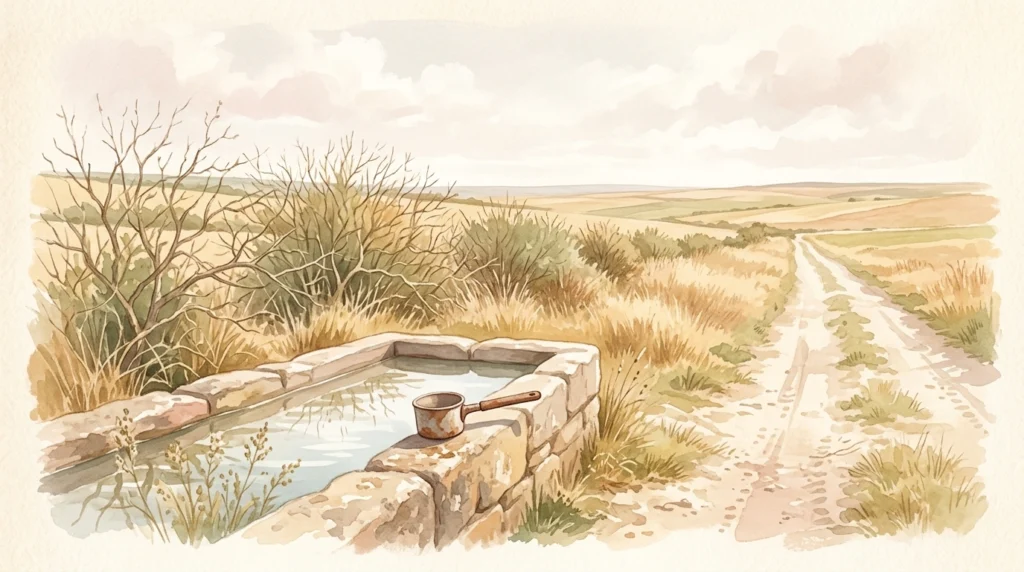
And whosoever shall give to drink to one of these little ones a cup of cold water only in the name of a disciple, amen I say to you, he shall not lose his reward.
The Offering
Daily Homily | A Cup of Cold Water
Everything here turns on what kind of sentence Christ is speaking. He is forecasting.
He said the house would divide
Everything here turns on what kind of sentence Christ is speaking. He is forecasting.
Nobody in this passage is told to take up a sword, and nobody is told to set anybody at variance with anybody. He says what will happen when his claim lands in a house where not everyone accepts it, and then spends the rest of the passage telling his disciples what to do inside it. The answer he gives them is a cup of cold water.
A forecast of division that ended in verse 36 would be a bleak half-sentence and nothing else. This one runs on past the sword, past the cross, past losing your life, and arrives at somebody handing somebody else a drink, the smallest measurable act anywhere in this chapter and the only thing in the passage a person with no power at all can actually do. A cup of cold water is the floor, and he sets the floor very low.
He does not pretend the house can be kept whole on the way to a cup of cold water. A cup of cold water is where he leaves them standing, on purpose.
His own brother did it
The Catholic Encyclopedia gives him as Wenceslaus, Duke of Bohemia, born probably in 903 and killed at Alt-Bunzlau on this day in 935. His father Wratislaw was a Christian, his mother Dragomir was not, and he was educated by his grandmother Ludmilla and at Budweis. When his father died, his mother governed in his place and set herself against Christianity, and Wenceslaus took the government when the people pressed him to.
He was murdered by his brother Boleslaw, at his mother’s instigation, for reasons the article gives as religious and national together. His body was hacked to pieces and buried where it fell. Three years later the brother who had ordered it repented and had what was left carried to Prague.
That is the whole of what the encyclopedia carries, and what it leaves us is a man and a Gospel about a cup of cold water.
Set that beside verse 36. And a man’s enemies shall be they of his own household. The Missal does not choose this Gospel for Wenceslaus personally; it comes to him from the Common of a Martyr. It is the ordinary Gospel for a man killed for the faith, and it happens to describe this particular death with an accuracy that is difficult to sit with. His household was his enemy in the plainest sense the words can carry, and the same reading hands him a cup of cold water at the end.
We have stood near this ground once, and the difference matters. In July, on Alexius, the question was about a family that looked straight at one of its own and did not see him. That was blindness. Today is a household that saw clearly and turned, which is harder and a different claim.
The verse that gets used on people
He that loveth father or mother more than me, is not worthy of me; and he that loveth son or daughter more than me, is not worthy of me. That verse has been used in two opposite directions, and both of them are misreadings of what it says. It has been used to tell people to cut off a relative who believes wrongly. It has also been used to tell people whose relatives cut them off that the loss was arranged by God and should be accepted quietly.
The verse ranks a claim; it does not rate an affection. It says who is Lord when two claims collide, and nothing whatever about loving a child less.
Nobody is instructed here to withdraw love from a son or a daughter. A parent separated from a child is not being told that this is what worthiness looks like. Both doors close, and a cup of cold water is still the only action the passage actually commands.
Apply the fruit test: by their fruits you shall know them. Ask what the cutting-off reading has actually grown wherever it was believed. It grew households where a person became a position to be held rather than a son to be fed. It grew young people sleeping in cars in the week they told the truth about themselves.
It grew a great many adults who can recite the verse that was read at them and cannot remember being asked a single question. Not one of those houses was short of doctrine. Every one of them was short of a cup of cold water.
I will name who has carried the most of that, because the verse itself makes me. Trans people and queer people are, in this ministry’s own experience, much of who that has happened to, and they did not arrive at it by choosing a sword. They said a true thing in a room and the room divided. A cup of cold water in the name of a disciple is not a small consolation prize offered to them afterwards; it is the whole of what this Gospel asks anybody to supply.
The passage has one more hard line in it. He that taketh not up his cross. Nothing in that line is telling you to stay somewhere you are being harmed. The cross in this chapter is the cost of telling the truth about Christ, not the cost of staying within reach of someone who hurts you. Leaving is not dropping it. A cup of cold water can be handed through a door you have every right to keep shut.
A cup of cold water only
The last three verses descend. He that receiveth you. He that receiveth a prophet. He that receiveth a just man.
And then, at the bottom of the ladder, one of these little ones—and the reward does not shrink as the recipient does. A cup of cold water given to the least important person in the sentence carries the same promise as receiving a prophet.
Then the size of the act itself. Not a meal. Not shelter, not a plan. A cup of cold water, and the Douay keeps a word that is easy to slide past: a cup of cold water only.
That only forecloses the objection before anybody raises it, and the objection is always the same—that what I have to give is too small to be worth giving.
Of everything named in this chapter, cold water is the thing that costs the giver least, and that is plainly why it is the one chosen. A cup of cold water is what is left when a person has no resources at all, and he says it will not be lost.
There is no test of the recipient anywhere in the verse. He does not say a cup of cold water given to the deserving, or to the repentant, or to one who will use it well. The only qualifier in the sentence attaches to the giver’s reason, in the name of a disciple. A cup of cold water goes to whoever is in front of you.
What you can still hand over
There is a story sometimes told of a woman who keeps a cooler in the boot of her car and drives, two mornings a week, to the release door of a county jail.
People come out at an hour when nothing nearby is open. No bus for forty minutes, nothing in their pockets but a paper envelope, and a walk to a main road in whatever they were arrested in. She parks where the door is. She hands over a bottle of water and a bus fare, and she asks nobody what they were inside for, and she is gone inside the hour. A cup of cold water, handed over at a kerb, twice a week.
She is not running a programme, she says, and she would be embarrassed to have it called one. She is at a door that opens early with a cup of cold water, because somebody was at a door for her brother once and nobody has ever been able to tell her whether it mattered. She has said she would rather be the person who was there than the person who worked out first whether it would help.
The part worth carrying is the part she finds least interesting. A bottle of water does not undo a sentence, does not restore a household, does not fix a Tuesday, and she would say so before you could.
A cup of cold water was never advertised as doing any of that. It is a cup of cold water at a door, and on the strength of this Gospel it is the named act with the promise on it.
If you do not believe any of this, the passage still holds without a single article of faith. The people who got you through the worst stretch of your life were mostly not the ones with a plan for you. They were the ones who turned up with something small and did not require you to explain yourself first. A cup of cold water, in the plain version, is that a small unconditional thing given at the right hour outperforms a large conditional one, and that most of us withhold the small thing because we have talked ourselves into believing it is beneath the size of the problem.
Which is the practical question. Not what you could do if you had more. What you have got in your hand this morning that would take you twenty minutes, and who would have to be sent nothing at all for you to feel that you had done enough. A cup of cold water is the measure this Gospel sets, and almost everybody reading this can clear it before lunch.
One more thing in the verse. He shall not lose his reward. Not he shall be rewarded—the promise is put in the negative, which is a different and stranger assurance. It answers a specific fear: that a small kindness given to someone who never mentioned it again simply evaporated, and that you were foolish for the trouble. A cup of cold water is not lost, and neither is the person who handed it over.
Wenceslaus was about thirty-two, ruling a duchy his own mother had governed before him, and the people who killed him lived in his house. His household came for him and the Church put a crown on him and the Gospel that carries his name asks nothing larger of us than what he had at the end. A cup of cold water, and the promise that it will not be lost.
↑ The order resumes below.
IX
Secret
Having received our gifts and prayers, O Lord, we beseech Thee: cleanse us by Thy heavenly mysteries, and graciously hear us. Through our Lord Jesus Christ, Thy Son, Who liveth and reigneth with Thee in the unity of the Holy Ghost, God, world without end. Amen.
X
The Holding
May God give you today whatever it is you have gone without, and may He put in your way one person you can hand a cup of cold water to before the day is out. If your own house divided, may you hear plainly that it was not arranged for your instruction. May Almighty God bless you, the Father, and the Son, and the Holy Ghost. Amen.
And if that language is not yours, take it as it stands. Somebody is within reach of you today who needs something small enough that you could do it now, and the reason to do it is not that it will fix anything. Hand it over anyway.
XI
Frequently Asked Questions
Because Wisdom 10:10-14 comes from the Common and this archive has already printed it in full twice inside five weeks, on the feasts of St. Louis and of St. Joseph Calasanctius, both of which are linked above the Gradual. The citation stands where the Lesson would, with the text one click away. Everything else in today’s Mass is printed whole, because everything else is either new here or has been here only once.
No. Only seven vigils survived Pope Pius XII’s reform of 1955 into the 1962 Missal, and September 28 is not the eve of any of them. Only three octaves survived, and none of them falls in September. Tomorrow is a first-class feast, but the 1962 calendar gives it no vigil, so today is a third-class feast standing on its own.
It is the last thing Christ names in today’s Gospel and the smallest act in the chapter, and of everything named there it is the thing that costs the giver least. The Douay keeps the word only, which answers the objection that a gift this size is not worth making. The promise attached to it does not depend on the recipient deserving it.
No, and the why matters. Verse 37 ranks a claim rather than rating an affection: it says who is Lord when two claims collide. Nothing in it instructs anyone to withdraw love from a parent or a child, and nothing in it makes an estrangement somebody else imposed into a sign of anybody’s worthiness. The one action the passage actually commands is a cup of cold water.
The Catholic Encyclopedia calls him Duke of Bohemia throughout, and that is the title this ministry uses. It does report that the Emperor Otto conferred a regal dignity and title on him. Whatever else you may have heard him called, duke is the word the source carries.
Because the encyclopedia gives the motives for his murder as religious and national together, not personal. He had placed the duchy under German protection, brought in German priests and favoured the Latin rite, and the murder was instigated by the household party that had set itself against Christianity. The Church reads that as dying for the faith, which is why his Mass comes from the Common of a Martyr.
No. The logic holds with no theology attached at all. Small unconditional help given at the right hour does more than large conditional help given after an assessment, and most people withhold the small thing because they have decided it is beneath the size of the problem. In one sentence: give the thing you can give now, and stop grading it against the thing you cannot.
Faith in Bloom is the daily liturgical work of Bloom Ministries, a 501(c)(3) nonprofit, and it is free to read and always will be. If it has been worth something to you and you are able, you can give once or give monthly below. Sending a post to one person who needs it does real work too.
Propers for the feast of St. Wenceslaus, Duke and Martyr, are taken from the 1962 Roman Missal. Scripture is quoted from the Douay-Rheims Bible. Biographical material is drawn from the Catholic Encyclopedia. The liturgical spine of Faith in Bloom is The New Marian Missal for Daily Mass by Sylvester P. Juergens, S.M., S.T.D., Regina Press, Imprimatur 1961.
Faith in Bloom is offered by Bloom Ministries in the Independent Catholic tradition and is not affiliated with or recognized by the Roman Catholic Church.
