


Daily Offering · 14 August 2026 · Vigil of the Assumption
Daily Offering: August 14, 2026 | Blessed Are They Who Hear
Blessed are they who hear the word of God, and keep it—that is Christ’s own correction of a compliment, and it’s the sentence to carry into this morning before anything else is said. Beloved, grace and peace to you: however you arrive here, tired…
The order of this offering
Before the readings
The Word
Offering and Canon
I
Opening Address
Blessed are they who hear the word of God, and keep it—that is Christ’s own correction of a compliment, and it’s the sentence to carry into this morning before anything else is said. Beloved, grace and peace to you: however you arrive here, tired or hopeful, certain or doubting, welcomed elsewhere or shut out elsewhere. Bloom is not a room you have to earn your way into. Sit with us a moment, offered today in the spirit of a low Mass—Word, prayer, and offering, without pretense to more than that.
Today is a vigil, which means today is the night before. Tomorrow the Church keeps the Assumption; today it keeps watch. Those are two different jobs, and this one is ours. Blessed are they who hear the word of God, and keep it—today is the keeping.
II
Introit
(Psalm 44:13, 44:15-16; Ps. 44:2)
All the rich among the people seek your favor. Behind her the virgins of her train are brought to the King. They are borne in to you with gladness and joy. (Ps.) My heart overflows with a goodly theme; as I sing my ode to the King. Glory be to the Father, and to the Son, and to the Holy Ghost.
III
Collect
O God, Who chose for Your dwelling the virginal womb of the blessed Mary, grant, we beseech You, that, with the help of her protection, we may with joy take part in her festival. Who livest and reignest with God the Father in the unity of the Holy Spirit, God, world without end.
IV
The Commemoration
(Collect for St. Eusebius, Confessor)
O God, Who, year by year, dost gladden us by the solemn feast-day of Thy blessed confessor Eusebius, mercifully grant unto all who keep his birthday, grace to follow after the pattern of his godly conversation. Through our Lord Jesus Christ, Thy Son, who liveth and reigneth with Thee in the unity of the Holy Spirit, God, world without end.
V
Epistle
Ecclesiasticus 24:23-31, Douay-Rheims
As the vine I have brought forth a pleasant odour: and my flowers are the fruit of honour and riches. I am the mother of fair love, and of fear, and of knowledge, and of holy hope. In me is all grace of the way and of the truth, in me is all hope of life and of virtue. Come over to me, all ye that desire me, and be filled with my fruits.
For my spirit is sweet above honey, and my inheritance above honey and the honeycomb. My memory is unto everlasting generations. They that eat me, shall yet hunger: and they that drink me, shall yet thirst. He that hearkeneth to me, shall not be confounded: and they that work by me, shall not sin. They that explain me shall have life everlasting.
VI
Gradual
Blessed and venerable are you, O Virgin Mary, who, without spot, were made the Mother of the Saviour. O Virgin, Mother of God, He Whom the whole world cannot contain, shut Himself in your womb, becoming Man.
VII
Gospel
Luke 11:27-28, Douay-Rheims
And it came to pass, as He spoke these things, a certain woman from the crowd, lifting up her voice, said to Him: “Blessed is the womb that bore Thee, and the paps that gave Thee suck.” But He said: “Yea rather, blessed are they who hear the word of God, and keep it.”
The Offering
Daily Homily | Blessed Are They Who Hear
Two verses. That is the entire Gospel for the day before one of the largest Marian feasts in the calendar—two verses, one interruption, and a correction so quiet that people have been walking past…
Two verses. That is the entire Gospel for the day before one of the largest Marian feasts in the calendar—two verses, one interruption, and a correction so quiet that people have been walking past it for centuries. Blessed are they who hear the word of God, and keep it.
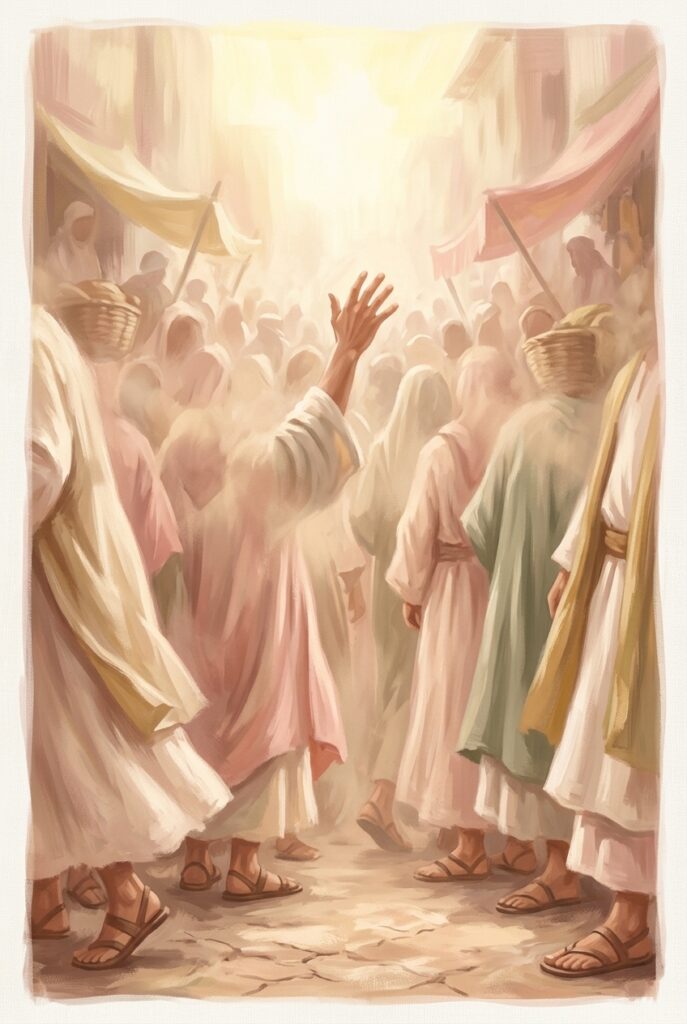
Start with the woman, because she deserves credit before she gets corrected. She is standing in a crowd, she has been listening to Jesus, and something in her breaks open and she shouts. What she shouts is a blessing on his mother. In her world it was the highest compliment available to a woman—look what your body produced—and she meant every word of it generously.
And Jesus says: yea rather. Not no. Not you’re wrong to bless her. Two words that leave her intact and move the criterion anyway. Blessed are they who hear the word of God, and keep it.
Sit with where he moved it from and to. She located blessedness in a womb and in nursing—in biological function, in what a body did. He relocates it into hearing and keeping: Blessed are they who hear the word of God, and keep it. From anatomy to attention. From what happened to a body to what a person does with what they’ve been told.
And notice what that does for Mary rather than to her. It doesn’t demote her. It promotes her out of the category she’d been put in. The woman in the crowd praised her for something she had no say in; Christ praises her for the thing she actually chose, which was to hear an impossible message and keep it anyway.
She goes from being remarkable furniture in someone else’s story to being the first and best example of the very thing he just named. Blessed are they who hear the word of God, and keep it—and no one ever did it better.
Here is what I want to hold up, and it is not a modern reading imposed on an old text. This is the Gospel the Church itself assigned to the eve of the Assumption. On the day before the feast that celebrates Mary’s whole person being taken up, the reading chosen is the one where Christ takes the blessing off her body and puts it on her hearing. Whoever built this calendar knew exactly what they were doing. Blessed are they who hear the word of God, and keep it, on the eve of the feast of her glory.
So let me say plainly who that lands on, because the text lands there first and I would rather follow it than tiptoe. Anyone whose body has been treated as the entire argument about them knows what the woman in the crowd was doing, even when she meant well. And anyone in that position should hear where Christ put the blessing instead: Blessed are they who hear the word of God, and keep it.
People who have been told their worth or their womanhood is a matter of anatomy. People who wanted children and could not have them, and have sat through years of being blessed for the wrong things or pitied for the wrong reasons. People whose disability gets read as a verdict on their soul rather than a fact about their body.
To every one of them, today’s Gospel says: yea rather. The criterion is not your body. It never was. Blessed are they who hear the word of God, and keep it.
Put plainly, for anyone here who doesn’t hold the theology: a person’s worth has never actually been located in what their body can produce. That’s true whether or not you call the source of it God, and most of us know it clearly about everybody except ourselves.
Now the Epistle, which turns out to be saying the same thing from the other end. Wisdom speaks in her own voice through all of Ecclesiasticus 24—come over to me, all ye that desire me, and be filled with my fruits—and then lands on this: He that hearkeneth to me, shall not be confounded.
Hearkeneth. Hears. Both of today’s readings pivot on the same faculty, chosen independently and centuries apart, and neither makes the entry requirement anything you have to be born as. Blessed are they who hear the word of God, and keep it—Wisdom said it first and Christ said it plainer. The door is listening.
That is a door almost nobody can be locked out of.
But the Gospel doesn’t stop at hearing, and I would be shortchanging you if I did. Blessed are they who hear the word of God—and keep it. Two verbs. The first takes a moment. The second takes the rest of your life.
Keep here carries the sense of custody. Guarding something entrusted to you. Luke uses it elsewhere about Mary keeping words in her heart, and it isn’t storage—it’s the work of holding onto something true while everything around you argues with it. Hearing is what happens to you.
Keeping is what you do about it afterward, on the days it costs you. Blessed are they who hear the word of God, and keep it: the blessing sits on both halves, not the first one alone.
And that is what a vigil is for. A vigil isn’t the celebration; it’s the sitting-up beforehand. Nobody throws a party for the night watch. Today the Church is not yet rejoicing—it is keeping, in the dark, ahead of a morning it trusts is coming. Blessed are they who hear the word of God, and keep it, is a description of a night watch as much as a life.
Which is most of a life, if we’re honest about it. Very few people spend much time on the feast day. Almost everyone spends most of their years on the vigil, keeping something they heard once, waiting on a resolution they’ve been promised and haven’t seen. This day is built for exactly that condition, and it does not treat it as a lesser state. Blessed are they who hear the word of God, and keep it—which is a blessing pronounced squarely on the waiting.

There is a story sometimes told of a woman who died at ninety-one having held no office of any kind. She was not a deacon or a teacher or a board member. She had shown up to the same building for sixty-odd years, sat in roughly the same place, and read the same worn book so many times that the spine had given up and it opened by itself to certain pages.
When she died, the pastor found he could not write the eulogy from any of the usual material. There were no committees to list, no building campaigns, no titles. What he had was a woman about whom the only true sentence was Blessed are they who hear the word of God, and keep it. What he had instead was a stack of about forty notes people had handed him after the announcement, and nearly every one said some version of the same thing: she asked me about that thing I told her a year ago, and she remembered the details.
That’s it. That’s the whole record. She heard things and she kept them—kept them in the custodial sense, the way you keep something entrusted—and forty people separately noticed that being remembered accurately by one person for a decade had changed something in them. Blessed are they who hear the word of God, and keep it. She would have been embarrassed to hear it applied to her, which is generally a sign that it applies.
This is the same shape as a hidden life nobody ever applauded, and the calendar honors that shape with a consistency the rest of us rarely match. Blessed are they who hear the word of God, and keep it—the calendar has been saying so for centuries. The Church keeps putting quiet, uncredentialed faithfulness at the center and then the rest of us keep looking past it toward the people with titles.
Today’s second name belongs in that company. St. Eusebius is commemorated after the vigil’s own prayers—a Roman patrician and priest, an ardent defender of the Nicene Creed, and what the record actually holds about him is a real grave in the cemetery of Callistus with a simple inscription. The dramatic narrative that grew up around him, in which he is shut away for seven months and dies in confinement, sits under serious historical doubt, and the tradition that remembers him has never depended on it.
What the Church actually prays for today is the interesting part. It doesn’t ask for his courage under interrogation or his stamina in a cell. It asks for “grace to follow after the pattern of his godly conversation”—his conversatio, his ordinary daily manner of living. Of all the things that could have been requested from a confessor, the prayer asks for his habits. Blessed are they who hear the word of God, and keep it, is a description of habits.
That’s the same move the Gospel makes. Not the dramatic fact about a body, whether a womb or a dungeon; the daily practice of a person. Yesterday we sat with a man the tradition remembers as dying in confinement whose vivid death was borrowed from a poem, and the point held anyway. Today the prayer skips the drama entirely and asks for the man’s routine, because Blessed are they who hear the word of God, and keep it, was never a claim about anybody’s worst afternoon.
There is one more thread worth pulling, because it’s in today’s own Introit. The psalm behind it is the same psalm we sang for St. Clare two days ago, and two of the verses are identical—after her shall virgins be brought to the king: they shall be brought with gladness and rejoicing. The Church reuses that line for one woman after another, across centuries, and it never seems to run out of people to apply it to.
That’s not liturgical laziness. It’s a claim about how many of these there are. The same verse fits a thirteenth-century woman who refused to own anything and a first-century woman who said yes to something nobody would have believed, and it would fit the woman with the worn-out book, and it will fit somebody in your life you have not thought to count. Blessed are they who hear the word of God, and keep it. The line is not scarce.
So here is the day, plainly. Tomorrow the Church says something enormous about a woman’s whole self being carried into glory. Today it says the thing that makes tomorrow mean anything at all: she got there by hearing and keeping, which is a road open to every single person reading this.
Whatever was said about your body—by a family, a doctor, a church, a stranger with an opinion—it was never the measurement. Blessed are they who hear the word of God, and keep it. That’s the sentence Christ preferred, and he was there for the other one.
↑ The order resumes below.
IX
Secret
O Lord, may the prayer of the Mother of God recommend our offerings to Your mercy, that she, whom You transported from this world, may trustingly intercede for our sins in Your presence. Through the same Christ our Lord, who liveth and reigneth with Thee in the unity of the Holy Spirit, God, world without end.
X
The Holding
(Benediction—two readings, one truth)
For those who hold this in faith:
Lord, You let a stranger praise Your mother for the wrong thing and You corrected it gently, without taking the blessing away from her. Do that for everyone here who has been measured by their body—by what it can do, what it can’t, what it looks like, what it never produced. Move the measurement where You put it, and give them the long patience to keep what they’ve heard, so that blessed are they who hear becomes a sentence about them too. Through Christ our Lord. Amen.
For those still finding their footing:
Nobody’s worth was ever stored in their body. Not in what it made, not in what it failed to make, not in how it’s read by people who never asked. What you do with what you’ve been told is yours, and it is available to you today, and no one can revoke it. Tonight is the vigil. That counts as much as the morning.
XI
Frequently Asked Questions
Epistle and Gospel text: Douay-Rheims Bible, Bishop Challoner revision—the standard English scripture translation used across traditional hand missals. Introit, Collect, commemoration Collect, Gradual, and Secret: the Missale Romanum (1962), Vigil of the Assumption of the Blessed Virgin Mary, with commemoration of St. Eusebius, Confessor, following The New Marian Missal for Daily Mass by Sylvester P. Juergens, S.M., S.T.D. (Regina Press, Imprimatur 1961). Biographical detail on St. Eusebius follows the Catholic Encyclopedia.
Faith in Bloom offers this reflection in the spirit of the traditional Roman Rite—a daily offering, not a Mass—welcoming all people, of every faith background, into the shelter of the Word.
