


Daily Offering · 1 November 2025 · All Saints
Daily Offering: November 1, 2025 | Which No Man Could Number
Let us all rejoice in the Lord, celebrating a feast day in honour of all the Saints. All of them. One morning, one Mass, and a congregation which no man could number.
The order of this offering
Before the readings
The Word
Offering and Canon
I
Opening Address
Let us all rejoice in the Lord, celebrating a feast day in honour of all the Saints. All of them. One morning, one Mass, and a congregation which no man could number.
Beloved, grace and peace to you this Saturday, however you have come to be reading: certain, unravelling, or trying the first prayer of your life on a phone screen. Bloom keeps no threshold you have to clear before you belong here.
Sit with us a while, in the spirit of a low Mass, Word and prayer and offering, and nothing pretending to be more.
Today the Church keeps the feast of All Saints, first class, white vestments, and the whole design of the day is that it does not itemise. There is no name in the title, because the title is a multitude which no man could number.
Hold that as we go, because the Epistle is going to do something startling with counting. It will count one crowd to the last man, and then meet a multitude which no man could number and put the pen down.
II
Introit
Psalm 32:1
Let us all rejoice in the Lord, celebrating a feast day in honour of all the Saints: at whose solemnity the Angels rejoice, and join in praising the Son of God.
Ps. Rejoice in the Lord, O ye just: praise becometh the upright. Glory be to the Father, and to the Son, and to the Holy Ghost. As it was in the beginning, is now, and ever shall be, world without end. Amen.
III
Collect
Almighty, everlasting God, Who hast granted us to honour the merits of all Thy Saints in one solemn festival: we beseech Thee that, as our intercessors are thus multiplied, Thou wouldst bestow upon us the desired abundance of Thy mercy. Through our Lord Jesus Christ, Thy Son, Who liveth and reigneth with Thee in the unity of the Holy Ghost, God, world without end. Amen.
IV
Epistle
Apocalypse 7:2-12
And I saw another angel ascending from the rising of the sun, having the sign of the living God; and he cried with a loud voice to the four angels, to whom it was given to hurt the earth and the sea, saying: Hurt not the earth, nor the sea, nor the trees, till we sign the servants of our God in their foreheads. And I heard the number of them that were signed, an hundred forty-four thousand were signed, of every tribe of the children of Israel.
Of the tribe of Juda, were twelve thousand signed: Of the tribe of Ruben, twelve thousand signed: Of the tribe of Gad, twelve thousand signed: Of the tribe of Aser, twelve thousand signed: Of the tribe of Nephthali, twelve thousand signed: Of the tribe of Manasses, twelve thousand signed: Of the tribe of Simeon, twelve thousand signed: Of the tribe of Levi, twelve thousand signed: Of the tribe of Issachar, twelve thousand signed: Of the tribe of Zabulon, twelve thousand signed: Of the tribe of Joseph, twelve thousand signed: Of the tribe of Benjamin, twelve thousand signed.
After this I saw a great multitude, which no man could number, of all nations, and tribes, and peoples, and tongues, standing before the throne, and in sight of the Lamb, clothed with white robes, and palms in their hands: And they cried with a loud voice, saying: Salvation to our God, who sitteth upon the throne, and to the Lamb.
And all the angels stood round about the throne, and the ancients, and the four living creatures; and they fell down before the throne upon their faces, and adored God, Saying: Amen. Benediction, and glory, and wisdom, and thanksgiving, honour, and power, and strength to our God for ever and ever. Amen.
V
Gradual
Psalm 33:10-11; Matthew 11:28
Fear the Lord, all ye his saints: for there is no want to them that fear him. The rich have wanted, and have suffered hunger: but they that seek the Lord shall not be deprived of any good.
Alleluia, alleluia. V. Come to me, all you that labour, and are burdened, and I will refresh you. Alleluia.
VI
Gospel
Matthew 5:1-12
And seeing the multitudes, he went up into a mountain, and when he was set down, his disciples came unto him. And opening his mouth, he taught them, saying: Blessed are the poor in spirit: for theirs is the kingdom of heaven.
Blessed are the meek: for they shall possess the land. Blessed are they that mourn: for they shall be comforted. Blessed are they that hunger and thirst after justice: for they shall have their fill. Blessed are the merciful: for they shall obtain mercy.
Blessed are the clean of heart: for they shall see God. Blessed are the peacemakers: for they shall be called children of God. Blessed are they that suffer persecution for justice’ sake: for theirs is the kingdom of heaven.
Blessed are ye when they shall revile you, and persecute you, and speak all that is evil against you, untruly, for my sake: Be glad and rejoice, for your reward is very great in heaven. For so they persecuted the prophets that were before you.
The Offering
Daily Homily | Which No Man Could Number
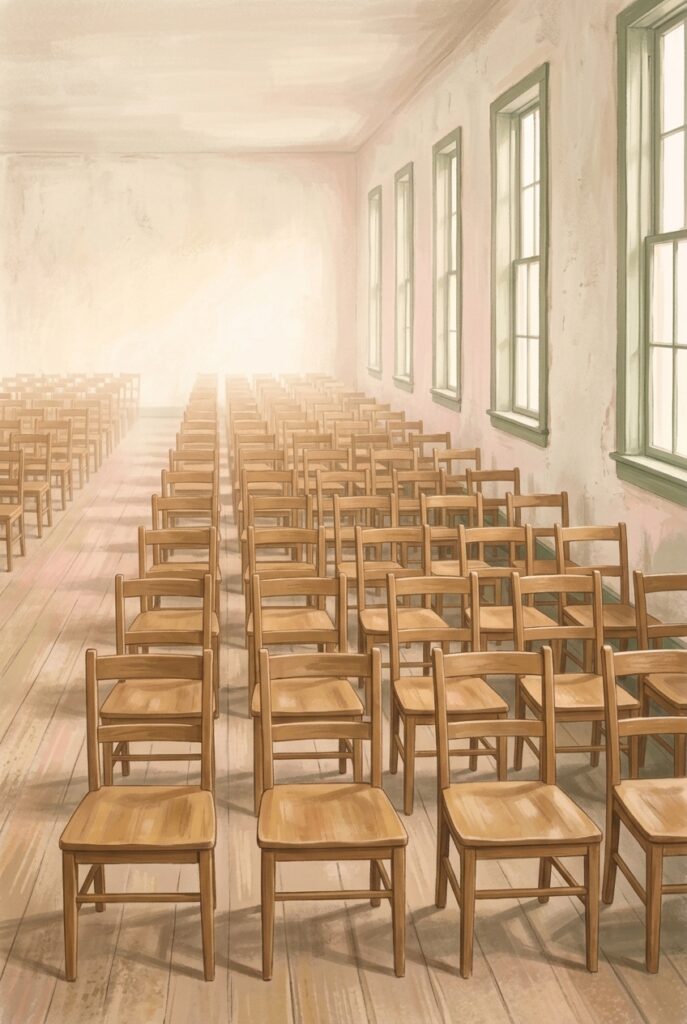
A great multitude, which no man could number. John is shown an enormous crowd and told almost nothing about it, except the one thing that turns out to matter most: nobody can count it.
A great multitude, which no man could number. John is shown an enormous crowd and told almost nothing about it, except the one thing that turns out to matter most: nobody can count it.
Watch the order of the chapter, because the order is the whole argument. Before that crowd appears, this same vision counts with extraordinary care.
An angel seals the servants of God on their foreheads, and the total is given exactly. A hundred forty-four thousand. Then it goes tribe by tribe, saying twelve thousand twelve separate times, until the arithmetic has been performed out loud in front of us.
That is a complete register. Twelve tribes, twelve thousand each, sealed, sorted, filed.
And then the chapter turns, and there is a multitude which no man could number, and every category the register used has vanished.
Of all nations, and tribes, and peoples, and tongues. Not the twelve tribes. All tribes, and then straight past tribes into peoples and tongues, which are not administrative units at all.
So Apocalypse gives us both, deliberately, in that sequence. First the crowd you can account for, then the crowd which no man could number, and the second one is described as great while the first one is merely described as accurate.
I want to sit in that gap all morning, because our whole instinct runs the other way. We trust the countable crowd. It has a list, and a list can be checked. A multitude which no man could number cannot be checked, and so we quietly file it as poetry.
Here is where today’s feast enters, and the honest history is better than any sermon I could build on top of it. This day exists because the counting broke down.
In the early centuries each martyr was kept on the anniversary of their death, at their own grave. That worked while the names were few. Then the names stopped being few, and, in the plain words of the Catholic Encyclopedia, a separate day could not be assigned to each.
Read that sentence as the administrative failure it was. The calendar ran out of days. There were three hundred and sixty-five slots and a multitude which no man could number, and no arrangement of the year could ever be made to fit.
So the Church stopped trying to fit them in, and gave one whole day to a multitude which no man could number. Gregory the Third consecrated a chapel in the basilica of Saint Peter to all the saints and fixed the anniversary on the first of November, and Gregory the Fourth, a century later, extended that celebration to the whole Church.
One day, for everyone unlisted. That is what we are keeping this morning.
And notice what the Collect asks on the strength of it. As our intercessors are thus multiplied, Thou wouldst bestow upon us the desired abundance of Thy mercy.
Multiplied. Not identified, not verified, not enumerated. The prayer treats an uncountable company as an increase rather than a problem, and it asks for mercy in proportion to a multitude which no man could number.
Now I have to name the teaching that stands against all of this, because it is quiet, respectable, and everywhere.
The teaching is that holiness has to be documented. To count as one of the saints, there should be a record: witnesses, a written life, a cause, a name that survived, ideally a grave someone can find. Where there is no file, the assumption runs the other way, and a life that left no paperwork is treated as a life that probably came to nothing.
Nobody says it in those words. It travels as atmosphere, in whose portraits hang in the corridor and whose stories get retold, and it works like an entrance requirement.
Apply the fruit test to it. Judge it by what it produces in real lives rather than by how reverent it sounds. Ask what it grows in somebody who belongs to the multitude which no man could number.
What it produces is a tiered afterlife with an archive attached. The documented at the front, the remembered in the middle, and at the back the multitude which no man could number, present in the text and absent from our imagination, because we cannot picture people we cannot list.
And the Epistle will not permit that ranking. The crowd in white robes with palms in their hands is not a lower tier appended to the register. It is the larger vision, given more words, and it arrives precisely when counting stops. The multitude which no man could number is where the chapter was going the whole time.
I will say plainly who the documentation rule injures, because today’s own text hands me the words for it.
Consider the people who die unhoused. In cities across this country there are burial fields where the dead who went unclaimed are laid in level rows under small flat markers, sometimes bearing a case number rather than a name, because no name was ever confirmed. There is a paperwork answer for what happened to them, and it is the thinnest possible answer, and it is all the record there is.
Hear what the documentation rule does to that. It takes people who were already uncounted while they were alive, unhoused and uncounted in the same motion, and it carries the shortage of records forward into eternity as though it were evidence about their souls. That arithmetic gets run on the multitude which no man could number every time we let silence stand in for absence.
Apocalypse says the opposite, and it says it in the vocabulary of counting itself. The multitude which no man could number is standing before the throne, robed, holding palms, which are what you carry in a victory procession.
The same goes for anyone whose family declined to claim them. It happens more than we admit, and it leaves a person with no obituary, no service, and no one to correct the record afterward. A missing file is not a verdict, and today the missing files are the feast.

There is a story sometimes told of a woman who volunteered for years at a winter memorial for people who had died outside in her city, an evening service where the names from the past twelve months were read aloud. Her one job was to hold the list and pass it to whoever was reading.
One year the list came to her with a gap in it. A man everyone at the shelter had known for six or seven years had died in October, and no legal name for him had ever been established, only the nickname everybody used.
The office had left the line blank, because a blank is what the procedure produces when the field cannot be filled. She wrote the nickname in by hand, in pen, and it was read aloud with the rest.
I think about that pen more than almost anything else I could tell you about this feast. The record was incomplete and it stayed incomplete; she did not fix the archive, and the archive is still wrong today.
What she did was refuse to let the gap in the file become a gap in the reading. That is the entire liturgical instinct of All Saints, performed by one volunteer with a biro, on behalf of a multitude which no man could number.
Now turn to the Gospel, because Christ builds the same thing and builds it more radically.
The Beatitudes name nobody. Not one person is identified, from beginning to end.
Blessed are the poor in spirit. Blessed are the meek. Blessed are they that mourn. These are descriptions, not a roster, and every single one of them is in the plural.
Then look at what is promised, and at the grammar of the promising. They shall be comforted. They shall have their fill. They shall obtain mercy. Every verb is passive, which means the blessing is something done to these people rather than something achieved by them.
So Christ, sitting on that mountain, describes the multitude which no man could number without naming a single member of it. He gives the criteria and withholds the list, and the withholding is not an oversight.
A list closes. Criteria stay open, and anyone who fits walks in, whether or not anybody wrote it down. That is how you end up with a multitude which no man could number instead of a guest list.
Blessed are they that mourn: for they shall be comforted. No stipulation about who is doing the mourning, or whether the death was recorded properly, or whether the mourner is on any register anywhere.
And there is one more thing in the Gospel that belongs to the unnamed specifically. Blessed are ye when they shall revile you, and persecute you, and speak all that is evil against you, untruly, for my sake.
Untruly. Christ blesses people about whom the record is actively false, which is a different case again from a record that is merely missing. Some in that multitude which no man could number went to their graves with the wrong story attached to their names.
The Gradual has already said the same thing more gently. Fear the Lord, all ye his saints: for there is no want to them that fear him.
All ye his saints. The Church sings that line this morning to a congregation it cannot enumerate, and the promise attached to it is not fame. It is that nothing will be lacking, which is precisely what the uncounted are usually short of. Nothing lacking, promised to a multitude which no man could number.
Then the Alleluia opens the door as wide as it goes. Come to me, all you that labour, and are burdened, and I will refresh you.
All you that labour. No qualification, no application, and no register at the door, which is how a multitude which no man could number comes into existence in the first place.
For anyone here who holds none of the theology, this translates with nothing lost at all. Whether a life mattered is not settled by how much of it got written down, and treating the survival of records as evidence about the worth of persons gets the causation exactly backwards.
Records survive for reasons that have almost nothing to do with goodness. Wealth, literacy, an address, a family willing to keep the paperwork, and the plain luck of somebody’s attention. The multitude which no man could number is largely made of people who had none of those advantages, which is a fact about filing systems rather than a fact about souls.
Say the practical version out loud. If you are quietly convinced that your life does not count for much because nobody is keeping any account of it, the accounting is what is missing, not the life. You would not be the first, and you would be one more in a multitude which no man could number.
And this is the day the Church says so on purpose. It could have chosen to honour only the documented, and it went the other way, and it ranked a multitude which no man could number above every individual name in the year.
First class, white vestments, on a Saturday in November, for a multitude which no man could number and a single Mass to hold them all.
So here is what I would have you carry out of this. Somebody in your life is uncounted right now, in the ordinary sense: unthanked, unrecorded, not on any list of people who did something that mattered.
You cannot repair the archive, any more than the woman with the pen could. You can read the name aloud.
That is the whole practice this feast asks for, and it takes about four seconds. Say the name of somebody nobody is counting, today, and you have joined the only liturgy that has ever managed to include a multitude which no man could number.
↑ The order resumes below.
VIII
Secret
We offer unto Thee, O Lord, the gifts of our devotion: may they be pleasing to Thee in honour of all the just, and, through Thy mercy, profitable unto our salvation. Through our Lord Jesus Christ, Thy Son, Who liveth and reigneth with Thee in the unity of the Holy Ghost, God, world without end. Amen.
IX
The Holding
(Benediction, two readings, one truth)
For those who hold this in faith:
Lord, You have never once required a paper trail. Bless everyone reading this who believes their life left no mark worth keeping, and let them find themselves standing in the multitude which no man could number, robed, holding a palm, entirely unsurprised.
Remember the dead nobody claimed, the graves marked with numbers, and the names that were never written down at all. Where we have honoured only what was recorded, widen us. Through Christ our Lord. Amen.
For those still finding their footing:
Nobody is keeping score of you, and that is not the same as nobody caring. The record of a life is not the measure of it, and the reasons some lives got written down are mostly reasons of money, address, and luck.
If you have gone uncounted, you are in enormous company, and the oldest liturgy in this tradition set aside its highest rank for exactly that company. Today, say one name out loud that no list contains.
X
Frequently Asked Questions
Scripture citations follow the Douay-Rheims Bible, Bishop Challoner revision, the standard English scripture translation used across traditional hand missals. Introit, Collect, Gradual and Secret: the Missale Romanum (1962), feast of All Saints, following The New Marian Missal for Daily Mass by Sylvester P. Juergens, S.M., S.T.D. (Regina Press, Imprimatur 1961). Historical detail on the origin of the feast follows the Catholic Encyclopedia.
Faith in Bloom offers this reflection in the spirit of the traditional Roman Rite, a daily offering rather than a Mass, welcoming all people, of every faith background, into the shelter of the Word.
