

Daily Offering · 7 November 2025 · Feria
Daily Offering: November 7, 2025 | Simple and Upright
Good morning, and welcome. Today is Friday, the seventh of November, the Feria VI after the Twenty-First Sunday after Pentecost. The vestments are green. There is no saint on the calendar today and no commemoration attached to the Mass, which means the Church hands…
The order of this offering
Before the readings
Offering and Canon
I
Opening Address
Good morning, and welcome. Today is Friday, the seventh of November, the Feria VI after the Twenty-First Sunday after Pentecost. The vestments are green. There is no saint on the calendar today and no commemoration attached to the Mass, which means the Church hands us the Sunday’s own texts one more time, unchanged, and then sings one sentence over the bread and wine that calls a ruined man simple and upright without explaining itself.
I want to be plain about what kind of day this is, because it is the fourth time these readings have come round in six days. Nothing has been added. Nothing has been transferred into this date from somewhere else. The Mass is the same Mass, and if you have been with us all week you have heard the Epistle and the Gospel already.
So today we are going where we have not yet been. The Offertory antiphon of this Mass is taken from the Book of Job, and it is the one text in these propers that has not yet had a word said about it. It calls Job simple and upright. Then, in the same sentence, it tells you what happened to him.
That sentence is the whole offering today. It is short, it is strange, and the thing that makes it strange is a single ordinary word that most people read straight past. Hold on to the phrase simple and upright as we go, because everything today turns on what the Church does and does not attach to it.
II
A Word on Today’s Propers
Today is a ferial continuation. That is a technical phrase for something simple: on a weekday with no feast of its own, the Church keeps saying the previous Sunday’s Mass. The Introit, the Collect, the Lesson, the Gradual, the Gospel, the Offertory, the Secret, the Preface, the Communion and the Postcommunion of this Friday are the ones assigned to the Twenty-First Sunday after Pentecost, and every one of them was compared against the earlier days rather than assumed to match.
The result is that this Friday is liturgically identical to Thursday, and identical to Wednesday, and identical to the Sunday itself in all but nothing at all. Every proper matches. That is unusual enough to say out loud.
Because the scripture has already been printed in full here three times, it is not printed a fourth. The Epistle and the Gospel are cited and linked below, and the full text sits where it first appeared, in the Sunday Mass of November 2, which is also where the Gospel of the unforgiving servant is handled at length. Wednesday’s offering on the armour took up the Lesson, and it is there under not against flesh and blood. Thursday’s offering took up the Introit, and it is there under none that can resist thy will.
What is left is the Offertory. It is the one proper of this Mass that no offering has yet touched, and it turns out to be the most peculiar text of the ten. It calls a man simple and upright and then describes the destruction of everything he had, and it puts both halves inside one breath.
III
The Introit
(Esther 13:9, 10, 11; Ps. 118:1)
In Thy will, O Lord, are all things, and there is none that can resist Thy will: for Thou hast made all things, heaven and earth, and all things that are under the cope of heaven: Thou art Lord of all. Blessed are the undefiled in the way: who walk in the law of the Lord.
The entrance chant is unchanged from yesterday, and yesterday’s offering read it through the man who first prayed it. Today it stands as the frame around a second man who was also called simple and upright while everything around him came apart. Two men, four days apart in this Mass, both described as simple and upright at the exact hour their world was being taken apart.
IV
The Collect
Keep, we beseech Thee, O Lord, Thy household with continual pity: that it may be freed by Thy protection from all adversities, and devoted in good works to the glory of Thy name. Through our Lord.
The prayer asks for two things and holds them apart. It asks to be kept from harm, and it asks to be given over to good works. It does not claim the second is a way of guaranteeing the first, and a household of simple and upright people is not promised an easy week. Protection is asked for here, never assumed, which is a very different prayer from one that treats safety as a receipt.
V
The Epistle
The Lesson is unchanged and is not reprinted here. Saint Paul tells the Ephesians that our wrestling is not against flesh and blood, and every piece of equipment he names is defensive. Nothing in the passage asks a simple and upright person to be strong on their own account, and the one weapon in the list is not theirs. Standing still is the whole instruction, which is roughly what a simple and upright man does for thirty-nine chapters of the book we are about to open.
VI
The Gradual
(Ps. 89:1-2; Ps. 113:1)
Lord, Thou hast been our refuge from generation to generation. Before the mountains were made, or the earth and the world was formed: from eternity and to eternity Thou art God. Alleluia, alleluia. When Israel went out of Egypt, the house of Jacob from among a barbarous people. Alleluia.
The Gradual reaches back before the mountains and then, in the Alleluia verse, forward into a nation walking out of a country. Both halves are about duration. Whatever a simple and upright person is in the middle of this morning, it is not the longest-standing fact in the room. The refuge is older than the trouble and it outlasts the trouble.
VII
The Gospel
The Gospel is unchanged and is not reprinted here. A servant owing ten thousand talents is forgiven the whole debt before he has repaid a coin of it, and then goes out and takes a hundred denarii off a man by the throat. What the master gives is given ahead of any evidence, which is the same order of events the Offertory will use about a simple and upright man in a moment. Mercy first and accounting afterward, with the description printed before a single thing has been lost.
The Offering
Daily Homily | Simple and Upright
Here is the sentence the Church sings today while the bread and the wine are carried up.
Here is the sentence the Church sings today while the bread and the wine are carried up.

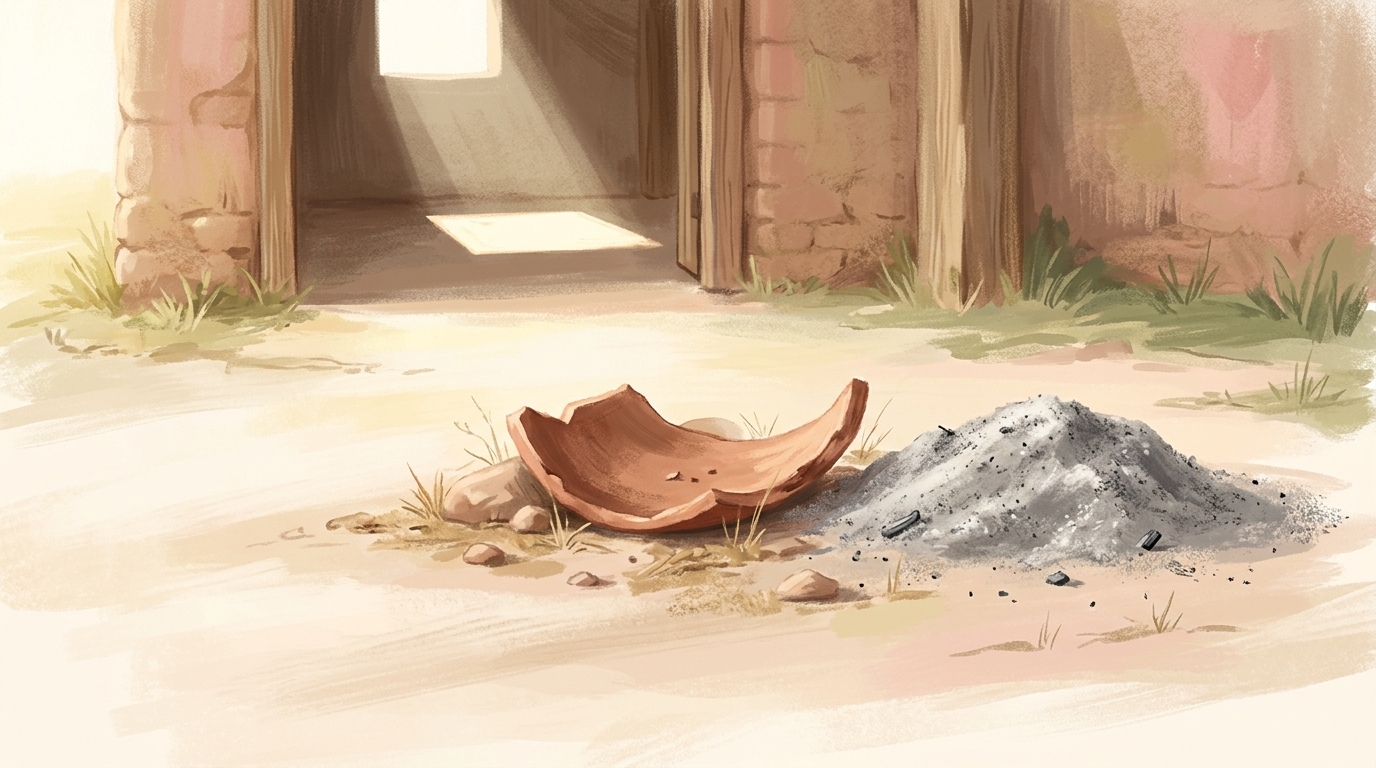
There was a man in the land of Hus, whose name was Job, simple and upright, and fearing God: whom Satan besought that he might tempt: and power was given him from the Lord over his possessions and his flesh; and he destroyed all his substance and his children, and wounded his flesh also with a grievous ulcer.
Read it again slowly, because that sentence does not exist anywhere in the Bible. The Missal built it. The first clause is Job 1:1, where the Douay reads that “that man was simple and upright, and fearing God, and avoiding evil.” The permission given to Satan comes from later in that same chapter. The ulcer comes from Job 2:7, a chapter later still, where he is struck “from the sole of the foot even to the top of his head.”
Somebody stitched those pieces together on purpose. Somebody decided that at the Offertory, the moment when everyone in the room has something in their hands to bring forward, the congregation would sing about a man who had nothing left. And that person made one editorial decision that carries the whole day.
Look at the joints. Simple and upright, and fearing God, and power was given him, and he destroyed all his substance, and wounded his flesh. Every hinge in that sentence is the word and.
There is no but. There is no yet. There is no because, and there is no therefore, and there is no nevertheless. The Church laid a man’s goodness and a man’s wreckage end to end and joined them with the flattest conjunction in the language. A simple and upright man and a destroyed household, laid end to end, with no seam between them.
That refusal is not an accident, because the entire Book of Job is a forty-two chapter argument about which conjunction belongs there. Job’s three friends arrive and spend the length of the book insisting on because. The Catholic Encyclopedia states their position without softening it: “The three friends are fully convinced that trouble is always a result of wrongdoing. They consider Job, therefore, a great sinner and stigmatize his assertions of innocence as hypocrisy.” They are not cruel men by their own lights. They are men with a working theory, and the theory requires that a simple and upright man in that condition cannot actually be a simple and upright man.
You can see why the theory is attractive. It makes the world readable. If suffering follows wrongdoing the way smoke follows fire, then you can look at a person’s life and know something true about their conduct, and better than that, you can look at your own life and feel safe. A rule that explains other people’s disasters is also a rule that promises to keep you out of them.
That teaching has a record inside Christianity, and the record is what we judge it by. It is the teaching that has told sick people their illness is an unconfessed sin. It has told poor people that their poverty is laziness with a pious name on it. It has told the bereaved that the child would have lived with more faith, and it has told women in dangerous houses that the danger is a lesson. Judge it by what it grows, and what it grows is a person who is already flattened being handed a reason to be ashamed.
And a simple and upright person, in that situation, learns very quickly to stop talking.
There is a story sometimes told of a woman who spent four years caring for her mother in the back bedroom of a small house. The money went first, then the job, then most of the friendships. What she remembered afterward was not the work. It was the visitors, who came in two kinds.
The first kind arrived with an explanation. This was a season. This was preparation. This was what happens when you take on more than you were called to.
One of them asked, kindly, whether she had considered that the whole situation might be teaching her something about control. She said she nodded and made the tea and counted the minutes. Not one of them ever managed the only true sentence available, which was that she was simple and upright and having a terrible year.
The second kind was one woman from two streets over who came on Thursdays. She never said what any of it meant. She carried a chair in from the kitchen, sat down in the doorway where she could be seen from the bed, and stayed about an hour. Sometimes she washed what was in the sink on her way out. That was the entire visit, every Thursday, for two years.
The first kind of visitor was supplying a because. The second was supplying an and. She sat in a room with a wrecked household and did not attach a cause to it, and that is the harder thing to do, because leaving the conjunction alone means admitting you do not know.
Job’s friends managed it once. Before any of them opened their mouths, they sat with him on the ground seven days and seven nights, “and no man spoke to him a word: for they saw that his grief was very great.” That week is the best thing they ever do. Everything that goes wrong in the next thirty-five chapters goes wrong the moment somebody starts explaining. For seven days they treated him as simple and upright and did not once ask him to prove it.
Now hold the antiphon next to the Gospel of this same Mass. The master forgives ten thousand talents before the servant has produced anything at all, and the fellow-servant is throttled in the yard by a man who has already been let off. That mercy comes first and gets no explanation either. The verdict runs ahead of the evidence in both texts, which is why the Church can put them in one Mass without straining. Forgiven before he paid, simple and upright before he lost anything, and in neither case does the sentence arrive as a reward.

Notice too what simple and upright does not say. It does not say Job was calm. It does not say he was quiet, or patient in the way the phrase is usually thrown at people, or careful with his words.
He curses the day he was born. He accuses God to God’s face and demands a hearing. The description was given before any of that and it is not withdrawn after it, so whatever being simple and upright means here, it plainly does not mean composed.
That matters for anyone who has been told their grief was a failure of faith. The man the Church holds up at the Offertory is not the man who took it well. He is the man who took it badly, out loud, at length, and kept the description anyway. Simple and upright survived the shouting, which means it was never a wage for good behaviour under pressure.
And if you do not believe any of the theology in this, the ethical claim underneath it stands on its own and does not need a word of it. You cannot read a person’s worth off their circumstances. The inference does not work, it has never worked, and the confidence people feel when they make it is not evidence of anything except how much they want the world to be fair. Refusing to make that inference is a discipline, and it is available to anybody.
There is a version of that discipline we practice here every time somebody is remembered by name without their file being read out first, which is what we said on the day of eternal rest give to them. There is another version in the parable of the talents, where the master hands out sums calibrated to what each man can carry and settles the question of fairness before he asks anyone for anything, which is what we said under faithful over a few things.
Today’s version is smaller and harder. It is one word, and the discipline is leaving it alone.
So when you come to the offering this morning, whatever is in your hands, bring it up under that antiphon. The Church is not going to tell you why your year has gone the way it has gone. She is going to sing and, and she is going to keep calling you what she called you before it started. Simple and upright, and the year you are having, joined by nothing but a conjunction.
↑ The order resumes below.
IX
The Secret
Grant, we beseech Thee, O Lord, that this oblation may cleanse us from sin, and may make Thy servants pure in body and mind. Through our Lord.
The prayer over the gifts asks for cleansing, not for an explanation, and the request is made by simple and upright people who have not been told why the week went the way it did.
X
The Holding
For those who pray: may God keep the description He has already given you, and may He keep it when your health does not hold, when the money does not hold, and when your own words about Him come out badly. May you be simple and upright on a bad Friday and know that nothing about the Friday touches it. May the Lord who was your refuge from generation to generation be your refuge this Friday. And may He send you somebody on a Thursday who carries in a chair and explains nothing.
For everyone else, and the same thing said without the theology: nothing that has happened to you is a statement about what you are. The people who read your circumstances and hand you back a verdict are guessing, and their guess is built to make them feel safe rather than to describe you. You can be simple and upright and still be having the worst year of your life, and both halves are true at the same time. You are allowed to leave the question of why unanswered and still be exactly what you were before the year started. And you are allowed to be the person in the doorway with the chair.
Go in peace.
The propers of this Mass are those of the Feria VI after the Twenty-First Sunday after Pentecost in the 1962 Roman Missal, following The New Marian Missal for Daily Mass compiled by Sylvester P. Juergens, S.M., S.T.D. (Regina Press, imprimatur 1961). Scripture is quoted from the Douay-Rheims. Faith in Bloom is offered by Bloom Ministries in the Independent Catholic tradition, and is not affiliated with or recognized by the Roman Catholic Church.
