
Daily Offering · 13 November 2025 · Feria
Daily Offering: November 13, 2025 | He Hath Begun a Good Work in You
Good morning, and welcome to the Daily Offering for Thursday, the thirteenth of November. Today is a fourth-class feria, green, the fifth weekday after the twenty-second Sunday after Pentecost, and it has no feast of its own. It takes that Sunday’s Mass entire, with…
The order of this offering
Before the readings
Offering and Canon
I
Opening Address
Good morning, and welcome to the Daily Offering for Thursday, the thirteenth of November. Today is a fourth-class feria, green, the fifth weekday after the twenty-second Sunday after Pentecost, and it has no feast of its own. It takes that Sunday’s Mass entire, with one commemoration laid over it: St. Didacus, a Franciscan lay brother who kept a gate, kept an infirmary, and left no writings behind him. And the Lesson appointed for this unremarkable Thursday says that God hath begun a good work in you.
That is the sentence I want to hand you before anything else. Not that you should finish something. That someone else has begun a good work, and the finishing is on him.
There is no drama in today’s calendar. Nobody is crowned, nobody is martyred, no octave is running, no vigil is kept. The green vestments mean only that the year is going on, which is the condition most of our days are lived in.
Today’s Gospel is the one about the coin, and I want to say plainly at the start what this offering does with it. It does not treat the coin as a rule about governments, laws, or anybody’s obligations to anybody’s treasury. It stays with the metal itself, because that is what Christ actually picks up, and it asks his two questions about the metal: whose likeness is stamped on this, and whose name is written round the edge.
Those two questions turn out to be the whole day. And the Lesson answers the second half of them with something unfinished.
II
Introit
Ps 129:3-4
If thou, O Lord, wilt mark iniquities: Lord, who shall stand it? For with thee there is merciful forgiveness, O God of Israel.
Out of the depths I have cried to thee, O Lord: Lord, hear my voice.
Glory be to the Father, and to the Son, and to the Holy Ghost. As it was in the beginning, is now, and ever shall be, world without end. Amen.
If thou, O Lord, wilt mark iniquities: Lord, who shall stand it? For with thee there is merciful forgiveness, O God of Israel.
(The antiphon is the third and fourth verses of Psalm 129, the De profundis, with the psalm’s opening verses sung beneath it. The closing address, “O God of Israel,” belongs to the Missal’s arrangement of the antiphon rather than to the psalm text.)
III
Collect
O God, our refuge and our strength, who art thyself the author of all godliness, be attentive to the devout prayers of thy Church, and grant that what we ask in faith we may obtain in fact. Through our Lord Jesus Christ, thy Son, who liveth and reigneth with thee in the unity of the Holy Ghost, God, world without end. Amen.
IV
The Commemoration
Commemoration of St. Didacus, Confessor.
Almighty and everlasting God, who by thy wonderful ordering dost choose the weak things of the world to confound the strong: mercifully grant unto our lowliness that, by the loving prayers of blessed Didacus thy Confessor, we may be found worthy to be raised to everlasting glory in heaven. Through our Lord Jesus Christ, thy Son, who liveth and reigneth with thee in the unity of the Holy Ghost, God, world without end. Amen.
Didacus was born at San Nicolas del Puerto to poor parents, and the year is not recorded. His parents put him under the direction of a hermit. He asked to be admitted to the Franciscans at the convent of Arizafa and was received as a lay brother, which is to say he was never ordained and never held office in the ordinary sense.
In 1445 he was chosen guardian of the Franciscan community on the Canary island of Fortaventura. Later he was infirmarian at the convent of Ara Coeli in Rome, which means his work was the bodies of sick men. He died at Alcalá, in Spain, on the twelfth of November, 1463, and Sixtus V canonized him in 1588.
His own order keeps him on the twelfth, the day he died. The universal calendar of 1962 keeps him here, on the thirteenth, the day after the pope who died in exile that yesterday’s offering was built on. Two calendars, one man, a day apart.
The Collect for him asks for something very particular, and it is the same thing the Lesson will say in a minute. It does not ask that the weak be made strong. It asks that God keep choosing them, which is a claim about who is doing the work.
V
Epistle
Lesson from the letter of blessed Paul the Apostle to the Philippians, 1:6-11
Brethren: Being confident of this very thing, that he, who hath begun a good work in you, will perfect it unto the day of Christ Jesus. As it is meet for me to think this for you all, for that I have you in my heart; and that in my bands, and in the defence and confirmation of the gospel, you all are partakers of my joy. For God is my witness, how I long after you all in the bowels of Jesus Christ.
And this I pray, that your charity may more and more abound in knowledge, and in all understanding: that you may approve the better things, that you may be sincere and without offence unto the day of Christ, filled with the fruit of justice, through Jesus Christ, unto the glory and praise of God.
VI
Gradual
Ps 132:1-2
Behold how good and how pleasant it is for brethren to dwell in unity.
Like the precious ointment on the head, that ran down upon the beard, the beard of Aaron.
VII
Alleluia
Alleluia, alleluia.
They that fear the Lord have hoped in the Lord: he is their helper and their protector. Alleluia.
(The Gradual is the opening of Psalm 132. The Missal cites the Alleluia verse as Psalm 113, verse 11; the wording stands at verse 20 in the Douay’s numbering of that psalm.)
VIII
Gospel
Continuation of the Holy Gospel according to St. Matthew, 22:15-21
At that time: Then the Pharisees going, consulted among themselves how to insnare him in his speech. And they sent to him their disciples with the Herodians, saying: Master, we know that thou art a true speaker, and teachest the way of God in truth, neither carest thou for any man: for thou dost not regard the person of men. Tell us therefore what dost thou think, is it lawful to give tribute to Caesar, or not?
But Jesus knowing their wickedness, said: Why do you tempt me, ye hypocrites? Shew me the coin of the tribute. And they offered him a penny. And Jesus saith to them: Whose image and inscription is this? They say to him: Caesar’s. Then he saith to them: Render therefore to Caesar the things that are Caesar’s; and to God, the things that are God’s.
The Offering
Daily Homily | He Hath Begun a Good Work in You
Start with what they say to him, because every word of it is true.
Start with what they say to him, because every word of it is true.

They tell him he is a true speaker. He is. They tell him he teaches the way of God in truth. He does.
They tell him he does not regard the person of men, and that is the most accurate sentence anybody says about Jesus in the whole chapter. Three true statements, arranged into a snare.
That is worth sitting with for a moment, because we are trained to look for the lie. There isn’t one. A description can be entirely accurate and still be built as a trap, and the trap is not in the description; it is in what the question after it is for.
And the question after it is a closed door with two handles. Say the tribute is lawful and he loses the crowd. Say it is unlawful and he is a rebel in front of witnesses. There is no third answer available in the terms offered, which is precisely the design.
He does not take either handle. He asks for the coin.
I want to be slow here, because this is the hinge and it is easy to read past. Shew me the coin of the tribute. He does not have one. The thing the entire argument is about is not in his pocket; it is in theirs, and he has to ask them to produce it. They do, immediately. The coin was on them the whole time they were asking whether it was permitted.
Then he asks two questions about the piece of metal, and neither of them is the question he was asked. Whose image and inscription is this? Not: is this lawful. Not: what does the law say. Whose face is on it, and whose name is written on it.
He has changed the test. The question came in as a question about permission and he answers it as a question about likeness. Render to Caesar the things that are Caesar’s, and you can tell which those are by looking at whose picture is stamped on them.
And then the sentence does something I find almost unbearable in its restraint. And to God, the things that are God’s. He names no object. The first half of the sentence has a coin in it. The second half has a blank where the coin should be, and he walks away without filling it in.
The Lesson set for the same day fills it in. He who hath begun a good work in you will perfect it unto the day of Christ Jesus.
Hold that sentence, because the rest of the day turns on it. He hath begun a good work in you.
That is the answer, and look at what kind of answer it is. The thing that carries God’s likeness is not a finished article. It is a work in progress. Not a coin, minted, stamped, cooled, complete, ready to be handed over. Something still on the bench.
He hath begun a good work in you, and nobody clears a bench of work still in hand.
He hath begun a good work in you. Begun. The word is doing enormous labour there.
Not completed a good work. Begun a good work, which is a different report entirely.
Now look at who is holding the tools in Paul’s sentence, because the grammar decides the theology. He, who hath begun a good work in you, will perfect it. One subject, two verbs, and the subject is not you. You are where the work is happening. You are not the one doing it.
He hath begun a good work in you. You are the you in that sentence and not the he.
Keep going and it holds all the way down. Paul does not command anybody in these six verses. He prays. And this I pray, that your charity may more and more abound. May abound, not: make it abound. That you may approve the better things. That you may be sincere and without offence. Filled with the fruit of justice, filled by someone, the passive sitting there in the open.
Six verses, and not one order given. Whoever hath begun a good work in you is the only one working.
Nobody here is told to finish anything, because he who hath begun a good work is the one who finishes it.
This matters because of what the alternative reading costs people. If the day of Christ is a deadline, then an unfinished life is a failed one, and everybody living in the middle of a change is living on borrowed time. The Lesson refuses that arithmetic. It puts the day of Christ at the end of a sentence whose subject is God, and it calls the current state of you a good work already underway.
He hath begun a good work in you. Past tense on the beginning, future tense on the end, and neither tense is yours.
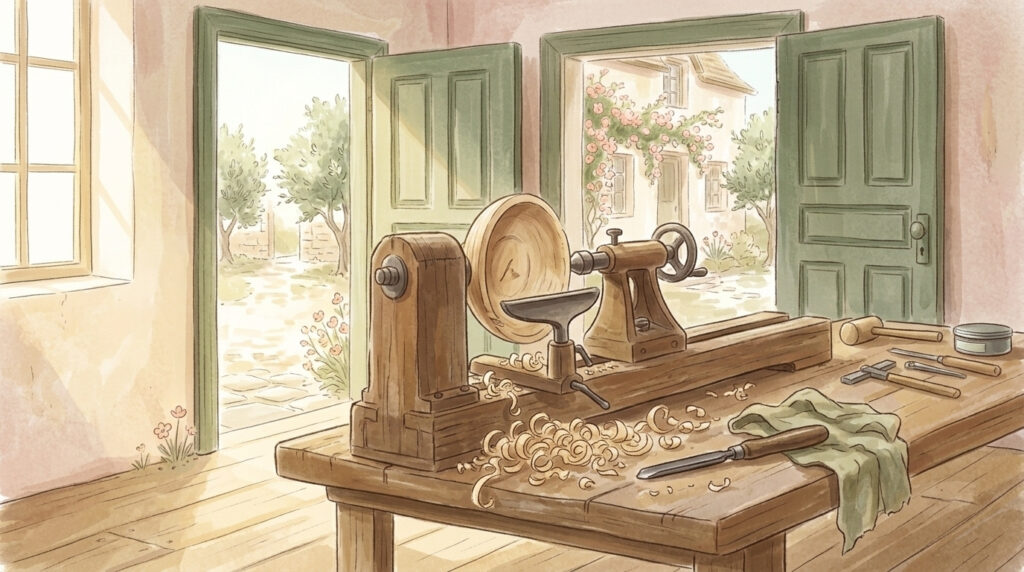
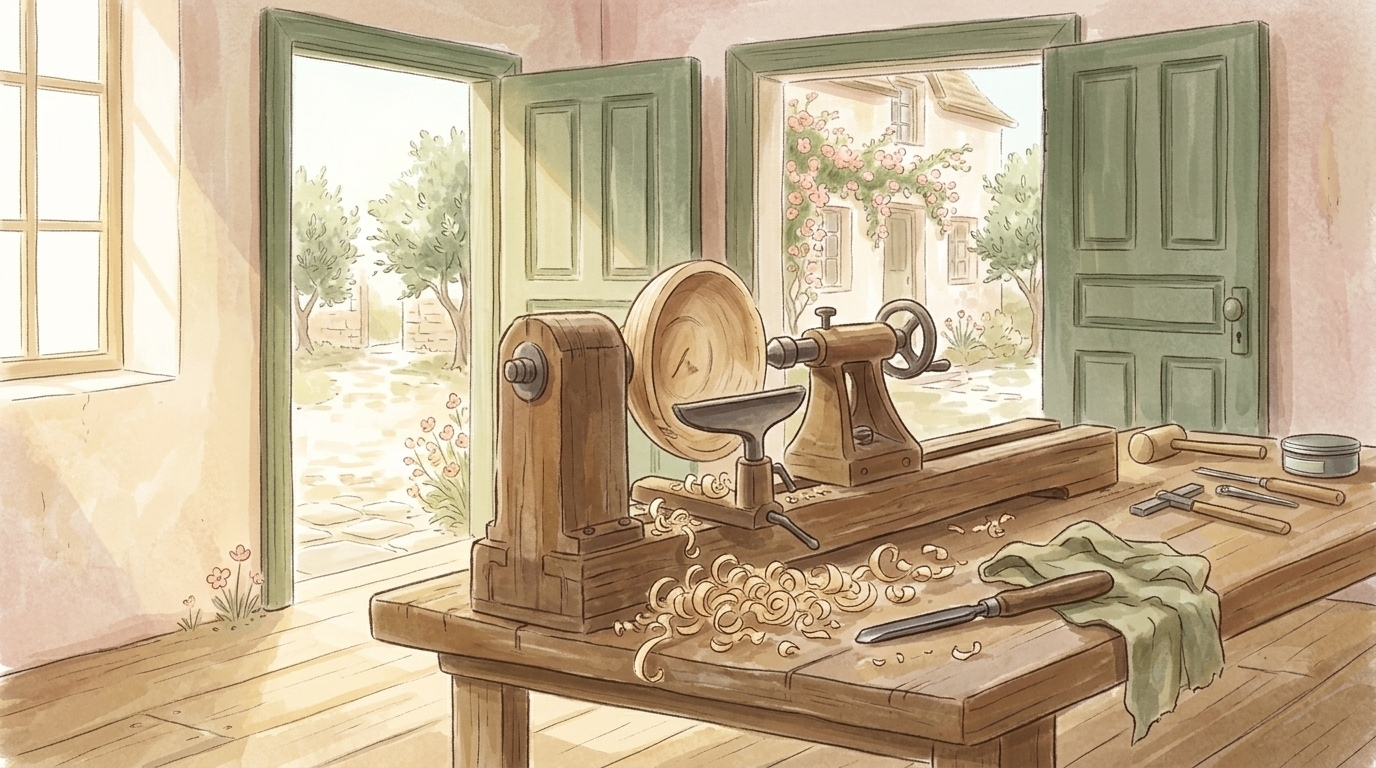
Which is to say, in plain terms and without needing any of the theology: you do not have to be finished to be worth something. The half-turned bowl on the lathe is not a failed bowl. It is a bowl being made, and it is already the thing it is going to be, in the way that a thing being made always already is.
He hath begun a good work in you, and half-made is a description rather than a grade.
He hath begun a good work in you. Not: he will begin one when you are ready.
(An aside on the word the Douay uses, because it belongs to the same field as the coin: not “upright,” which is how we usually hear it, but “sincere.” Unmixed. Nothing else stirred in. A metal, not a manner.)
So the whole day sits in one field, and the field is making rather than measuring. Image, inscription, likeness, begun, perfected, filled, sincere in the sense of unalloyed.
Every load-bearing word in today’s texts belongs to a workshop and not to a courtroom.
Read in a workshop, the sentence goes easily. He hath begun a good work in you.
And in a workshop, unfinished is not a verdict. It is a stage.
This is where I want to name who this is for, because the text has done the work of earning it. The teaching that has to be evaluated here is the one that says a person must be complete before they can be counted: that belonging waits on arrival, that you are provisional until the process is over, and that the church can hold its blessing in escrow until then.
There is no escrow in Philippians. He hath begun a good work in you, and the blessing is already released.
That teaching lands hardest on trans people, and it lands there constantly. Not far enough along. Not settled. Ask again in a few years. There is always one more threshold, and the threshold moves.
He hath begun a good work in you, and the sentence has no threshold in it anywhere.
I named trans people eight days ago as well, and the claim was a different one, so let me say what the difference is rather than repeat myself. That day the passage was Ephesians and the harm was being called a battle, a darkness, a thing for other people to resist. Today the harm is gentler in tone and heavier in effect: not you are the enemy but you are not done yet, said kindly, said pastorally, said as though it were patience. It is not patience. It is a way of never having to say yes.
He hath begun a good work in you is a yes. It is said once, in the past tense, about work already started.
And the fruit test settles it, applied where Bloom always applies it, to Christianity’s own record. What has that teaching actually grown? People who cannot rest. People who audit themselves for signs of sufficient progress. People who leave, not in anger, but because provisional is not somewhere anyone can live for thirty years.
Whereas he who hath begun a good work in you says the opposite thing about the same unfinished life. It says the work is his, it is good, and it is already begun.
He hath begun a good work in you. Nothing in that clause waits on you catching up.
There is a story sometimes told of a woman who lived in her car for a year and eight months, parked most nights at the far edge of a supermarket lot where the lights were dim enough to sleep under. She had a glove box with the registration in it, an envelope of receipts, and one library card. Every twelve months she drove to the branch on the ring road and had it renewed, in the years she had no shelves to put a book on and no address to send an overdue slip to.
The librarian never asked her why. She would slide the old card across, they would type, and she would put the new one back in the glove box on top of the registration, and drive off.
He hath begun a good work in you, and some people keep their evidence of it in a glove box.
Here is what I think that card was. It was the only piece of card in the world with her name spelled the way she spells it. Everything else had a version of her on it: an old surname on the insurance, an initial where a name should be, a misspelling nobody would correct because nobody who mattered was reading it. The card had her, exactly, and she owned it, and she kept it current.
I am not going to tell you that ended well, because I do not know that it did, and a card is not a house. Nothing in this story gets fixed. She was still in the car in the spring.
He hath begun a good work in you does not promise a spring. It promises a maker who has not stopped.
But there is a reason it belongs beside this Gospel. Whose image and inscription is this? Half of what the world stamps on a person is somebody else’s spelling of them, and Christ’s own answer to what he is asked about people is that he does not regard the person of men. He does not price anybody by the inscription somebody else put on them.
He hath begun a good work in you, and that is the only inscription he troubles to read.
And what he does claim, he claims as unfinished. He hath begun a good work in you and he has not put down the tools.
That word begun is also what makes room for a request I have made in this pulpit before. Two Sundays back the debtor in the parable asked his lord for time, and we said then that the request have patience with me is granted once in that story and refused once, and that the difference is the whole parable. Today’s Lesson answers the same request before it is made. Time is not something you have to ask for when the work is his and it is only begun.
He hath begun a good work in you. The clock in that sentence belongs to him.

And on the third of this month we buried the dead with a petition that had no merit test in it at all, eternal rest give to them, because the whole point of that day is the people whose case is not closed. Today puts the living in the same position, and it is a kinder position than it sounds. Unclosed is not the same as failing. He hath begun a good work in you, unto the day of Christ, and that day is not an audit.
Go back to the Introit one last time, because the day opens with the question the Gospel is quietly answering. If thou, O Lord, wilt mark iniquities: Lord, who shall stand it? Nobody. That is the honest answer and the psalm knows it. If the test is a finished article, the shop is empty.
The test is not that. He hath begun a good work in you, and the shop is full of pieces at every stage.
But the antiphon does not stop there, and neither should we. For with thee there is merciful forgiveness. The reason nobody has to stand a full accounting today is that the one taking the inventory is the one who hath begun a good work in the first place, and no maker writes off a piece halfway through.
The Gradual then says the strangest and most domestic thing in the whole Mass. Behold how good and how pleasant it is for brethren to dwell in unity, like ointment running down a beard. It is an image of something spilling past its edges, and the Church put it here, on a Thursday, between a promise about unfinished work and a coin.
He hath begun a good work in you, and apparently that is a thing best said in company.
I think that placement is the point. A room where nobody has to be complete to be counted is the only kind of room where people can actually dwell together, because everybody is at a different stage and none of the stages are disqualifying. He hath begun a good work in each of them.
So take the day as it is. Fourth class, green, no feast, a lay brother remembered, a coin borrowed to make a point, and one sentence you are allowed to carry out of the door with you.
He hath begun a good work in you. He will perfect it. Neither clause is your job.
↑ The order resumes below.
X
The Secret
Grant, O merciful God, that this saving oblation may unceasingly free us from our own faults and defend us from all adversity. Through our Lord Jesus Christ, thy Son, who liveth and reigneth with thee in the unity of the Holy Ghost, God, world without end. Amen.
Commemoration of St. Didacus: Grant unto us, we beseech thee, almighty God, that the offering of our lowliness may be pleasing unto thee in honour of thy Saints, and may cleanse us in body and in mind. Through our Lord. Amen.
XI
The Holding
If you believe: God hath begun a good work in you, and the promise attached to it is not conditional on your progress. You are not on probation. The one who started this is the one who finishes it, and he has never once abandoned a piece for being partly made. Go into this Thursday as a work under way, which is the only honest description any of us has ever had. He hath begun a good work in you, and the work is the point rather than your report on it.
If you do not believe, or you are not sure what you believe today: the ethical claim underneath all of that stands entirely on its own, and it is this. An unfinished person is not a lesser person. Whatever is being made in you counts now, at this stage, in the state it is actually in, and anybody who tells you that you become real at the end of the process is asking you to spend the middle of your life waiting for permission. Do not spend it that way.
Whether or not anyone hath begun a good work in you, the middle of a life is not a waiting room.
Either way, the same sentence carries. Something good has begun a good work in the direction of who you are becoming, and it is not finished, and that is not a fault. It is what being alive looks like from the inside.
And that is the offering for today.
The Daily Offering follows the 1962 Roman Rite, using the propers of the Feria V after the twenty-second Sunday after Pentecost with the commemoration of St. Didacus, Confessor. The Mass of the day takes the Common Preface. Scripture is given in the Douay-Rheims. The liturgical spine of this ministry is The New Marian Missal for Daily Mass, edited by Sylvester P. Juergens, S.M., S.T.D., Regina Press, with the Imprimatur of 1961.
Faith in Bloom, the religious ministry of Bloom Ministries offers this content in the Independent Catholic tradition through the Church of Bloom. It is not affiliated with or recognized by the Roman Catholic Church.
