

Christmas Mass · 25 December 2025 · The Nativity of Our Lord
Christmas Mass: December 25, 2025 | Good Tidings of Great Joy
Welcome to Bloom’s Christmas Mass, the Mass at Midnight for the Nativity of Our Lord. The waiting is over, the violet is gone, and the Gospel of this Mass is the one most of the world can half-recite: a decree, a road, a manger,…
The order of this offering
Before the readings
Communion and close
Offering and Canon
I
Opening Address
Welcome to Bloom’s Christmas Mass, the Mass at Midnight for the Nativity of Our Lord. The waiting is over, the violet is gone, and the Gospel of this Mass is the one most of the world can half-recite: a decree, a road, a manger, and a field full of working men who are told, before they have asked a single question, good tidings of great joy. That phrase is where we are staying today. This Mass is offered in the Independent Catholic tradition, from the 1962 Roman Rite, and Bloom is not affiliated with or recognized by the Roman Catholic Church.
We say that plainly, the way Old Catholic and Anglo-Catholic communities have said it for more than a century, because you are entitled to know whose table you are sitting at, tonight of all nights.
Wherever you are, you are welcome here. If you came in tonight unsure you belong in a church, or sure that you do not, stay. The first people told about this birth were on a night shift outside the town, and nobody checked their standing before they were told.
The vestments are white. The Church keeps three Masses today, at midnight, at dawn and in the day, each with its own Introit, its own prayers and its own Gospel, and this is the first of them. Yesterday we watched Joseph make a just decision alone, before the angel came. Tonight the angel comes to a whole field of people, and again the good tidings of great joy arrive before anyone has done anything to be told.
II
The Three Masses of Christmas
The Missal gives Christmas Day three complete Masses, and it is honest to say which one this is. The Mass at Midnight, which we keep here, opens with the Introit Dominus dixit from Psalm 2 and reads the birth itself, Luke 2:1-14. The Mass at Dawn, Lux fulgebit, reads Titus 3:4-7 and the shepherds going to Bethlehem in Luke 2:15-20, with a commemoration of St. Anastasia. The Mass of the Day, Puer natus est, reads the opening of Hebrews and the opening of John, In the beginning was the Word.
One post cannot hold three Masses honestly, so it holds one and names the other two. The Midnight Mass is the one whose Gospel puts the angel in the field, and the angel’s sentence is the reason this ministry exists.
III
The Penitential Rite
(The Confiteor and Kyrie are said here, from the Missal.)
We begin the way the Church has always begun, even at midnight on the feast, not with achievement but with an honest accounting. There is something clarifying about a liturgy that opens by admitting failure out loud, in company, before a word has been said about grace. It settles the question of who is entitled to be here before anyone can raise it, because everyone in the room says the same sentence.
IV
The Gloria
(The Gloria is said here, from the Missal.)
Yesterday morning this hymn was withheld, and tonight it is the first thing the Church does after confessing. The words are the angels’ words from tonight’s Gospel, Glory to God in the highest, so the congregation is not singing about the field. It is singing what the field heard.
V
Introit
The Lord said to Me: Thou art My Son; this day I have begotten Thee.
Why do the nations rage and the people utter folly?
(Glory be to the Father, and to the Son, and to the Holy Ghost. As it was in the beginning, is now, and ever shall be, world without end. Amen. The antiphon is repeated.)
The antiphon is the Missal’s Dominus dixit, from Psalm 2, and it belongs to the one Mass of the year the Church keeps at midnight. This day I have begotten Thee. The Church sets the eternal sentence over a particular midnight and lets the two dates sit on top of each other, which is the whole claim of the feast in six words.
VI
Collect
O God, Who hast brightened this most holy night with the splendor of the true Light: grant, we beseech Thee, that we may know in heaven the joy of that Light which we have known mystically on earth. Who liveth and reigneth with Thee in the unity of the Holy Ghost, God, world without end. Amen.
The prayer asks for a joy we already know in part to be given in full, and it does not ask us to have earned the part we have. On Monday we said the aid in these prayers arrives before the room has done anything to deserve it. Tonight the light arrives the same way, and the prayer only asks that it not stop.
VII
Epistle
For the grace of God our Saviour hath appeared to all men; Instructing us, that, denying ungodliness and worldly desires, we should live soberly, and justly, and godly in this world,
Looking for the blessed hope and coming of the glory of the great God and our Saviour Jesus Christ, Who gave himself for us, that he might redeem us from all iniquity, and might cleanse to himself a people acceptable, a pursuer of good works.
These things speak, and exhort and rebuke with all authority. Let no man despise thee.
VIII
Gradual and Alleluia
Ps 109:3, 1; Ps 2:7.
Thine is princely power in the day of Thy birth, in holy splendor; before the daystar, I have begotten Thee. The Lord said to my Lord: Sit at My right hand, till I make Thine enemies Thy footstool.
Alleluia, alleluia. The Lord said to Me: Thou art My Son; this day I have begotten Thee. Alleluia.
The Gradual is from Psalm 109, and the Alleluia verse repeats the Introit so that the Mass has now said this day I have begotten Thee three times before the Gospel. The Church wants the sentence in your ear before the census is read.
IX
Gospel
At that time: there went out a decree from Caesar Augustus, that the whole world should be enrolled. This enrolling was first made by Cyrinus, the governor of Syria. And all went to be enrolled, every one into his own city.
And Joseph also went up from Galilee, out of the city of Nazareth into Judea, to the city of David, which is called Bethlehem: because he was of the house and family of David, to be enrolled with Mary his espoused wife, who was with child.
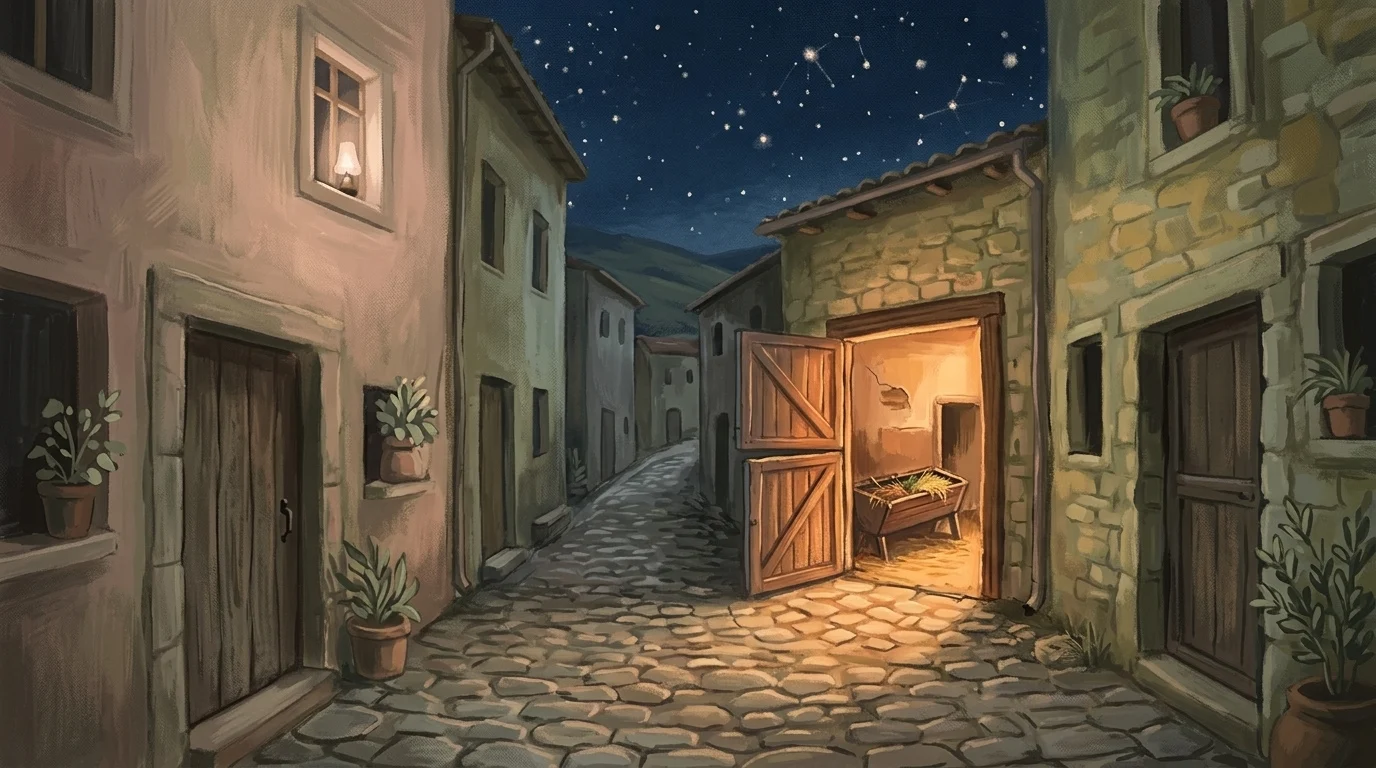
And it came to pass, that when they were there, her days were accomplished, that she should be delivered. And she brought forth her firstborn son, and wrapped him up in swaddling clothes, and laid him in a manger; because there was no room for them in the inn.
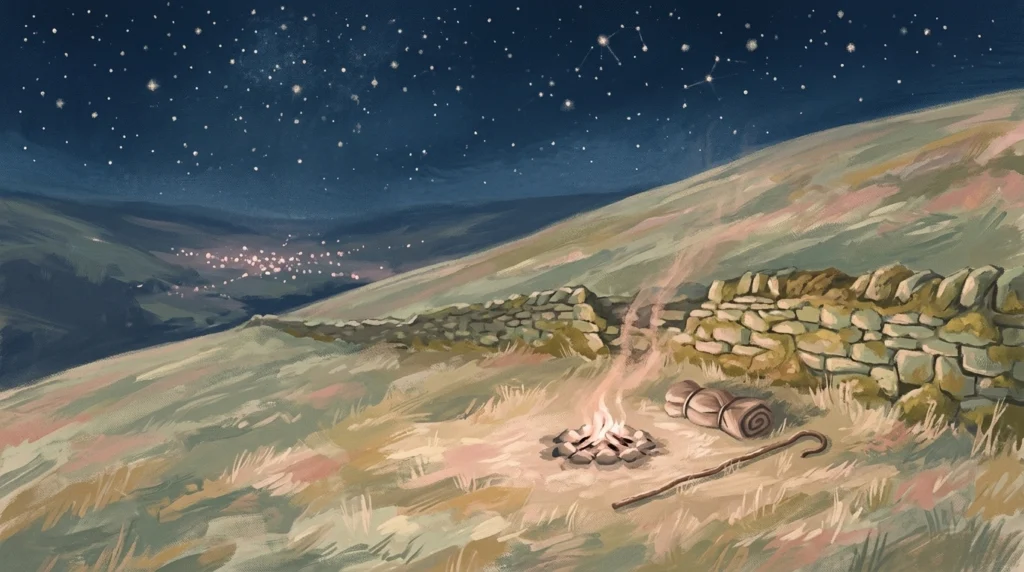
And there were in the same country shepherds watching, and keeping the night watches over their flock. And behold an angel of the Lord stood by them, and the brightness of God shone round about them; and they feared with a great fear.
And the angel said to them: Fear not; for, behold, I bring you good tidings of great joy, that shall be to all the people: For, this day, is born to you a Saviour, who is Christ the Lord, in the city of David. And this shall be a sign unto you. You shall find the infant wrapped in swaddling clothes, and laid in a manger.
And suddenly there was with the angel a multitude of the heavenly army, praising God, and saying: Glory to God in the highest; and on earth peace to men of good will.
The last line is the one the Gloria took. Peace to men of good will is the army’s own summary of what has happened, and it is peace stated as an intention rather than a reward. In November the Introit said God’s thoughts toward us are thoughts of peace, and tonight the heavenly army says the same thing out loud over a field.
X
The Creed
(The Nicene Creed is said here, from the Missal, with the genuflection at the words and was made man.)
We say it together, in the plural, because it was never meant to be a personal inventory of certainties. It is the faith of the whole body, held out loud, and on the nights when you cannot manage a line of it the rest of us are still saying it around you. Tonight the Church bends the knee at one clause of it, the one this whole Mass is about.
The Offering
Christmas Homily | Good Tidings of Great Joy
Luke begins the most famous birth in the world with paperwork. There went out a decree from Caesar Augustus, that the whole world should be enrolled. Before there is a manger there is a…
A decree, a road, and no room
Luke begins the most famous birth in the world with paperwork. There went out a decree from Caesar Augustus, that the whole world should be enrolled. Before there is a manger there is a census, and before there is an angel there is a man on a road because a government told him to be.
Read what the decree does to the family in this story. It moves them. Joseph goes up from Galilee to Bethlehem because of where his family is from, and Mary goes with him, near her time, because the decree does not make exceptions for that. The birth happens in the wrong town for the simple reason that a distant power wanted a count. Nothing about the arrangement was theirs.
And then the line that everyone knows and few people hear. There was no room for them in the inn. Luke does not say the innkeeper was cruel, and he does not say anyone was cruel. He says the town was full and the arriving family was not a priority, which is a colder thing than cruelty and far more common.
The manger is not a punishment. It is what was left over, and Luke records it without a word of comment, the way you record weather.
So hold the scene as Luke actually gives it before the angel arrives. A family moved by an order it did not choose, a town with no room for it, a birth in the place kept for animals, and, some way off, men on a hillside doing the overnight work nobody else wanted. That is the world the good tidings of great joy are about to be announced into. Not a prepared one. A full one, with the doors shut.
Good tidings of great joy, to whom
Now the announcement, and the first question to ask of any announcement is who was in the room when it was made.
The angel does not go to the inn. The angel does not go to the city of David’s leading men, or to the governor who carried out the census, or to anyone with the standing to spread the word properly. The angel goes to shepherds, at night, at work, in a field. And behold an angel of the Lord stood by them. The first human beings told good tidings of great joy were the night shift.
Consider what a shepherd on a night watch is in the order of a small town. He is the man whose work keeps him outside the walls after everyone else has gone in. He is the one who smells of the animals, whose hours make him a stranger to daylight company, who is not in the inn because he was never going to be in the inn. When the angel says good tidings of great joy, that is who hears it first, and Luke is not embarrassed by it.
Listen to the whole sentence. Fear not; for, behold, I bring you good tidings of great joy, that shall be to all the people. The joy is to all the people, but it is delivered to these particular people, and the order matters. It is not announced in the centre and allowed to trickle out to the edge. It is announced at the edge and allowed to run in.
That is the reversal the feast is built on, and it is not a small one. Good tidings of great joy go first to people whose position in the town was the opposite of first. If you want to know what God thinks of the arrangement that left no room in the inn, look at where the angel chose to stand.
And the sign the angel gives them matches. You shall find the infant wrapped in swaddling clothes, and laid in a manger. A week ago Wednesday Isaias promised that the Lord Himself would give a sign, and this is the shape it takes: not a palace, not a proper room. The proof offered to men who work with animals is a child laid where the animals eat. The good tidings of great joy come with a sign that the shepherds, of all people, would know how to find.
The announcement comes before the question
Here is the part I most want you to carry home, so I am going to say it plainly and then say it again.
The angel asks the shepherds nothing. There is no test. Nobody is asked whether he believes, or whether he has kept the law, or whether he is the sort of man who ought to be receiving news like this. Fear not is addressed to men who are afraid, and then the announcement is simply made. Good tidings of great joy are handed over, whole, to people who have not been examined.
Set that beside the way religious institutions usually work, including the ones built in this child’s name. The usual order is question first, then announcement: prove your standing and then you may hear the good news. Luke has the order the other way round. The good tidings of great joy come first, and whatever the shepherds do about them comes after, and nothing they do afterwards can make the announcement not have happened.
Last Sunday Paul told the Corinthians to judge not before the time. Tonight the angel goes further than not judging. The angel announces before the time, before any of the shepherds has had a chance to show what kind of man he is, and the good tidings of great joy are not made conditional on the answer.
Put the fruit test to both orders, the way this ministry tests everything. Ask what a church grows when it examines people before it tells them anything. It grows a congregation of people who passed, and a much larger crowd outside who were never told.
Ask what the angel’s order grows, and Luke tells you: a hillside of men who feared with a great fear and were then given a reason not to. Good tidings of great joy that wait for the hearer to qualify are not good tidings at all. They are terms, and a hillside of frightened men would have known the difference at once.
The Church has an old name for the angel’s order, and the name is grace. The plain version, for anyone in the room for whom that word carries no charge, is this: the best news you ever received in your life was almost certainly told to you by someone who did not first check whether you deserved it. That is what the angel did. That is what good tidings of great joy are.
Outside the inn, in the name of order
Now the naming, because Luke’s own sentence asks for it and walking around it would be a failure.
There was no room for them in the inn. Read that clause and think about who, in the actual life of the towns we live in, is outside on this particular night because there was no room. People sleeping in doorways and under bridges and in cars while the rest of the town is inside. People who will hear the Midnight Mass bells from a pavement. The family in this Gospel had that night, once, and the Church has sung about it for two thousand years without always opening its own doors to the people living it.
The teaching under the shut door is that order comes first: that a building must be kept for those who belong in it, that a person must be housed and presentable and inside before the good news is properly for them. It has been practised as prudence for a very long time. Luke’s Gospel says the opposite in a single clause. The good tidings of great joy went to the people outside, and the Saviour they announced was born in the place the town had not thought to keep for anybody.
I want to say what the harm is exactly, because it hides inside a reasonable-sounding word. The harm is not that a community has a building to keep. The harm is that it mistakes the keeping for the mission, and comes to believe that the people outside are outside because of something about them rather than because the town was full.
Luke does not blame the family for the manger, and he blames nobody else either. He simply records that the good tidings of great joy were announced to people who were not indoors, and lets the Church draw its own conclusion about where it should stand.
Apply the fruit test to Christianity’s own record here, as this ministry does, naming no other faith. What grew from the shut-door teaching was not holier congregations. It was churches that were warm and empty on cold nights, and a population of people who learned that the building with the manger painted on its window was the one place in town that would not take them in. That is not the fruit of the sentence Luke wrote.
Set the Epistle beside it. Paul says grace hath appeared to all men, instructing us, and the instruction comes after the appearing. The order is the angel’s order again: the announcement is made to everyone first, and the living is what follows it. Good tidings of great joy are for the people the town had no room for, and the Church that believes that is the Church that props its door.
One door to close before it swings the wrong way. To say the announcement comes before the question is not to say that nothing the shepherds did afterwards mattered. The next Mass of this feast, at dawn, reads what they did: they went, and they saw, and they told.
The good tidings of great joy did not excuse them from the walk to Bethlehem. They made the walk possible. Grace announced before the question is what a person can actually act on, and terms announced before grace are what a person cannot.
The last pew by the door
Which brings the whole thing down to the size it actually lives at.
There is a story sometimes told of a woman who went to a Midnight Mass in a small stone church because her daughter asked her to, and for no other reason at all.
She had not been in a church in nineteen years and she did not believe a word of it. She said afterwards that she had decided in the car park exactly where she would stand: the last pew, on the aisle, by the heavy door at the back, so that she could leave the moment it got to be too much. She kept her coat on. She did not pick up a book. Her whole plan for the evening was to be present and unexamined.
What she had not planned for was the sidesman. Before the first hymn a man she had never seen came down the aisle handing out tapers for the candlelit part of the Mass, and when he got to the last pew he handed her one, lit it from his own, and moved on without a word. He did not ask if she was a member. He did not ask if she believed anything. He gave her the light because she was in the row.
She said the Gospel was the part that undid her, and not the part she expected. It was the census. It was the family moved by an order they had not chosen, and the town that was full, and the clause about no room in the inn.
She had been in a town with no room for her for a long time, and she had come in tonight braced to be asked why. Nobody asked. Good tidings of great joy were being read out to a room she had been let into on no conditions at all.
She did not go forward. She did not say the Creed. She stood at the back with a coat on and a lit taper and let the whole thing be announced to her, and when it finished she blew the taper out, set it in its holder on the end of the pew, and went home. Her daughter drove.
I am not going to tell you she believes now. She has said since that she does not know what she believes, and that this is a more honest place than the one she stood in nineteen years ago. What she does know is that the announcement was made to her before anyone checked, and that she has never once been able to unhear it.
Good tidings of great joy are like that. They do not wait at the door for you to qualify. They come down the aisle and hand you a light, and whether you keep it lit is a question for later.
↑ The order resumes below.
XII
Offertory
Let the heavens be glad and the earth rejoice before the Lord, for He cometh.
For He cometh. Two words of reason for the whole of creation to be glad, and neither of them is about anything creation did. The Offertory gives the same order the angel gave: the coming is the cause, and the gladness is the response, and nothing in between has to be earned.
XIII
Secret
May the offering of this day’s festivity, we beseech Thee, O Lord, find acceptance with Thee; that, by the bounty of Thy grace, we may, through these sacred dealings, be made like unto Him in Whom our nature is united with Thee. Who liveth and reigneth with Thee in the unity of the Holy Ghost, God, world without end. Amen.
XIV
The Preface of the Nativity
(Sung aloud, from the Missal. It is proper to this feast and is printed here in full.)
It is truly meet and just, right and for our salvation, that we should at all times, and in all places, give thanks unto Thee, O holy Lord, Father almighty, everlasting God: for through the Mystery of the Word made flesh, the new light of Thy glory hath shone upon the eyes of our mind, so that while we acknowledge God in visible form, we may through Him be drawn to the love of things invisible.
And therefore with Angels and Archangels, with Thrones and Dominations, and with all the hosts of the heavenly army, we sing the hymn of Thy glory, evermore saying:
(The Sanctus follows, from the Missal.)
The Preface is sung out loud, and on this feast it has words of its own. Hear what it claims: a light has come to the eyes of our mind, and it came through something visible. The shepherds were told the same thing in the same order, a sign they could see and then good tidings of great joy they could not.
XV
The Canon and Consecration
(The Canon of the Mass, with the Communicantes of the Nativity, and the words of Consecration are said here, from the Missal.)
This is the oldest and quietest part of the rite, and it is not a performance. What the Church has always claimed happens here does not depend on how anyone in the room is feeling about it tonight. That is a mercy at midnight, when a good many people in a good many churches are feeling a great deal, and a good many others are feeling nothing at all.
XVI
Act of Spiritual Communion
(Said by all who are not receiving sacramentally.)
My Jesus, I believe that Thou art present in the Most Holy Sacrament. I love Thee above all things, and I desire to receive Thee into my soul. Since I cannot now receive Thee sacramentally, come at least spiritually into my heart. I embrace Thee as if Thou wert already there, and I unite myself wholly to Thee. Never permit me to be separated from Thee.
If you are homebound tonight, or working, or in a body that could not get to a church building, or standing at the back with your coat on, that prayer is not a lesser version of anything. It is the door the Church left open on purpose, and on this night above all it stays propped.
XVII
Communion
In holy splendor, before the daystar I have begotten Thee.
XVIII
Postcommunion
Grant, we beseech Thee, O Lord our God, that we who joyfully celebrate the birth of our Lord Jesus Christ in this sacrament, may by worthy living gain His companionship. Who liveth and reigneth with Thee in the unity of the Holy Ghost, God, world without end. Amen.
XIX
The Closing Blessing
Go out and be the angel for somebody, in the only way any of us can. If there is a person in your life who has been kept outside a thing for a long time, waiting to be asked whether they qualify, tell them the good part first. Tell them before you ask them anything. Let them stand at the back with their coat on if they need to, and hand them the light anyway.
That is the whole move, and it is not lowering a standard. It is the order the Gospel of this night actually keeps, which is announcement before examination. Good tidings of great joy are the only kind of tidings that can be given away without first checking who is receiving them, and that is exactly why they are good. May Almighty God bless you, the Father, and the Son, and the Holy Ghost. Amen.
And if none of that language belongs to you, take it plainly. The best news you ever got was told to you by someone who did not first make sure you deserved it, and you can be that person for someone else this week. Go home. Merry Christmas.
XX
Frequently Asked Questions
Because Christmas is not an ordinary weekday and Bloom does not treat it as one. Monday through Saturday you normally get a Daily Offering, which is a low-Mass-shaped morning reflection and is not a Mass. The Nativity of Our Lord is a feast of the first class with three complete Masses of its own, so it is offered here as a Mass in the Independent Catholic tradition, with the ordinary indicated by rubric and the propers, homily and blessing written in full, exactly as a Sunday is. Yesterday’s Christmas Eve Mass took the same form.
Because Christmas has three Masses and a post has to choose one honestly rather than blur them together. The Midnight Mass is the one whose Gospel reads the birth itself and puts the angel in the field with the shepherds, which is the announcement this whole ministry is built around. The Mass at Dawn and the Mass of the Day are named in the body with their own readings cited, and the days within the Octave that follow take up the Mass of the Day, so its texts are not lost to the archive.
Because it is true and you are entitled to know it before you sit down. Bloom Ministries offers this liturgy in the Independent Catholic tradition, using the 1962 Roman Rite, and it is neither part of nor recognized by the Roman Catholic Church. Old Catholic and Anglo-Catholic communities have named themselves this way for more than a century, and the naming is honest rather than defensive.
It is a prayer said by anyone who cannot receive the sacrament in person, asking Christ to come spiritually into the soul instead. The Church has carried it for centuries precisely for people who are sick, homebound, travelling or otherwise kept away. It is not a lesser substitute or a consolation prize. It is the door the Church deliberately left open.
It is the angel’s own phrase in Luke 2:10, I bring you good tidings of great joy, that shall be to all the people, spoken to shepherds at work in a field at night. The homily reads it for its order: the announcement is made to men at the edge of the town before anyone in the centre, and it is made before the shepherds are asked a single question about themselves. So the phrase names news that is given away first and examined afterwards, which the Church calls grace and which anyone can recognize as the shape of the best news they ever received.
There is an octave, and it begins today. The Octave of the Nativity is one of only three octaves that survived Pope Pius XII’s reform of 1955, alongside Easter and Pentecost, and it runs from today to the first of January, so the whole coming week is kept as a single continuing feast. There is no vigil today; yesterday was the vigil, one of the seven that survived the same reform, and it was kept as its own Mass.
No, and the homily closes that door on purpose. Luke blames nobody for the manger; he records that the town was full and the arriving family was not a priority, and then records where the angel chose to make the announcement. The point is not that being indoors is wrong but that the good news was not made conditional on being indoors. The Gospel asks the Church where it stands on a cold night, not whether its members are allowed to own a roof.
No. The ethical logic stands on its own with no theology attached. The best news you ever received was almost certainly told to you by someone who did not first check whether you deserved it, and you can be that person for someone else. In one plain sentence: tell people the good part before you ask them anything, and let them stand at the back if they need to.
Faith in Bloom is the daily liturgical work of Bloom Ministries, a 501(c)(3) nonprofit, and it is free to read and always will be. If it has been worth something to you and you are able, you can give once or give monthly below. Sending a post to one person who needs it does real work too.
Propers for the Mass at Midnight of the Nativity of Our Lord are taken from the 1962 Roman Missal. Scripture is quoted from the Douay-Rheims Bible. The liturgical spine of Faith in Bloom is The New Marian Missal for Daily Mass by Sylvester P. Juergens, S.M., S.T.D., Regina Press, Imprimatur 1961.
Faith in Bloom, under the Church of Bloom, is a ministry of Bloom Ministries, a nonprofit organization tax-exempt under section 501(c)(3) of the Internal Revenue Code. It is offered in the Independent Catholic tradition and is not affiliated with or recognized by the Roman Catholic Church.
