
Sunday Mass · 15 November 2026 · VI Sunday after Epiphany
Sunday Mass: November 15, 2026 | A Grain of Mustard Seed
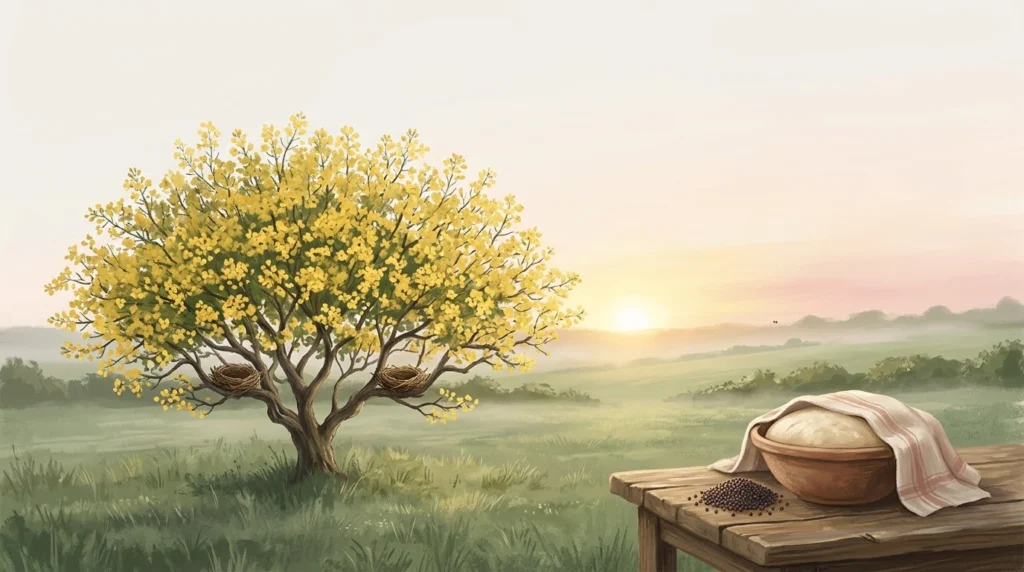
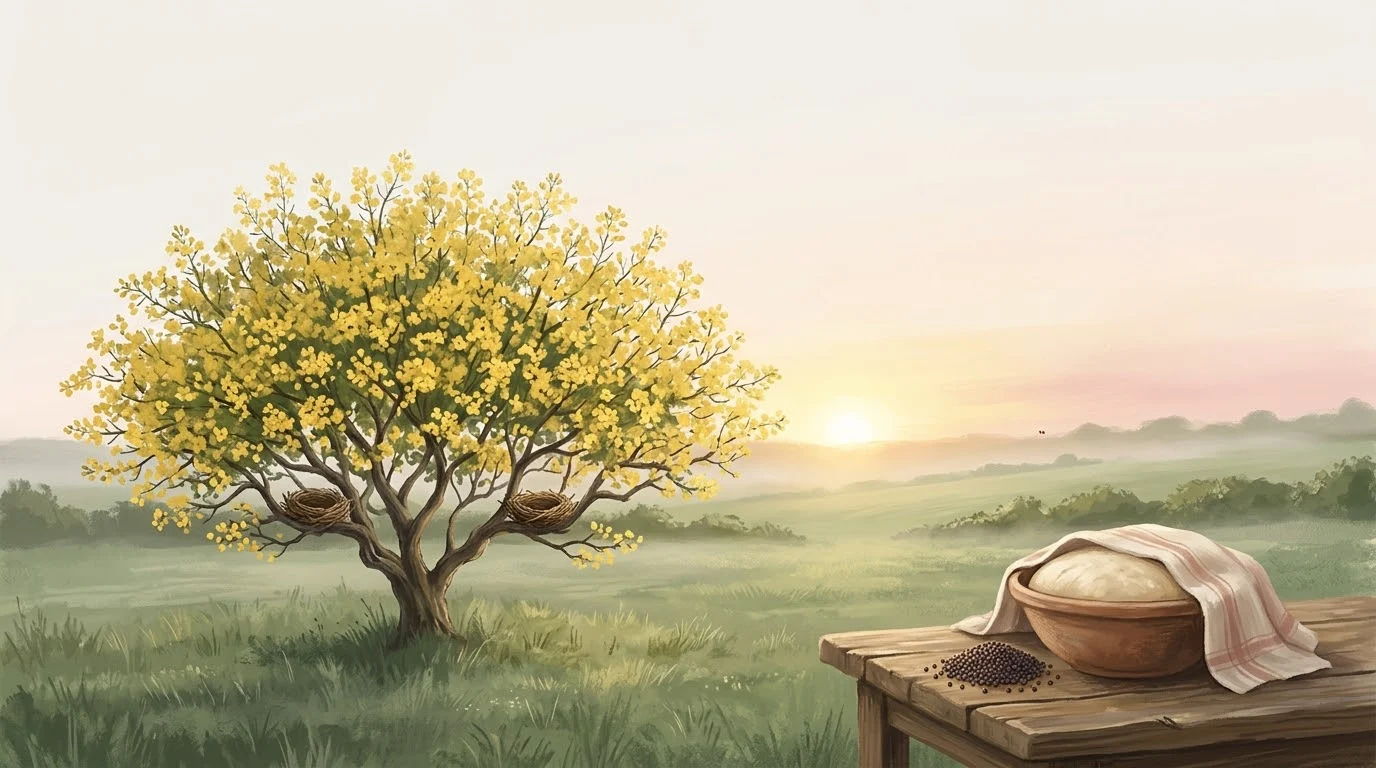
Most of what matters in a life starts too small to count. Today Christ tells two stories about that, and the first of them begins with a grain of mustard seed, the smallest thing a farmer ever bothered to plant.
The order of this offering
Before the readings
Offering and Canon
I
Opening Address
Most of what matters in a life starts too small to count. Today Christ tells two stories about that, and the first of them begins with a grain of mustard seed, the smallest thing a farmer ever bothered to plant.
Welcome to Bloom’s Sunday Mass for the Sixth Sunday after Epiphany, Sunday, November 15, 2026. It is a Sunday of the second class, in green. The Gloria and the Creed are said, the Preface is the Preface of the Most Holy Trinity, and St. Albert the Great, whose day this is, gives way to the Sunday.
Bloom offers this Mass in the Independent Catholic tradition, from the 1962 Roman Rite, and is not affiliated with or recognized by the Roman Catholic Church. We say it at the door every Sunday, because honesty is the first thing a church owes the people who walk in.
However you arrive this morning, with a great deal to offer or with almost nothing, you are welcome here. The smallest faith in the room is the kind today’s Gospel is about.
II
A Word on Today’s Propers
This Mass is the Sixth Sunday after Epiphany, a Sunday that never came round this winter, because Septuagesima came on February 1. The Missal takes it up now, the second such Sunday in a row. Its Collect, Epistle, Gospel, Secret and Postcommunion are printed here for the first time. Its chants, the Introit, Gradual, Offertory and Communion, belong to the XXIII Sunday after Pentecost: they were printed most recently on Sunday, November 8, and first on November 16, 2025.
Each repeated chant was checked against last Sunday’s printing one at a time, and they match. Every proper is printed in full, in Latin and English, as a Sunday Mass reads everything. The homily stays with the Gospel’s first parable and its first image: a grain of mustard seed.
III
Prayers at the Foot of the Altar
(Psalm 42, Judica me, and the Confiteor are said here, at the foot of the altar, from the Missal.)
The Mass begins small. A priest and a server at the bottom step, a psalm said almost under the breath, and the plain admission in the Confiteor that we come with very little. The psalm says it plainly, I will go in to the altar of God. Every Mass starts the way a seed does, low and quiet.
IV
Introit
Jeremias 29:11-12, 14; Psalm 84:2
English
The Lord saith: I think thoughts of peace, and not of affliction: you shall call upon Me, and I will hear you; and I will bring back your captivity from all places.
Ps. 84:2. Lord, Thou hast blessed Thy land: Thou hast turned away the captivity of Jacob.
Glory be to the Father, and to the Son, and to the Holy Ghost. As it was in the beginning, is now, and ever shall be, world without end. Amen.
The Lord saith: I think thoughts of peace, and not of affliction: you shall call upon Me, and I will hear you; and I will bring back your captivity from all places.
Latin
Dicit Dóminus: Ego cógito cogitatiónes pacis, et non afflictiónis: invocábitis me, et ego exáudiam vos: et redúcam captivitátem vestram de cunctis locis.
Ps. 84:2. Benedixísti, Dómine, terram tuam: avertísti captivitátem Jacob.
Glória Patri…
Dicit Dóminus: Ego cógito cogitatiónes pacis, et non afflictiónis: invocábitis me, et ego exáudiam vos: et redúcam captivitátem vestram de cunctis locis.
V
The Kyrie and the Gloria
(The Kyrie and the Gloria are said here, from the Missal.)
Nine small cries for mercy, and then a hymn big enough for the whole earth. The Mass moves the way the parable does, from a few words to glory in the highest.
VI
Collect
(℣. marks what the priest says. ℟. marks the answer of the server and the people.)
English
℣. The Lord be with you.
℟. And with thy spirit.
Let us pray.
Grant us, we beseech Thee, almighty God, ever to think of spiritual things and in every word and work always to do what is well pleasing in Thy sight. Through our Lord.
℟. Amen.
Latin
℣. Dóminus vobíscum.
℟. Et cum spíritu tuo.
Orémus.
Præsta, quǽsumus, omnípotens Deus: ut, semper rationabília meditántes, quæ tibi sunt plácita, et dictis exsequámur et factis. Per Dóminum…
℟. Amen.
VII
Epistle
English
Lesson from the first Epistle of blessed Paul the Apostle to the Thessalonians.
Brethren: We give thanks to God always for you all; making a remembrance of you in our prayers without ceasing, being mindful of the work of your faith, and labour, and charity, and of the enduring of the hope of our Lord Jesus Christ before God and our Father: knowing, brethren beloved of God, your election:
For our gospel hath not been unto you in word only, but in power also, and in the Holy Ghost, and in much fulness, as you know what manner of men we have been among you for your sakes. And you became followers of us, and of the Lord; receiving the word in much tribulation, with joy of the Holy Ghost: so that you were made a pattern to all that believe in Macedonia and in Achaia.
For from you was spread abroad the word of the Lord, not only in Macedonia, and in Achaia, but also in every place, your faith which is towards God, is gone forth, so that we need not to speak any thing.
For they themselves relate of us, what manner of entering in we had unto you; and how you turned to God from idols, to serve the living and true God, and to wait for His Son from heaven (whom He raised up from the dead), Jesus, who hath delivered us from the wrath to come.
℟. Thanks be to God.
Latin
Léctio Epístolæ beáti Pauli Apóstoli ad Thessalonicénses.
Fratres: Grátias ágimus Deo semper pro ómnibus vobis, memóriam vestri faciéntes in oratiónibus nostris sine intermissióne, mémores óperis fídei vestræ, et labóris, et caritátis, et sustinéntiæ spei Dómini nostri Jesu Christi, ante Deum et Patrem nostrum: sciéntes, fratres, dilécti a Deo. electiónem vestram:
quia Evangélium nostrum non fuit ad vos in sermóne tantum, sed et in virtúte, et in Spíritu Sancto, et in plenitúdine multa, sicut scitis quales fuérimus in vobis propter vos. Et vos imitatóres nostri facti estis, et Dómini, excipiéntes verbum in tribulatióne multa, cum gáudio Spíritus Sancti: ita ut facti sitis forma ómnibus credéntibus in Macedónia et in Achája.
A vobis enim diffamátus est sermo Dómini, non solum in Macedónia et in Achája, sed et in omni loco fides vestra, quæ est ad Deum, profécta est, ita ut non sit nobis necésse quidquam loqui.
Ipsi enim de nobis annúntiant, qualem intróitum habuérimus ad vos: et quómodo convérsi estis ad Deum a simulácris, servíre Deo vivo et vero, et exspectáre Fílium ejus de cœlis quem suscitávit ex mórtuis Jesum, qui erípuit nos ab ira ventúra.
℟. Deo gratias.
VIII
Gradual and Alleluia
English
Thou hast saved us, O Lord, from them that afflict us: and hast put them to shame that hate us.
℣. In God shall we glory all the day long: and in Thy name we will give praise for ever.
Alleluia, alleluia. ℣. Out of the depths I have cried to Thee, O Lord: Lord, hear my prayer. Alleluia.
Latin
Liberásti nos, Dómine, ex affligéntibus nos: et eos, qui nos odérunt, confudísti.
℣. In Deo laudábimur tota die, et in nómine tuo confitébimur in sǽcula.
Allelúja, allelúja. ℣. De profúndis clamávi ad te, Dómine: Dómine, exáudi oratiónem meam. Allelúja.
IX
Gospel
English
℣. The Lord be with you.
℟. And with thy spirit.
℣. Continuation ☩ of the holy Gospel according to Matthew.
℟. Glory be to Thee, O Lord.
At that time, Jesus spoke this parable to the multitudes: The kingdom of heaven is like to a grain of mustard seed, which a man took and sowed in his field. Which is the least indeed of all seeds; but when it is grown up, it is greater than all herbs, and becometh a tree, so that the birds of the air come, and dwell in the branches thereof.
Another parable he spoke to them: The kingdom of heaven is like to leaven, which a woman took and hid in three measures of meal, until the whole was leavened.
All these things Jesus spoke in parables to the multitudes: and without parables he did not speak to them. That it might be fulfilled which was spoken by the prophet, saying: I will open my mouth in parables, I will utter things hidden from the foundation of the world.
℟. Praise be to Thee, O Christ.
Latin
℣. Dóminus vobíscum.
℟. Et cum spíritu tuo.
℣. Sequéntia ☩ sancti Evangélii secúndum Matthǽum.
℟. Gloria tibi, Domine.
In illo témpore: Dixit Jesus turbis parábolam hanc: Símile est regnum cœlórum grano sinápis, quod accípiens homo seminávit in agro suo: quod mínimum quidem est ómnibus semínibus: cum autem créverit, majus est ómnibus oléribus, et fit arbor, ita ut vólucres cœli véniant et hábitent in ramis ejus.
Aliam parábolam locútus est eis: Símile est regnum cœlórum ferménto, quod accéptum múlier abscóndit in farínæ satis tribus, donec fermentátum est totum.
Hæc ómnia locútus est Jesus in parábolis ad turbas: et sine parábolis non loquebátur eis: ut implerétur quod dictum erat per Prophétam dicéntem: Apériam in parábolis os meum, eructábo abscóndita a constitutióne mundi.
℟. Laus tibi, Christe.
This Gospel is printed here for the first time. It follows directly on last Sunday’s parable of the wheat and the cockle, in the same chapter of the Gospel, and it is the reading the homily keeps.

The Offering
Sunday Homily | A Grain of Mustard Seed
Last Sunday’s parable was about a field with an enemy in it. This Sunday Christ goes back to the same field and tells two very short stories about what God is growing there. The…
What does “a grain of mustard seed” tell us?
Last Sunday’s parable was about a field with an enemy in it. This Sunday Christ goes back to the same field and tells two very short stories about what God is growing there. The first: The kingdom of heaven is like to a grain of mustard seed, which a man took and sowed in his field.
He stops to make sure we do not miss how small it is. Which is the least indeed of all seeds. The Latin is mínimum, the least, the smallest, the one you could drop and never miss. Christ did not reach for an acorn or a cedar seed. He chose the seed most like nothing at all.
And then: when it is grown up, it is greater than all herbs, and becometh a tree, so that the birds of the air come, and dwell in the branches thereof. The least of all seeds becomes the largest thing in the garden. That is the whole shape of the parable, smallest to greatest, and Christ says it is the shape of the kingdom of heaven.
Mark what the tree is for at the end. It is not for show, and it is not for the gardener. It is for the birds.
They do not plant it, water it or earn it. They simply come, and dwell, and the Latin verb, hábitent, means they live there. The parable’s last picture of the kingdom is shelter, with room in the branches for whoever arrives.
The people listening would have heard an echo. In the prophet Ezechiel, God promises to take a tender twig and plant it on a mountain until it becomes a great cedar, and all birds shall dwell under it, and every fowl shall make its nest under the shadow of the branches thereof. All birds. Every fowl. The prophet did not draw up a list.
St. John Chrysostom, preaching on this chapter in the fourth century, heard the disciples’ worry underneath the parable. He imagined them asking, What shall we be able to do, twelve men, throwing ourselves upon so vast a multitude?
He answered with the seed: His disciples were weakest of all, and least of all; but nevertheless, because of the great power that was in them, It has been unfolded in every part of the world.
So the parable of the mustard seed makes two promises at once. God’s work begins smaller than anyone would bother to count. And when it grows, it grows for the sake of those who need somewhere to rest.
Who opened the door at Thessalonica?
Today’s Epistle shows us what one of those seeds was like in real life. St. Paul is writing to the church at Thessalonica, a port city in Macedonia, and the Acts of the Apostles tells us how that church began.
Paul and Silas came into the city, and Acts 17 says that for three sabbath days Paul reasoned in the synagogue from the Scriptures. Some believed, among them of the Gentiles a great multitude, and of noble women not a few. Three weeks of preaching. That was the planting.
Then a crowd set the city in an uproar. They went besetting Jason’s house, hunting for the two missionaries. Jason had taken Paul and Silas in under his own roof.
The crowd did not find the missionaries. So they took Jason instead, and some of the other believers, and dragged them before the rulers of the city, shouting: They that set the city in an uproar, are come hither also; Whom Jason hath received. That was the charge against him: he had received them.
The magistrates made Jason give security for the peace, having taken satisfaction of Jason and of the rest, and let them go. And that same night, the brethren immediately sent away Paul and Silas by night unto Berea.
Think about what was left behind. A church a few weeks old. Its founder smuggled out of town after dark. Its host hauled before the magistrates and made to pay, its members under suspicion, and only one another to teach them.
By any reasonable measure that church was finished before it began. It was the least of all seeds.
What became of a church weeks old?
Now listen to what Paul writes to them, soon afterwards, in this morning’s Epistle. You became followers of us, and of the Lord; receiving the word in much tribulation, with joy of the Holy Ghost: so that you were made a pattern to all that believe in Macedonia and in Achaia.
A pattern. The church that started in Jason’s house, with its preacher run out of town, became the example other churches copied. For from you was spread abroad the word of the Lord, not only in Macedonia, and in Achaia, but also in every place. Paul says he no longer has to tell anyone about them. People were telling him.
And Paul gives thanks for exactly the small, unshowy things that grew it: the work of your faith, and labour, and charity, and of the enduring of the hope. Work, labour, love and endurance. Not a single miracle in the list, and not one famous person. Just ordinary people who kept going after the person who started it all had been chased away.
That is a grain of mustard seed in history. It is not much to speak of when it is planted: one open door, a few frightened believers, and a bond paid to the magistrates. And within months of that night, Paul could write that their faith was known across two provinces.
Jason is the one I would like you to carry out of here. We know almost nothing about him except that he opened his door, and that he paid for it.
Most of the kingdom’s beginnings are like that. A spare room. A hot meal for someone new in town. A kitchen table where a frightened person can say what they believe out loud.
Whom Jason hath received: in the end, that was the whole accusation, and it is not a bad thing to be accused of.
What does the leaven do?
The second parable is shorter still: The kingdom of heaven is like to leaven, which a woman took and hid in three measures of meal, until the whole was leavened.
The mustard seed grows where everyone can find it. Leaven works the other way. Once it is kneaded in, it cannot be picked out again, and for a good while nothing appears to happen. Then the whole batch rises. The work is done from inside, slowly, all through the dough.
And it is a large batch. Three measures of meal is a great deal of flour, and Chrysostom read it that way: by three measures, here, He meant many, for He is wont to take this number for a multitude.
It is also the quantity Abraham asks for when three strangers arrive at his tent and he wants to feed them well: Make haste, temper together three measures of flour, and make cakes, he says in Genesis 18. This is bread for guests, baked by a woman at work in her kitchen, and Christ says the kingdom of heaven is like that.
Much of the faith of the Thessalonians must have been leaven. Paul thanks God for their labour, a word for tiring work, and for the enduring of the hope, which is what you need when the dough has not risen yet. Most holiness is kneading. Most of it happens out of sight, in kitchens and hospital rooms and night shifts and late conversations, and it does its work on the whole loaf.
Chrysostom saw one more thing in the dough: that which has been once leavened, becomes leaven again for what remains. Every person the kingdom reaches becomes leaven for the next. The Thessalonians, leavened by three weeks of preaching, leavened two provinces.
If your faith feels too small this morning, or too unremarkable, you are in good company. The kingdom of heaven is a grain of mustard seed you could lose in your palm and a pinch of leaven in a bowl of flour. God does not seem to mind starting there.
Today’s Collect asks for the same small things in our own lives. It asks God to grant us ever to think of spiritual things and in every word and work always to do what is well pleasing in His sight. In the Latin it is et dictis exsequámur et factis, in words and in deeds. A thought becomes a word, a word becomes a deed, and that is how a seed turns into a tree.
How do we plant a mustard seed this week?
Scripture remembers a day when God’s people did not know whether to laugh or cry at a small beginning. When the exiles laid the foundation of a new temple in Jerusalem, the oldest among them, who remembered the first one, when they had the foundation of this temple before their eyes, wept with a loud voice, while others were shouting for joy. The book of Esdras says one could not distinguish the voice of the shout of joy, from the noise of the weeping.
Some years later, with the work still small, the prophet Zacharias put a question to people discouraged by how little they had to show for it: For who hath despised little days? Do not despise yours.
So this week, plant one seed you can actually hold. Open your door the way Jason did, to one person who needs a table or a room or an hour. Pick one small, faithful act and do it every day until next Sunday: a prayer for one particular person before you sleep, a call to someone who is alone, one kindness at work that was not asked for.
If you lead anything, a parish, a ministry, a household, a team, stop measuring it only by size. Ask instead who is resting in its branches, and whether there is room for the next bird to land.
And if you are one of the people who have been told there is no room for you in the Church, hear the end of the parable as it was written. The tree is for the birds of the air. They do not have to earn a branch. All birds shall dwell under it, the prophet said. That includes you.
Every great thing in the kingdom started small. If you would like a few people around you while yours grows, the Bloom Network is free to join, and the daily Offering can come to your inbox each morning from the Faith in Bloom page, a little leaven for the week between Sundays.
If none of this is yours as faith, keep the plain version: small, faithful things done every day change more than grand gestures, and the best things we build are the ones with room in them for others.
A grain of mustard seed. A pinch of leaven. A church that began at one open door and became a pattern for every church after it. God likes to begin with very little. Give Him your little this week, and let Him do the growing.
↑ The order resumes below.
XI
The Creed
(The Nicene Creed is said here, after the sermon, from the Missal.)
Its words are said in languages all over the world, by people who agree on little else. A creed grows the way the mustard seed does.
XII
Offertory
English
℣. The Lord be with you.
℟. And with thy spirit.
Let us pray.
Out of the depths I have cried to Thee, O Lord: Lord, hear my prayer. Out of the depths I have cried to Thee, O Lord.
Latin
℣. Dóminus vobíscum.
℟. Et cum spíritu tuo.
Orémus.
De profúndis clamávi ad te, Dómine: Dómine, exáudi oratiónem meam: de profúndis clamávi ad te, Dómine.
XIII
Secret
English
May this offering, O God, we beseech Thee, cleanse and renew us, govern and protect us. Through our Lord.
℣. World without end.
℟. Amen.
Latin
Hæc nos oblátio, Deus, mundet, quǽsumus, et rénovet, gubérnet et prótegat. Per Dóminum…
℣. Per omnia saecula saeculorum.
℟. Amen.
XIV
The Canon and Consecration
(The Preface of the Most Holy Trinity is said aloud here, as on Sundays, followed by the Sanctus and the Canon of the Mass, all from the Missal. Every prayer of the Canon is said silently.)
The bread on the altar began as seed in a field. In the silence of the Canon the Church asks God to take something small enough to hold in two fingers and make it holy.
Nothing about it depends on how much you brought. The smallest gift on the altar is enough for God to work with.
XV
Act of Spiritual Communion
(Said by all who are not receiving sacramentally.)
My Jesus, I believe that Thou art present in the Most Holy Sacrament. I love Thee above all things and I desire to receive Thee into my soul. Since I cannot now receive Thee sacramentally, come at least spiritually into my heart. I embrace Thee as if Thou wert already there, and I unite myself wholly to Thee. Never permit me to be separated from Thee.
If you are joining from a hospital bed, a night shift or a body that could not get to church today, this prayer is a full welcome, not a consolation prize.
XVI
Communion
English
Amen I say to you, all things whatsoever you ask when you pray, believe that you shall receive, and it shall be done to you.
Latin
Amen, dico vobis, quidquid orántes pétitis, crédite, quia accipiétis, et fiet vobis.
XVII
Postcommunion
English
℣. The Lord be with you.
℟. And with thy spirit.
Let us pray.
Nourished by Thy heavenly food, O Lord, we beseech Thee that we may always strive after those things that give us true life. Through our Lord.
℟. Amen.
Latin
℣. Dóminus vobíscum.
℟. Et cum spíritu tuo.
Orémus.
Cœléstibus, Dómine, pasti delíciis: quǽsumus; ut semper éadem, per quæ veráciter vívimus, appetámus. Per Dóminum…
℟. Amen.
XVIII
The Closing Blessing
Go out this week and plant something small. Open one door, keep one faithful habit, give thanks for one small beginning you were tempted to despise.
The Introit sang it at the start: I think thoughts of peace, and not of affliction. God’s thoughts of peace often arrive the size of a seed. Do not wait for them to seem important before you tend them.
Whether or not any of the theology is yours, take the plain version with you: small things done faithfully grow, and the best of them grow with room for others.
English
℣. The Lord be with you.
℟. And with thy spirit.
℣. Go, the Mass is ended.
℟. Thanks be to God.
May Almighty God bless you: the Father, ☩ the Son, and the Holy Ghost.
℟. Amen.
Latin
℣. Dóminus vobíscum.
℟. Et cum spíritu tuo.
℣. Ite, Missa est.
℟. Deo gratias.
Benedícat vos omnípotens Deus, Pater, et Fílius, ☩ et Spíritus Sanctus.
℟. Amen.
XIX
Frequently Asked Questions
In Matt 13:31-32 Christ says the kingdom of heaven is like a grain of mustard seed, the least indeed of all seeds, which grows into a tree where the birds of the air come, and dwell in the branches thereof. The parable of the mustard seed teaches that God’s work begins very small and grows far beyond its beginning, and that it grows to give shelter to others.
It is the second parable in today’s Gospel, Matt 13:33: the kingdom of heaven is like leaven that a woman hid in three measures of meal, until the whole was leavened. Leaven works from inside the dough, slowly and out of sight, until the whole batch rises. It pictures the kingdom at work quietly through ordinary lives.
Because this year Septuagesima came on February 1, before the season after Epiphany reached its Fifth and Sixth Sundays. The 1962 Missal takes those Sundays up in November instead, before the last Sunday after Pentecost. Their Collect, Epistle, Gospel, Secret and Postcommunion are their own, and their chants are those of the XXIII Sunday after Pentecost.
He was the man at Thessalonica who took in Paul and Silas. Acts 17 says they stayed with him, and when a crowd stirred up the city, they went besetting Jason’s house, then dragged Jason before the rulers because he had received the missionaries. He had to give security before he was released, and Paul and Silas left for Berea that night.
Paul thanks God for the work of your faith, and labour, and charity, and for the enduring of the hope. Though they received the word in much tribulation, they were made a pattern to all that believe in Macedonia and in Achaia, and from you was spread abroad the word of the Lord. A church only weeks old when its founder left became an example to others.
Because 15 November falls on a Sunday this year, and a Sunday of the second class takes precedence over his feast in the 1962 calendar. His day gives way to the Sixth Sunday after Epiphany and is not commemorated at this Mass.
Because it is true, and honesty comes first. Bloom Ministries offers this liturgy in the Independent Catholic tradition, using the 1962 Roman Rite, and it is neither part of nor recognized by the Roman Catholic Church. Old Catholic and Anglo-Catholic communities have described themselves this way for well over a century.
It is a prayer said by anyone who cannot receive the sacrament in person, asking Christ to come spiritually into the soul instead. It is meant for people who are sick, working, travelling or otherwise kept away, and it is a full welcome rather than a lesser substitute.
No. The plain version works for anyone: small, faithful things done every day change more than grand gestures, and the best things we build have room in them for others. Faith in Bloom offers the liturgy to anyone and asks nothing of you in exchange.
Faith in Bloom is the daily liturgical work of Bloom Ministries, a 501(c)(3) nonprofit, and it is free to read and always will be. If it has been worth something to you and you are able, you can give once or give monthly below. Sending a post to one person who needs it does real work too.
Propers for the Sixth Sunday after Epiphany are taken from the 1962 Roman Missal, in the Missal’s Latin and in English. Scripture is quoted from the Douay-Rheims Bible.
The liturgical spine of Faith in Bloom is The New Marian Missal for Daily Mass by Sylvester P. Juergens, S.M., S.T.D., Regina Press, Imprimatur 1961. Faith in Bloom is offered by Bloom Ministries in the Independent Catholic tradition and is not affiliated with or recognized by the Roman Catholic Church.
