

Daily Offering · 17 November 2026 · St. Gregory the Wonderworker
Daily Offering: November 17, 2026 | All His Meekness
St. Gregory’s Mass, like the Mass of many bishops who did not die as martyrs, opens with a psalm verse most of us hurry past: O Lord, remember David, and all his meekness. It has been printed here eight times and never once preached.…
The order of this offering
Before the readings
The Word
Offering and Canon
I
Opening Address
St. Gregory’s Mass, like the Mass of many bishops who did not die as martyrs, opens with a psalm verse most of us hurry past: O Lord, remember David, and all his meekness. It has been printed here eight times and never once preached. Today it is.
Welcome to Bloom’s Daily Offering for Tuesday, November 17, 2026, the feast of St. Gregory the Wonderworker, Bishop and Confessor, of the third class. There is no commemoration. The Gloria is said, there is no Creed, and the Preface is the Common Preface.
St. Gregory was born at Neocaesarea in Pontus, in Asia Minor, about 213. He studied for seven years under the great teacher Origen and was bishop of his own city for thirty years. He died there between 270 and 275, and the Church has always called him Thaumaturgus, the wonderworker.
Wherever this finds you, holding your temper or barely holding it, you are welcome here.
II
A Word on Today’s Propers
St. Gregory’s Mass was first printed here on November 17, 2025, whose homily preached the Gospel’s Have the faith of God. It is the Common of a Confessor Bishop, Státuit, with a Gospel of its own, Mark 11:22-24. Each proper was checked against that printing one at a time, and they match. Last year’s post did not print the Lesson in full, so it is printed here as it was for St. Martin on November 11, 2026.
There is no vigil and no octave today. The alleluias this Common adds in Eastertide are left out, as the Missal directs outside that season. The homily stays with the Introit’s psalm verse: all his meekness.
III
Introit
Ecclesiasticus 45:30; Psalm 131:1
English
The Lord made to him a covenant of peace, and made him a prince: that the dignity of priesthood should be to him for ever.
Ps. 131:1. O Lord, remember David, and all his meekness.
Glory be to the Father, and to the Son, and to the Holy Ghost. As it was in the beginning, is now, and ever shall be, world without end. Amen.
The Lord made to him a covenant of peace, and made him a prince: that the dignity of priesthood should be to him for ever.
Latin
Státuit ei Dóminus testaméntum pacis, et príncipem fecit eum: ut sit illi sacerdótii dígnitas in ætérnum.
Ps. 131:1. Meménto, Dómine, David: et omnis mansuetúdinis ejus.
Glória Patri…
Státuit ei Dóminus testaméntum pacis, et príncipem fecit eum: ut sit illi sacerdótii dígnitas in ætérnum.
IV
Collect
(℣. marks what the priest says. ℟. marks the answer of the server and the people.)
English
Let us pray.
Grant, we beseech Thee, almighty God, that the venerable feast of blessed Gregory, Thy Confessor and Bishop, may increase our devotion and promote our salvation. Through our Lord.
℟. Amen.
Latin
Orémus.
Da, quǽsumus, omnípotens Deus: ut beáti Gregórii Confessóris tui atque Pontíficis veneránda solémnitas, et devotiónem nobis áugeat et salútem. Per Dóminum…
℟. Amen.
V
Epistle
Ecclesiasticus 44:16-27; 45:3-20
(The Missal gathers this Lesson from verses of two chapters into one portrait of a great priest.)
English
Lesson from the Book of Wisdom.
Behold a great priest, who in his days pleased God, and was found just: and in the time of wrath he was made a reconciliation. There was not found the like to him, who kept the law of the most High. Therefore by an oath the Lord made him to increase among his people.
He gave him the blessing of all nations, and confirmed His covenant upon his head. He acknowledged him in His blessings: He preserved for him His mercy: and he found grace before the eyes of the Lord. He glorified him in the sight of kings, and gave him a crown of glory.
He made an everlasting covenant with him, and gave him a great priesthood: and made him blessed in glory. To execute the office of the priesthood, and to have praise in His name, and to offer Him a worthy incense for an odour of sweetness.
℟. Thanks be to God.
Latin
Léctio libri Sapiéntiæ.
Ecce sacérdos magnus, qui in diébus suis plácuit Deo, et invéntus est justus: et in témpore iracúndiæ factus est reconciliátio. Non est invéntus símilis illi, qui conservávit legem Excélsi. Ideo jurejurándo fecit illum Dóminus créscere in plebem suam.
Benedictiónem ómnium géntium dedit illi, et testaméntum suum confirmávit super caput ejus. Agnóvit eum in benedictiónibus suis: conservávit illi misericórdiam suam: et invénit grátiam coram óculis Dómini. Magnificávit eum in conspéctu regum: et dedit illi corónam glóriæ.
Státuit illi testaméntum ætérnum, et dedit illi sacerdótium magnum: et beatificávit illum in glória. Fungi sacerdótio, et habére laudem in nómine ipsíus, et offérre illi incénsum dignum in odórem suavitátis.
℟. Deo gratias.
VI
Gradual
Ecclesiasticus 44:16, 20; Psalm 109:4
English
Behold a great priest, who in his days pleased God.
℣. There was not found the like to him, who kept the law of the most High.
Alleluia, alleluia. ℣. Thou art a priest for ever according to the order of Melchisedech. Alleluia.
Latin
Ecce sacérdos magnus, qui in diébus suis plácuit Deo.
℣. Non est invéntus símilis illi, qui conserváret legem Excélsi.
Allelúja, allelúja. ℣. Tu es sacérdos in ætérnum, secúndum órdinem Melchísedech. Allelúja.
VII
Gospel
English
℣. Continuation ☩ of the holy Gospel according to Mark.
℟. Glory be to Thee, O Lord.
At that time, Jesus answering, said to His disciples: Have the faith of God. Amen I say to you, that whosoever shall say to this mountain, Be thou removed and be cast into the sea, and shall not stagger in his heart, but believe, that whatsoever he saith shall be done; it shall be done unto him.
Therefore I say unto you, all things, whatsoever you ask when ye pray, believe that you shall receive; and they shall come unto you.
℟. Praise be to Thee, O Christ.
Latin
℣. Sequéntia ☩ sancti Evangélii secúndum Marcum.
℟. Gloria tibi, Domine.
In illo témpore: Respóndens Jesus discípulis suis, ait illis: Habéte fidem Dei. Amen, dico vobis, quia, quicúmque díxerit huic monti: Tóllere et míttere in mare, et non hæsitáverit in corde suo, sed credíderit, quia, quodcúmque díxerit, fiat, fiet ei.
Proptérea dico vobis: Omnia quæcúmque orántes pétitis, crédite quia accipiétis, et evénient vobis.
℟. Laus tibi, Christe.

The Offering
Daily Homily | All His Meekness
Psalm 131 opens by asking God to remember a king: O Lord, remember David, and all his meekness. Not his victories, his psalms or his kingdom. His meekness.
What is “all his meekness”?
Psalm 131 opens by asking God to remember a king: O Lord, remember David, and all his meekness. Not his victories, his psalms or his kingdom. His meekness.
The Latin word is mansuetúdinis, and there is a picture inside it. Mansuétus means used to the hand, tamed: the word for a strong creature that has learned to be gentle. Meekness is not weakness. It is strength that has learned not to grab.
The Church sets that verse at the front of Státuit, its first Mass for a confessor bishop. Of all the things it could ask God to remember about its shepherds, it chose meekness. And David is an honest choice for the verse, because at least once David’s meekness had to be carried to him, on a mountain road, by someone braver than he was.
Who stopped David on the mountain road?
The story is in the First Book of Kings, which most Bibles today call First Samuel. David was living as an outlaw in the wilderness with six hundred men, and all the while they had kept a rich man’s shepherds safe. One of the shepherds said of David’s men: They were a wall unto us both by night and day.
At shearing time David sent ten young men to the owner, Nabal, to ask for whatever he could spare. Nabal sent them away with an insult, calling David’s men runaway servants: servants are multiplied now a days who flee from their masters.
David’s answer was one sentence. Let every man gird on his sword. Four hundred men followed him toward Nabal’s house, and David swore that by morning not one man of Nabal’s would be left alive.
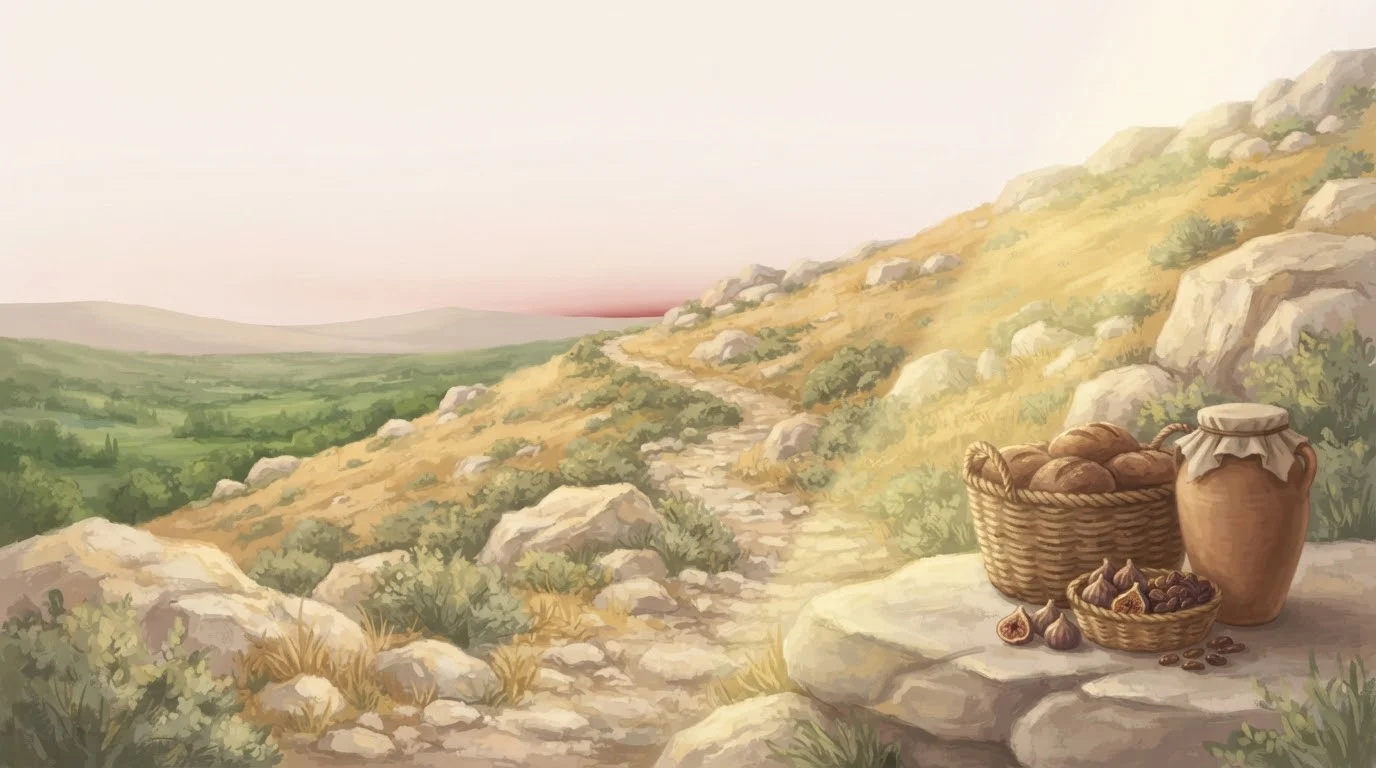
One of Nabal’s servants ran to Abigail, a woman of Nabal’s house whom Scripture calls prudent. She did not argue and she did not wait. She made haste, loaded asses with two hundred loaves, and two vessels of wine, and five sheep ready dressed, with raisins and figs, and rode out to meet him. She met David as she was coming down to the foot of the mountain.
She got down, fell at his feet, and took the blame on herself: Upon me let this iniquity be, my lord. Then she told him what his anger would cost him. When he was prince over Israel, she said, he would not want to carry the memory that thou hast shed innocent blood, or hast revenged thyself.
And David, sword on and four hundred men behind him, listened. Blessed be thy speech, he said. And blessed be thou, who hast kept me today, from coming to blood, and revenging me with my own hand.
The psalm asks God to remember David’s meekness. On that road David had none. Abigail carried it down the mountain to him in bread and figs, and he had just enough meekness left to take it. Most of us have stood on David’s road with the sword already on, and most of us needed an Abigail.
Who was St. Gregory the Wonderworker?
Gregory was first called Theodore, the gift of God. As a young man he set out to study law at Beirut, met Origen at Caesarea in Palestine, and stayed to study with him instead. His farewell speech to his teacher is, the Catholic Encyclopedia says, the first attempt at autobiography in Christian literature.
He became bishop of his own city at forty, when its Christians numbered only seventeen souls, and governed it for thirty years. The Encyclopedia is careful with the miracle stories told of him and says the imaginative element is very active in them. Yet it also says that the lives of few bishops of the third century are so well authenticated.
One detail in the article sounds like a bishop who knew meekness. To bring people to the festivals of the martyrs, Gregory organized profane amusements as an attraction for the pagans, ordinary pleasures beside the prayers, so that outsiders would feel free to come. He made room at the feast for people who did not yet believe.
But the clearest picture of his meekness is a letter he wrote after a war.
What did Gregory write after the invasion?
In Gregory’s time, the Encyclopedia says, the invading Goths had begun to aggravate a situation made difficult enough by the imperial persecutions. Raiders swept through Pontus. People were killed, and others were carried off as captives. Gregory answered a fellow bishop’s questions about the Christians left behind in a letter now called his Canonical Epistle.
What troubled him most was not the invaders. It was Christians who used the disaster. Some, he wrote, had dared to consider the crisis which brought destruction to all the very period for their own private aggrandizement. They kept goods the captives had left behind. Some went so far as to be detaining by force certain captives who have made their escape.
His sharpest sentence is about them: just as the Boradi and Goths brought the havoc of war on them, they make themselves Boradi and Goths to others. The people who grab in a catastrophe become the invasion for somebody else.
Then comes the meekness. Gregory did not call for revenge, and he did not let it pass. Those convicted of plundering were barred from the congregation, But if they have declared themselves and made restitution, they should be placed in the rank of the repentant. And those who gave back what they had picked up were to do it demanding neither recompense, nor reward, nor fee.
That is a strong hand used gently. It states the wrong plainly, it asks for repair, and it leaves a road open to the people who did it.
How do we practise meekness this week?
Crises come to every town: a fire, a flood, a layoff, an outbreak, a bitter season in the life of a country. In every one of them some people grab, and some people carry bread down the mountain. Gregory’s letter says which one a Christian is meant to be.
So this week, refuse to profit from anyone’s disaster. Do not hoard what others need, do not charge what a crisis will bear, and do not use somebody’s fall as your step up. If you have taken something that was not yours to take, give it back, and ask no reward for doing it.
And be Abigail for somebody. If you know a person with the sword already on, ready to say or post or do the thing that cannot be undone, go down the road with bread and a calm word. You may be the meekness they are grateful for later.
Today’s Gospel promises that whoever says to this mountain, Be thou removed, and believes, will have it done. Last year this Offering preached that verse. Today it is enough to remember that on the road near Carmel a mountain of anger moved, and it moved because someone came down the mountain with bread.
You do not have to keep any of this alone. The Bloom Network is free to join, if you would like a few people near you who would bring the bread, and the Faith in Bloom page will bring this Offering to your inbox at six each morning.
If none of this is yours as faith, keep the plain half: do not become the disaster in someone else’s life, and when you can, stand between an angry person and the harm they are about to do.
O Lord, remember David, and all his meekness. On the mountain road it came to David in a basket of bread. In Pontus it came in a bishop’s letter. Ask God today to remember all his meekness, and to lend you some of it.
↑ The order resumes below.
IX
Secret
English
May Thy Saints, we beseech Thee, O Lord, everywhere make us joyful: that, while we reflect upon their merits, we may enjoy their help. Through our Lord.
℣. World without end.
℟. Amen.
Latin
Sancti tui, quǽsumus, Dómine, nos ubíque lætíficant: ut, dum eórum mérita recólimus, patrocínia sentiámus. Per Dóminum…
℣. Per omnia saecula saeculorum.
℟. Amen.
X
The Holding
If you believe, hold this. The Church asks God to remember David and all his meekness, and God sends that meekness down the road to us in other people’s hands, and asks us to carry it on.
English
May Almighty God bless you: the Father, ☩ the Son, and the Holy Ghost.
℟. Amen.
Latin
Benedícat vos omnípotens Deus, Pater, et Fílius, ☩ et Spíritus Sanctus.
℟. Amen.
If that language is not yours, take this much: in a crisis, do not grab, and when you can, stop someone else from doing harm.
XI
Frequently Asked Questions
It comes from Psalm 131:1, O Lord, remember David, and all his meekness, the psalm verse of the Introit for a confessor bishop. The Latin word, mansuetúdinis, comes from mansuétus, used to the hand or tamed. Meekness in this sense is not weakness but strength that has learned to be gentle and not to grab.
Because St. Gregory’s feast falls on the same Mass every year, and this Offering printed it on 17 November 2025, with a homily on the Gospel’s Have the faith of God. Each proper matches that printing. Today’s homily preaches the Introit’s psalm verse, printed in eight posts and never preached until now.
St. Gregory of Neocaesarea, called Thaumaturgus, was born at Neocaesarea in Pontus about 213 and was first called Theodore. He studied for seven years under Origen at Caesarea in Palestine, became bishop of his own city at forty, and governed it for thirty years. He died there between 270 and 275.
Thaumaturgus means miracle-worker. The Catholic Encyclopedia says the fullest account of his miracles is St. Gregory of Nyssa’s Life of him, in which the imaginative element is very active. It also judges that if ever the title of “wonder-worker” was deserved, Gregory had a right to it.
A letter Gregory wrote to a fellow bishop after Goths and Boradi raided Pontus, about the Christians who had looted or kept captives’ goods. He barred the guilty from the congregation, admitted those who confessed and made restitution to the rank of the repentant, and wrote that those who grab in a crisis make themselves Boradi and Goths to others.
Because the Introit asks God to remember David’s meekness, and 1 Kings 25 tells of the day David lost it. He set out with four hundred men to kill Nabal’s household, and Abigail met him on the mountain road with bread and wine. David blessed her for keeping him from coming to blood.
Yes. Sign up on the Faith in Bloom page at bloomministries.org/faith. The Offering publishes at five each morning and the email leaves at six, and you can choose the Daily Offering, the Sunday Mass or both. Your address is never shared or sold, and unsubscribing takes one click.
No. The plain version works for anyone: do not become the disaster in someone else’s life, and when you can, stand between an angry person and the harm they are about to do. Faith in Bloom offers the liturgy to anyone and asks nothing of you in exchange.
Faith in Bloom is the daily liturgical work of Bloom Ministries, a 501(c)(3) nonprofit, and it is free to read and always will be. If it has been worth something to you and you are able, you can give once or give monthly below. Sending a post to one person who needs it does real work too.
Propers for the feast of St. Gregory the Wonderworker are taken from the 1962 Roman Missal, in the Missal’s Latin and in English. Scripture is quoted from the Douay-Rheims Bible.
The liturgical spine of Faith in Bloom is The New Marian Missal for Daily Mass by Sylvester P. Juergens, S.M., S.T.D., Regina Press, Imprimatur 1961. Faith in Bloom is offered by Bloom Ministries in the Independent Catholic tradition and is not affiliated with or recognized by the Roman Catholic Church.
