
Daily Offering · 24 November 2026 · St. John of the Cross
Daily Offering: November 24, 2026 | The Midst of the Church
Nine times this archive has printed today’s entrance chant, and nine times it has printed a word the Missal does not use. The Latin says Ecclésiæ. We have been giving you “assembly.” Today it is printed as it stands in the book, because the…
The order of this offering
Before the readings
The Word
Offering and Canon
I
Opening Address
Nine times this archive has printed today’s entrance chant, and nine times it has printed a word the Missal does not use. The Latin says Ecclésiæ. We have been giving you “assembly.” Today it is printed as it stands in the book, because the word the Missal chose is the whole of what this feast has to say to you: the mouth was opened in the midst of the Church.
Welcome to Bloom’s Daily Offering for Tuesday, November 24, 2026, the feast of St. John of the Cross, Confessor and Doctor of the Church. It is a feast of the third class, in white, with a commemoration of St. Chrysogonus, Martyr. The Gloria is said and the Creed is not, the Preface is the Common Preface, and there is no vigil and no octave. Tomorrow is St. Catherine of Alexandria.
Bloom offers this Mass in the Independent Catholic tradition, from the 1962 Roman Rite, and is not affiliated with or recognized by the Roman Catholic Church. We say that at the door every morning, because honesty is the first thing a church owes the people who walk in.
If you have ever come away from prayer with nothing to report and concluded from that you were failing at it, stay for the Introit. It names a place, and the place is not inside you.
II
A Word on Today’s Propers
This is a heavy shared-Common day and it is said here plainly. The Introit, the Gradual and the Gospel belong to the Common of Doctors, and all three have been printed in this archive repeatedly: on St. Albert the Great, November 15, 2025, St. Bonaventure, July 14, 2026, St. Bernard of Clairvaux, August 20, 2026, St. Augustine, August 28, 2026 and St. Jerome, September 30, 2026, among others. Each proper was checked against those printings on its own rather than as a set.
The Epistle is the same lesson from Timothy, and it was preached entire on St. Albert the Great last year, so it is printed today and not preached. The Gospel is in the same position: salt, light, the city on the hill and the least of the commandments were all opened on St. Bonaventure and again on St. Bernard. The Collect, the Secret and the commemoration prayers are proper to today, and all of them were preached last year on this same feast, November 24, 2025, which walked the Collect’s grammar clause by clause and read the Secret’s “wanting” in the old sense.
So the day’s fresh ground is one word in the Introit, which the last nine printings here translated past.
III
Introit
Ecclesiasticus 15:5; Psalm 91:2
English
In the midst of the Church He opened his mouth: and the Lord filled him with the spirit of wisdom and understanding: He clothed him with a robe of glory.
Ps. 91:2. It is good to give praise to the Lord: and to sing to thy name, O most High.
Glory be to the Father, and to the Son, and to the Holy Ghost. As it was in the beginning, is now, and ever shall be, world without end. Amen.
In the midst of the Church He opened his mouth: and the Lord filled him with the spirit of wisdom and understanding: He clothed him with a robe of glory.
Latin
In médio Ecclésiæ apéruit os ejus: et implévit eum Dóminus spíritu sapiéntiæ et intelléctus: stolam glóriæ índuit eum.
Ps. 91:2. Bonum est confitéri Dómino: et psállere nómini tuo, Altíssime.
Glória Patri…
In médio Ecclésiæ apéruit os ejus: et implévit eum Dóminus spíritu sapiéntiæ et intelléctus: stolam glóriæ índuit eum.
IV
Collect
(℣. marks what the priest says. ℟. marks the answer of the server and the people.)
English
Let us pray.
O God, Who didst make blessed John, Thy Confessor and Doctor, an exceeding great lover of perfect self-denial and of the Cross: grant that, cleaving continually to the imitation of him, we may attain to everlasting glory. Through our Lord Jesus Christ, Thy Son, Who liveth and reigneth with Thee in the unity of the Holy Ghost, God, world without end. Amen.
℟. Amen.
Latin
Deus, qui sanctum Joánnem Confessórem tuum atque Doctórem perféctæ sui abnegatiónis et Crucis amatórem exímium effecísti: concéde; ut, ejus imitatióni júgiter inhæréntes, glóriam assequámur ætérnam.
Per Dominum…
V
The Commemoration
St. Chrysogonus, a martyr, is commemorated today. The Catholic Encyclopedia’s article on him says he “suffered at Aquileia, probably during the persecution of Diocletian,” and that about the sixth century “arose a legend of the martyr that made him a Roman.” The Church keeps the name and keeps the record honest about itself at the same time.
English
Let us pray.
Be attentive, O Lord, to our supplications: that we, who know ourselves guilty by reason of our iniquity, may be delivered by the intercession of blessed Chrysogonus, Thy Martyr. Through our Lord Jesus Christ, Thy Son, Who liveth and reigneth with Thee in the unity of the Holy Ghost, God, world without end. Amen.
℟. Amen.
Latin
Adésto, Dómine, supplicatiónibus nostris: ut, qui ex iniquitáte nostra reos nos esse cognóscimus, beáti Chrysógoni Mártyris tui intercessióne liberémur.
Per Dominum…
VI
Epistle
English
Lesson from the second Epistle of blessed Paul the Apostle to Timothy.
Dearly beloved: I charge thee, before God and Jesus Christ, who shall judge the living and the dead, by his coming, and his kingdom: Preach the word: be instant in season, out of season: reprove, entreat, rebuke in all patience and doctrine. For there shall be a time, when they will not endure sound doctrine; but, according to their own desires, they will heap to themselves teachers, having itching ears: And will indeed turn away their hearing from the truth, but will be turned unto fables.
But be thou vigilant, labour in all things, do the work of an evangelist, fulfil thy ministry. Be sober. For I am even now ready to be sacrificed: and the time of my dissolution is at hand. I have fought a good fight, I have finished my course, I have kept the faith.
As to the rest, there is laid up for me a crown of justice, which the Lord the just judge will render to me in that day: and not only to me, but to them also that love his coming.
Latin
Léctio Epístolæ beáti Pauli Apóstoli ad Timótheum.
Caríssime: Testíficor coram Deo, et Jesu Christo, qui judicatúrus est vivos et mórtuos, per advéntum ipsíus et regnum ejus: prǽdica verbum, insta opportúne, importúne: árgue, óbsecra, íncrepa in omni patiéntia, et doctrína. Erit enim tempus, cum sanam doctrínam non sustinébunt, sed ad sua desidéria coacervábunt sibi magístros, pruriéntes áuribus, et a veritáte quidem audítum avértent, ad fábulas autem converténtur.
Tu vero vígila, in ómnibus labóra, opus fac Evangelístæ, ministérium tuum ímple. Sóbrius esto. Ego enim jam delíbor, et tempus resolutiónis meæ instat. Bonum certámen certávi, cursum consummávi, fidem servávi.
In réliquo repósita est mihi coróna justítiæ, quam reddet mihi Dóminus in illa die justus judex: non solum autem mihi, sed et iis, qui díligunt advéntum ejus.
VII
Gradual
Psalm 36:30-31; Ecclesiasticus 45:9
English
The mouth of the just shall meditate wisdom: and his tongue shall speak judgment.
℣. The law of his God is in his heart, and his steps shall not be supplanted.
Allelúja, allelúja.
℣. The Lord loved him and adorned him: He clothed him with a robe of glory. Allelúja.
Latin
Os justi meditábitur sapiéntiam, et lingua ejus loquétur judícium.
℣. Lex Dei ejus in corde ipsíus: et non supplantabúntur gressus ejus.
Allelúja, allelúja.
℣. Amávit eum Dóminus, et ornávit eum: stolam glóriæ índuit eum. Allelúja.
VIII
Gospel
English
Continuation ☩ of the holy Gospel according to Matthew.
At that time, Jesus said to His disciples: You are the salt of the earth. But if the salt lose its savour, wherewith shall it be salted? It is good for nothing any more but to be cast out, and to be trodden on by men. You are the light of the world. A city seated on a mountain cannot be hid. Neither do men light a candle and put it under a bushel, but upon a candlestick, that it may shine to all that are in the house. So let your light shine before men, that they may see your good works, and glorify your Father who is in heaven.
Do not think that I am come to destroy the law, or the prophets. I am not come to destroy, but to fulfill. For amen I say unto you, till heaven and earth pass, one jot, or one tittle shall not pass of the law, till all be fulfilled. He therefore that shall break one of these least commandments, and shall so teach men, shall be called the least in the kingdom of heaven. But he that shall do and teach, he shall be called great in the kingdom of heaven.
Latin
Sequéntia ☩ sancti Evangélii secúndum Matthǽum.
In illo témpore: Dixit Jesus discípulis suis: Vos estis sal terræ. Quod si sal evanúerit, in quo saliétur? Ad níhilum valet ultra, nisi ut mittátur foras, et conculcétur ab homínibus. Vos estis lux mundi. Non potest cívitas abscóndi supra montem pósita. Neque accéndunt lucérnam, et ponunt eam sub módio, sed super candelábrum, ut lúceat ómnibus qui in domo sunt. Sic lúceat lux vestra coram homínibus, ut vídeant ópera vestra bona, et gloríficent Patrem vestrum, qui in cælis est.
Nolíte putáre, quóniam veni sólvere legem aut prophétas: non veni sólvere, sed adimplére. Amen quippe dico vobis, donec tránseat cælum et terra, jota unum aut unus apex non præteríbit a lege, donec ómnia fiant. Qui ergo sólverit unum de mandátis istis mínimis, et docúerit sic hómines, mínimus vocábitur in regno cælórum: qui autem fécerit et docúerit, hic magnus vocábitur in regno cælórum.
The Offering
Daily Homily | The Midst of the Church
It means a room with other people in it. The Missal’s Latin for today’s entrance chant is In médio Ecclésiæ, and the Douay-Rheims of Ecclesiasticus 15:5 reads “And in the midst of the church…
What does the midst of the Church mean?
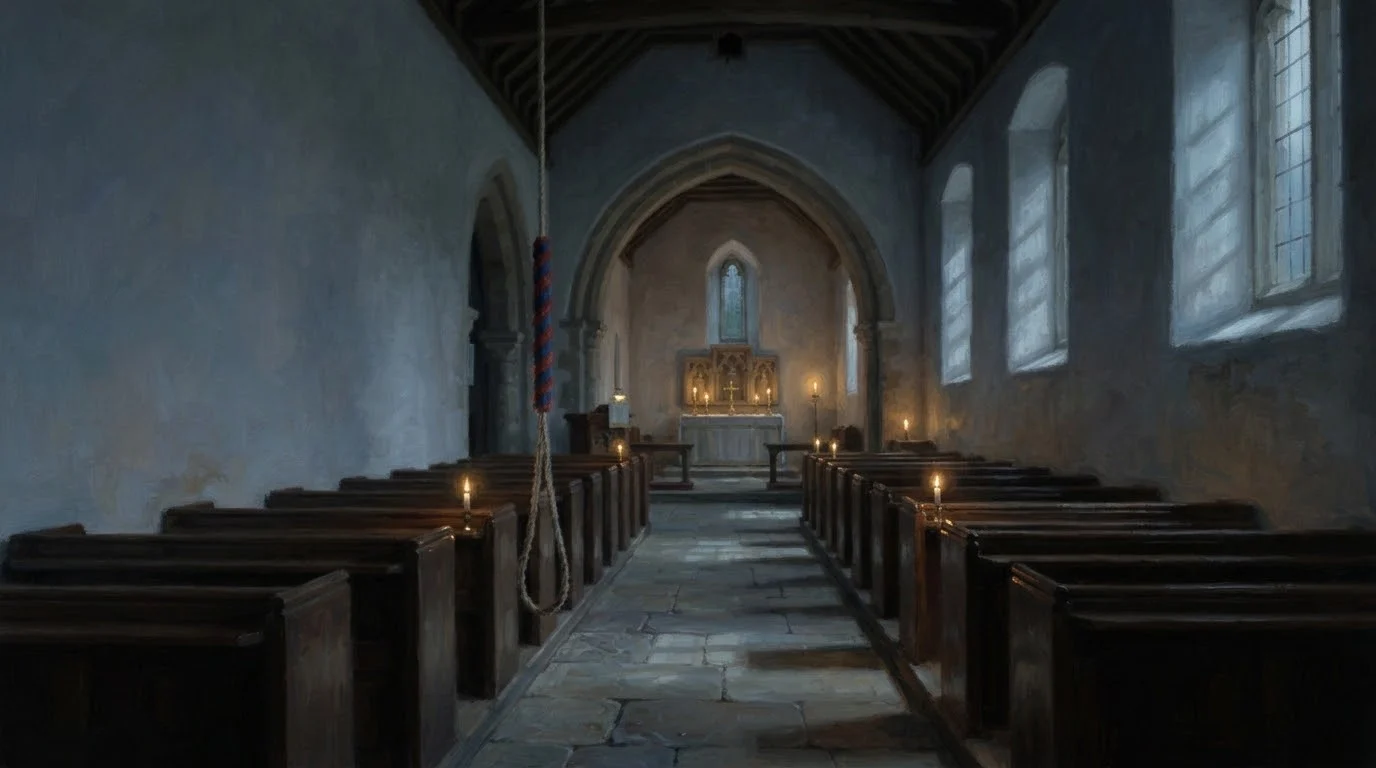
It means a room with other people in it. The Missal’s Latin for today’s entrance chant is In médio Ecclésiæ, and the Douay-Rheims of Ecclesiasticus 15:5 reads “And in the midst of the church she shall open his mouth.” Nine times this archive has printed that antiphon and nine times it has said “assembly” instead.
Assembly is not a lie. It is the general word standing where the Missal put the particular one, and the particular one is a building full of people you did not choose, on a Tuesday, at a stated hour. The Church sings this over her Doctors, and today she sings it over the one whose name has become a byword for the night of the soul. Of all the men she could have placed in the midst of the Church, she chose the one the world files under solitude.
Hold the two halves of that together. A man is remembered for what happened to him when he was alone and the Church’s own chant for him names the midst of the Church. She did not have to do that. She was not short of other words.
Who opens a mouth in this antiphon?
The Lord does, and He does it three times while the saint does nothing. Apéruit os ejus is a third-person singular perfect active with the Lord as its subject, named outright in the clause that follows: implévit eum Dóminus. Then índuit eum.
Three finite verbs, one subject, and John appears in all three only as the thing acted upon, os ejus, eum, eum, accusative every time. The Douay’s own version has Wisdom as the opener and the saint as the opened. Nowhere in the antiphon is the man given a verb of his own.
That matters because of where it happens. Had the chant said his mouth was opened in a cell at Toledo, it would still be true and it would describe a different religion. It says the midst of the Church, and it puts the sentence in the perfect tense, which is the tense for a thing already done.
What has the ladder actually grown?
It has grown people who think they have nothing to bring. The teaching on trial this morning says that the serious work with God is done alone, that what happens in the midst of the Church is the public report on it, and that the measure of your standing is therefore what goes on when you are by yourself. Nobody has to go looking for that idea. It is the ordinary air of a great deal of devotional writing, and this saint’s name is used to sell it more than any other.
Run it against its crop. What it has grown is people who stopped coming because nothing was happening inside them. People who time their prayer and grade it. People handed a ladder by a director and told which rung they had reached, who then spent twenty years anxious about slipping.
People who treat a dry morning as evidence against themselves. And a market in staged ascent, where a Carmelite’s name is attached to a rung you are told you can reach.
Notice what the crop has in common. Every one of those is a person who went looking for the evidence in the one place where nobody else can check it, and found nothing, and drew the obvious conclusion about themselves. The teaching does not fail by being too demanding. It fails by putting the whole examination somewhere no examiner can reach.
The man himself is not on trial. His name was borrowed for the arrangement, and the people who paid were the ones least able to argue back, because the arrangement had already ruled out anyone they might have asked. They were sitting in the midst of the Church the whole time.
The antiphon refuses the arrangement, and it refuses it by naming a place. The opening happened in the midst of the Church. Not reported there afterwards. There.
If that is where the Church says the mouth of her greatest solitary was opened, then the midst of the Church is not the room where you show your work. It is the room where the work is done to you.
Say the obvious inversion out loud before anybody builds it. This does not mean prayer alone is worthless, and it does not mean a person who cannot get to a church is outside the sentence. The chant names where a mouth was opened.
It does not name a condition anybody has to meet, and it does not turn the midst of the Church into the thing that does the opening. The Lord is the subject of every verb in the antiphon, and He is not confined to a building by a sentence that happens to mention one. A reader in a hospital bed is not being told she has missed it.
Where does a bellfounder stand to work?
In the open, with the parish listening, which is the point. There is a story told of a bellfounder who brought a new tenor out to the frame in the yard behind a village church, struck it once, and told the churchwardens it was flat and he would be cutting metal out of it before it went up. The warden who had raised the money said the bell was perfect, that it had come out of the loam sweet as anything, and that cutting it was vandalism dressed up as a trade. He said it loudly, in front of the carters and two of the ringers and a dozen people who had come out to hear the thing rung.
The founder cut anyway. He turned metal off the inside of the lip, a little at a time, and struck it again after each pass, and the note came up in front of all of them until the warden himself could hear where it had been and where it had got to. Nobody had to take his word for it. The whole operation happened in the middle of the yard, in the middle of the afternoon, with the man who thought he was wrong standing close enough to argue.
What the trade knows is this. A bell does not find its note. A bell has a mouth and no say in what comes out of it. The note is put there by somebody else’s hand, working to a shape the bell did not choose.
The founder’s own conviction about the note settled nothing in that yard. The proof was a sound that filled the valley. That is apéruit os ejus in trade form. The founder did his cutting in the midst of the Church’s own yard because that is where a note can be contradicted.
Does this make private prayer worthless?
No, and the Mass itself says so, because the Collect asks for something the antiphon does not. The Collect calls John perféctæ sui abnegatiónis et Crucis amatórem exímium and says God made him that, and then it asks only that we may attain to everlasting glory. It does not ask that we become lovers of self-denial, and it does not ask us to reproduce anything of his. A prayer that can describe a man’s whole interior life and then decline to require it of you is not a prayer that despises what he did alone. It simply refuses to put you on his ladder.
The antiphon is a statement of location. On the feast of the Church’s great teacher of the dark night, her own entrance chant puts the opening of his mouth in the midst of the Church, in the plural, in the daylight, where you are already standing.
You came in with nothing to report. The antiphon does not ask you for a report. It tells you where the thing happens and it tells you whose hand does it, and neither answer is in you. Whatever is going to be opened this morning is opened in the midst of the Church, and you are in the midst of the Church, and that is the entire qualification.
↑ The order resumes below.
X
Secret
English
May the pious prayer of holy John, Thy Confessor and illustrious Doctor, be not wanting to us, O Lord: that it may both make our offerings acceptable, and ever win for us Thy mercy. Through our Lord Jesus Christ, Thy Son, Who liveth and reigneth with Thee in the unity of the Holy Ghost, God, world without end. Amen.
Latin
Sancti Joánnis Confessóris tui atque Doctóris nobis, Dómine, pia non desit orátio: quæ et múnera nostra concíliet; et tuam nobis indulgéntiam semper obtíneat.
Per Dominum…
The commemoration of St. Chrysogonus is said again over the gifts.
English
Be appeased, we beseech Thee, O Lord, by the gifts we offer: and, by the intercession of blessed Chrysogonus, Thy Martyr, defend us from all dangers. Through our Lord Jesus Christ, Thy Son, Who liveth and reigneth with Thee in the unity of the Holy Ghost, God, world without end. Amen.
Latin
Oblátis, quǽsumus, Dómine, placáre munéribus: et, intercedénte beáto Chrysógono Mártyre tuo, a cunctis nos defénde perículis.
Per Dominum…
XI
The Holding
If you believe, hold this. The mouth was opened in the midst of the Church, and the hand that opened it is named in the next clause and is not yours.
English
May Almighty God bless you: the Father, ☩ the Son, and the Holy Ghost.
℟. Amen.
Latin
Benedícat vos omnípotens Deus, Pater, et Fílius, ☩ et Spíritus Sanctus.
℟. Amen.
If that language is not yours, take this much. When somebody tells you the real version of a thing happens privately and what you do in company is only the showing of it, ask them what that idea has grown in the people who believed it.
He was a Spanish Carmelite, born John de Yepes at Hontoveros in Old Castile in 1542 and dead at Ubeda in Andalusia on 14 December 1591. The Catholic Encyclopedia’s article on him records that he was apprenticed to an artisan as a boy and “seemed incapable of learning anything,” and that the governor of the hospital at Medina then took him into his service, where for seven years he divided his time between study and “waiting on the poorest of the poor.” He was beatified on 25 January 1675 and canonized on 27 December 1726. The 1962 calendar keeps his feast on 24 November rather than on the day of his death.
Because the Missal’s Latin says Ecclésiæ and the Douay-Rheims says church. Ecclesiasticus 15:5 in the Douay reads “And in the midst of the church she shall open his mouth, and shall fill him with the spirit of wisdom and understanding.” The English served to us by our calendar source gives “in the midst of the assembly,” and this archive printed that wording nine times before today. It is a defensible general rendering, but it is not what either the Latin or the Douay has, and on this feast the difference carries the whole homily, so the Missal’s own word is printed and the change is stated here.
The Catholic Encyclopedia says he was ordered by his provincial to return to Medina, refused “owing to the fact that he held his office not from the order but from the Apostolic delegate,” and was then “taken prisoner in the night of 3 December, 1577, and carried off to Toledo, where he suffered for more than nine months close imprisonment in a narrow, stifling cell.” It records that he escaped in August 1578. The article makes a point of adding that he has often been painted as a grim man, and says in its own words that “nothing could be more untrue.”
It is cited to that verse, and its Latin does not match it. The Douay of Ecclesiasticus 45:9 reads “And he girded him about with a glorious girdle, and clothed him with a robe of glory,” while the Missal’s Alleluia verse reads Amávit eum Dóminus, et ornávit eum: stolam glóriæ índuit eum, “The Lord loved him and adorned him: He clothed him with a robe of glory.” Only the last clause is shared. Both sources we cross-checked today print the Douay wording beside that Latin, so the mismatch is not ours alone. The English here is set to the Latin actually sung, and the citation is left as the Missal gives it.
Because this project will not present a text as new when it is not. 2 Timothy 4:1-8 belongs to the Common of Doctors and has been printed in this archive repeatedly, and it was opened at length on St. Albert the Great, November 15, 2025, which took Paul’s charge to preach in season and out of season as its whole subject. The Gospel is in the same position after St. Bonaventure and St. Bernard. Both are printed in full, because every proper is printed here, and neither is preached today.
Not on a third-class feast. The 1962 Code of Rubrics lists the Creed at number 475 for Sundays, first-class feasts and votive Masses, second-class feasts of the Lord and of Our Lady, the three surviving octaves, and the birthdays of the apostles and evangelists. Number 476 then says it is not said “in festive and votive Masses of the 3rd and 4th class,” and adds that it is not said “by reason of any commemoration occurring in the Mass.” Doctors of the Church are not named in either rule. So today the Gloria is said and the Creed is not.
Very little, and the Church’s own reference work says so. The Catholic Encyclopedia reports that he “suffered at Aquileia, probably during the persecution of Diocletian,” was buried there and venerated in that region, and that “about the sixth century arose a legend of the martyr that made him a Roman” and attached him to St. Anastasia as her teacher. The titular church in Trastevere that bears his name is first mentioned in the signatures of a Roman synod in 499 and probably dates from the fourth century, and the article will not say whether it was named for the martyr or for a founder of the same name. The hedging is the honest part.
No. The thing being argued here is about where a claim gets tested, and it survives translation. If somebody tells you the real work is done where only you can assess it, and that what happens in company is the presentation of a result, notice that this puts the whole grading inside your own head, where it can never be checked or appealed. The alternative is not performance but simply doing things where they can be heard, among people who can tell you that you are flat. You are welcome to take that much and leave the rest, and you are welcome here either way.
Faith in Bloom is the daily liturgical work of Bloom Ministries, a 501(c)(3) nonprofit, and it is free to read and always will be. If it has been worth something to you and you are able, you can give once or give monthly below. Sending a post to one person who needs it does real work too.
Propers for the feast of St. John of the Cross, Confessor and Doctor, and for the commemoration of St. Chrysogonus, Martyr, are taken from the 1962 Roman Missal, in the Missal’s Latin and in English. Scripture is quoted from the Douay-Rheims Bible. The historical notes are drawn from the Catholic Encyclopedia’s articles on St. John of the Cross and St. Chrysogonus, and the rubrical note on the Creed from the 1962 Code of Rubrics, numbers 475 and 476. The English of the Introit, the orations and the Alleluia verse has been set to the Missal’s Latin where the served translation departed from it, and each change is stated in the questions above.
The liturgical spine of Faith in Bloom is The New Marian Missal for Daily Mass by Sylvester P. Juergens, S.M., S.T.D., Regina Press, Imprimatur 1961. Faith in Bloom is offered by Bloom Ministries in the Independent Catholic tradition and is not affiliated with or recognized by the Roman Catholic Church.
