
Daily Offering · 7 November 2026 · V Mass of the B. V. M. – Salve, Sancta Parens
Daily Offering: November 7, 2026 | Likewise I Rested
Saturday has come. You may have slept late for the first time in a week, or you may have woken at the usual hour with your shoulders still up near your ears. Either way, the Lesson in today’s Mass has one sentence for you,…
The order of this offering
Before the readings
The Word
Offering and Canon
I
Opening Address
Saturday has come. You may have slept late for the first time in a week, or you may have woken at the usual hour with your shoulders still up near your ears. Either way, the Lesson in today’s Mass has one sentence for you, spoken by the Wisdom of God herself: in the holy city likewise I rested.
Welcome to Bloom’s Daily Offering for Saturday, November 7, 2026. With no feast on the calendar, the 1962 Missal gives this Saturday a Mass of Our Lady, Salve, sancta parens, of the fourth class, in white, with no commemoration. The Preface is the Preface of the Blessed Virgin.
After a week this Offering spent with Paul’s letter and with prayer for the city, the Missal hands us something simpler today: permission to stop, from the lips of God’s own Wisdom. Wherever this finds you, you are welcome, and you do not have to be useful to belong here.
II
A Word on Today’s Propers
This Mass of Our Lady was printed here a week ago, on Saturday, October 31, whose homily preached the Lesson’s an honourable people, and before that on November 8, 2025, whose homily heard the Lesson’s verbs as verbs of remaining. Each proper was checked against last Saturday’s printing one at a time, and they match.
Every proper is printed in full again, in Latin and English. The homily stays with one verb in the middle of the Lesson that neither homily made its subject: requiévi, I rested.
III
Introit
English
Hail, holy Mother, who in childbirth didst bring forth the King Who ruleth heaven and earth, world without end.
Ps. 44:2. My heart hath uttered a good word: I speak my works to the King.
Glory be to the Father, and to the Son, and to the Holy Ghost. As it was in the beginning, is now, and ever shall be, world without end. Amen.
Hail, holy Mother, who in childbirth didst bring forth the King Who ruleth heaven and earth, world without end.
Latin
Salve, sancta parens, eníxa puérpera Regem: qui cælum terrámque regit in sǽcula sæculórum.
Ps. 44:2. Eructávit cor meum verbum bonum: dico ego ópera mea Regi.
Glória Patri…
Salve, sancta parens, eníxa puérpera Regem: qui cælum terrámque regit in sǽcula sæculórum.
IV
Collect
(℣. marks what the priest says. ℟. marks the answer of the server and the people.)
English
Let us pray.
Grant to us, Thy servants, we beseech Thee, O Lord God, that we may enjoy perpetual health of mind and body: and by the glorious intercession of blessed Mary, ever Virgin, may be delivered from present sorrow and enjoy everlasting gladness. Through our Lord.
℟. Amen.
Latin
Orémus.
Concéde nos fámulos tuos, quǽsumus, Dómine Deus, perpétua mentis et córporis sanitáte gaudére: et, gloriósa beátæ Maríæ semper Vírginis intercessióne, a præsénti liberári tristítia, et ætérna pérfrui lætítia. Per Dóminum…
℟. Amen.
V
Epistle
English
Lesson from the Book of Wisdom.
From the beginning, and before the world, was I created, and unto the world to come I shall not cease to be, and in the holy dwelling place I have ministered before Him. And so was I established in Sion, and in the holy city likewise I rested, and my power was in Jerusalem. And I took root in an honourable people, and in the portion of my God His inheritance, and my abode is in the full assembly of saints.
℟. Thanks be to God.
Latin
Léctio libri Sapiéntiæ.
Ab inítio et ante sǽcula creáta sum, et usque ad futúrum sǽculum non désinam, et in habitatióne sancta coram ipso ministrávi. Et sic in Sion firmáta sum, et in civitáte sanctificáta simíliter requiévi, et in Jerúsalem potéstas mea. Et radicávi in pópulo honorificáto, et in parte Dei mei heréditas illíus, et in plenitúdine sanctórum deténtio mea.
℟. Deo gratias.
VI
Gradual
Gradual and Alleluia of the Blessed Virgin
English
Blessed and venerable art thou, O Virgin Mary, who without stain of thy purity wast found the Mother of the Saviour.
℣. O Virgin Mother of God, He Whom the whole world containeth not, being made man, shut Himself up within thy womb. Alleluia, alleluia.
℣. After childbirth thou didst remain a pure virgin: O Mother of God, intercede for us. Alleluia.
Latin
Benedícta et venerábilis es, Virgo María: quæ sine tactu pudóris invénta es Mater Salvatóris.
℣. Virgo, Dei Génetrix, quem totus non capit orbis, in tua se clausit víscera factus homo. Allelúja, allelúja.
℣. Post partum, Virgo, invioláta permansísti: Dei Génetrix, intercéde pro nobis. Allelúja.
VII
Gospel
English
℣. Continuation ☩ of the holy Gospel according to Luke.
℟. Glory be to Thee, O Lord.
At that time, as Jesus was speaking to the multitudes, a certain woman from the crowd, lifting up her voice, said to Him: Blessed is the womb that bore Thee, and the paps that gave Thee suck. But He said: Yea rather, blessed are they who hear the word of God, and keep it.
℟. Praise be to Thee, O Christ.
Latin
℣. Sequéntia ☩ sancti Evangélii secúndum Lucam.
℟. Gloria tibi, Domine.
In illo témpore: Loquénte Jesu ad turbas, extóllens vocem quædam múlier de turba, dixit illi: Beátus venter, qui te portávit, et úbera, quæ suxísti. At ille dixit: Quinímmo beáti, qui áudiunt verbum Dei, et custódiunt illud.
℟. Laus tibi, Christe.
The Offering
Daily Homily | Likewise I Rested
Today’s Lesson is Wisdom speaking about herself, and she starts large. She was with God from the beginning, and before the world. She ministered before Him, which is the language of service, of priests…
Why does Wisdom say, likewise I rested?
Today’s Lesson is Wisdom speaking about herself, and she starts large. She was with God from the beginning, and before the world. She ministered before Him, which is the language of service, of priests at work in the holy place. She was established in Sion. Then, before she says one word about power, she says she rested.
Read the whole line slowly: in the holy city likewise I rested, and my power was in Jerusalem. Rest comes first and power second, side by side, with no apology between them. The rest does not cost her the power. Her rest is part of how her strength stands in that city.
The order of her verbs matters too. She served first and rested after; the rest in this Lesson is not running away from the work. It is what the work is for. Rest, here, is not what the weak do when they run out. It is what the strongest thing God ever made does in the place it calls holy.
So if anyone has taught you that stopping is failure, Wisdom disagrees. Likewise I rested, she says, and her power stayed exactly where it was. If the Wisdom of God can sit down in the holy city, you may sit down in yours.
Who rested first?
When Wisdom says likewise I rested, the Latin verb is requievi. It is the same verb the Vulgate uses on the Bible’s first pages, where God finishes making the world: requievit die septimo. In the Douay, he rested on the seventh day from all his work which he had done.
Then Genesis adds what God did with that rest: he blessed the seventh day, and sanctified it. The city in today’s Lesson is civitate sanctificata, the sanctified city. Wisdom rests where things have been made holy, and the first thing God made holy in Scripture was not a temple or a mountain. It was a day of rest.
And the Law made sure that rest was never a privilege of the comfortable. In Deuteronomy the Sabbath is commanded that thy manservant and thy maidservant may rest, even as thyself, and for the stranger that is within thy gates. Then comes the reason: Remember that thou also didst serve in Egypt. People who had been worked without end were told to make sure that the people under their own roof were not worked without end either.
Today is the seventh day of the week. You do not have to earn its rest, because God did not rest from exhaustion; He rested and called it holy, and then He gave the day away.
Why would an apostle stroke a bird?
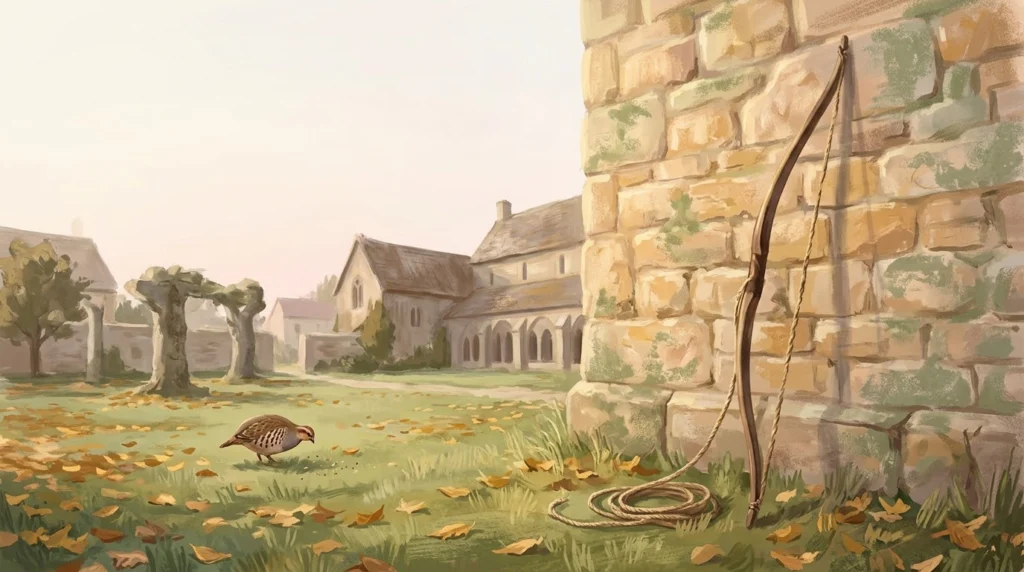
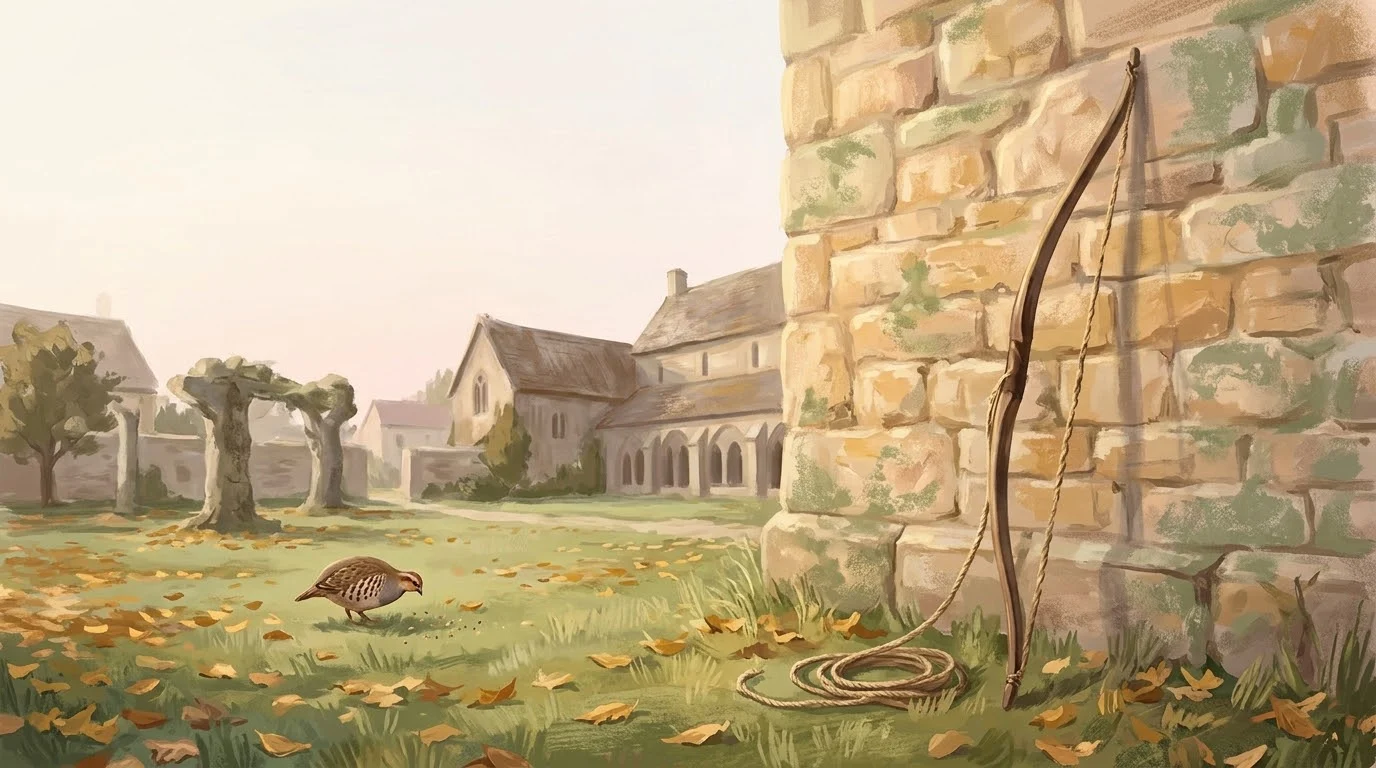
John Cassian, who wrote down the teaching of the desert monks, passes on what he calls an old story in his Conferences. It is said that the blessed John, while he was gently stroking a partridge with his hands suddenly saw a philosopher approaching him in the garb of a hunter. The visitor could not believe it. Was this really the great apostle, spending his time on a bird?
John asked him what he was carrying. A bow, the man said. Then why not keep it bent all the time? The hunter knew the answer from his trade: the force of its stiffness would be relaxed by its being continually bent, and when the moment came for it to send stouter arrows, the strength would be gone.
So John turned the hunter’s own answer back to him. A mind is like that, he said: unless it sometimes relieved and relaxed the rigour of its purpose by some recreation, the spirit would lose its spring owing to the unbroken strain.
Cassian is careful to say the story was handed down, not recorded on the day, and it cannot be checked now. But the monks kept it because it tells the truth about souls and bodies, the same truth Wisdom tells when she says likewise I rested. You have been strung tight all week. An unstrung bow is not a broken bow; it is a bow being kept for the day it is needed.
Is rest the same as laziness?
Many of us were raised to feel guilty the moment we sit down, and the old word for that guilt is sloth. It helps to know what the Church meant by it. St. Thomas Aquinas, in the Summa, says that sloth denotes sorrow for spiritual good: a heaviness that turns away from God’s good gifts. Rest that receives God’s gifts with thanks is the opposite of that.
And if a heaviness has settled on you that no amount of rest will lift, hear this gently: that may not be a sin to confess at all. It may be an illness to be cared for, and you deserve care.
Some of you have been told your rest is laziness because you are disabled or chronically ill, because your body needs more stopping than other bodies do. That is a lie about you, and Scripture answers it. Christ said: The sabbath was made for man, and not man for the sabbath. Rest was made for you. You were not made to earn it.
When the apostles gathered round Him full of reports of all they had done, He did not ask for more. He said, Come apart into a desert place, and rest a little. Mark tells us why: they had not so much as time to eat. The Lord who sends people out is the same Lord who calls them aside to sit down.
He rested Himself. On the lake in a storm, Mark says, he was in the hinder part of the ship, sleeping upon a pillow, while His friends were sure they would drown. When they woke Him, He said to the sea, Peace, be still. The One who could quiet a storm also knew how to sleep through the start of one.
How do we rest this weekend?
This week asked a great deal of a great many people. Whatever you hoped for on Tuesday, your body has probably been carrying it since, and a Saturday is a good day to set some of it down.
Take one hour today that is not for producing anything. Walk slowly, sit in the sun, cook something for the pleasure of it, or do nothing at all, and do not apologise to anyone for it. That is how to rest without guilt: not by deserving it, but by receiving it.
If an hour is impossible today, because the shift will not move or the person in your care cannot be left, take the ten minutes you can find and call them holy. God measured His rest in a day, but He does not measure yours against anyone else’s.
Then give an hour away. Deuteronomy’s command was for the household’s servants and strangers too, so find one person who never gets a day off, a carer, a coworker on a double shift, a neighbour caring for someone sick, and take a turn so they can sit down. Wisdom said likewise I rested; let someone else say it today because of you.
Then tonight, before you sleep, pray two lines of Psalm 4 in place of one more glance at the day’s troubles: In peace in the selfsame I will sleep, and I will rest: For thou, O Lord, singularly hast settled me in hope. The Latin of that psalm says requiescam, I will rest, the same verb Wisdom uses today.
Rest is easier with company. The Bloom Network is free to join, if you would like a few people to keep the day with you, and the Offering can arrive in your inbox at six each morning from the Faith in Bloom page, so there is one less thing to chase.
And if none of this is yours as faith, keep the plain half: you are not a machine, and an hour of rest today is not stolen from anyone.
The Wisdom that ruled in Jerusalem sat down in the holy city, and God blessed the day He rested before He blessed anything else. Your rest is not wages. It is a gift, and it was made with you in mind.
↑ The order resumes below.
IX
Secret
English
By Thy mercy, O Lord, and by the intercession of blessed Mary, ever Virgin, may this oblation profit us unto prosperity and peace, now and for ever. Through our Lord.
℣. World without end.
℟. Amen.
Latin
Tua, Dómine, propitiatióne, et beátæ Maríæ semper Vírginis intercessióne, ad perpétuam atque præséntem hæc oblátio nobis profíciat prosperitátem et pacem. Per Dóminum…
℣. Per omnia saecula saeculorum.
℟. Amen.
X
The Holding
If you believe, hold this. God rested, and blessed the day He rested, and His Wisdom says, likewise I rested. Rest without guilt today, and let tomorrow’s Sunday be lighter than this week was.
English
May Almighty God bless you: the Father, ☩ the Son, and the Holy Ghost.
℟. Amen.
Latin
Benedícat vos omnípotens Deus, Pater, et Fílius, ☩ et Spíritus Sanctus.
℟. Amen.
If that language is not yours, take this much: an hour of doing nothing today is not a debt you owe anyone.
XI
Frequently Asked Questions
When a Saturday has no feast of its own, the 1962 Missal gives it a Mass of Our Lady, and in this part of the year that Mass is Salve, sancta parens. Saturday, October 31 had no feast either, so the same Mass was said a week ago, and it was said here on November 8, 2025 as well. Each proper matches last Saturday’s, and today’s homily preaches a line of the Lesson those homilies did not make their subject.
In today’s Lesson the Wisdom of God says, in the holy city likewise I rested, and my power was in Jerusalem. The Latin verb, requievi, is the same verb the Vulgate uses in Genesis 2:2, where God rested on the seventh day. When Wisdom says likewise I rested, she means that rest belongs to God’s own Wisdom and sits beside her power, not against it. The Church reads these words on Our Lady’s Saturday.
No. St. Thomas Aquinas says that sloth denotes sorrow for spiritual good, a heaviness that turns away from God’s gifts. Resting with thanks receives those gifts, which is the opposite. If a heaviness will not lift however much you rest, that may be an illness rather than a sin, and it deserves care from someone you trust, a doctor or a counsellor.
John Cassian, a monk who wrote down the teaching of the desert monks in his Conferences, tells it in Conference XXIV as an old story handed down. In it the apostle John, stroking a partridge, explains to a hunter that a bow kept always bent loses its strength, and that a mind needs relaxing too. Cassian presents it as tradition, not as an eyewitness record.
Start with what Christ said: The sabbath was made for man, and not man for the sabbath. When His apostles were too busy even to eat, He told them, Come apart into a desert place, and rest a little. Take one hour that is not for producing anything, and if guilt arrives, tell God about it and keep resting. If you are disabled or chronically ill, the rest your body needs is not laziness.
When a Saturday has no feast and no other celebration of higher rank, the 1962 Missal appoints a Mass of the Blessed Virgin for it, of the fourth class, in white. Its Lesson, from Ecclesiasticus 24, gives voice to the Wisdom of God, and the Church reads it on Our Lady’s days. Today’s form is the one the Missal gives for Saturdays in this season.
Yes. Sign up on the Faith in Bloom page at bloomministries.org/faith. The Offering publishes at five each morning and the email leaves at six, and you can choose the Daily Offering, the Sunday Mass or both. Your address is never shared or sold, and unsubscribing takes one click.
No. Anyone can take the plain version: you are not a machine, and stopping for an hour is not stealing from anyone. Faith in Bloom offers the liturgy to anyone and asks nothing of you in exchange.
Faith in Bloom is the daily liturgical work of Bloom Ministries, a 501(c)(3) nonprofit, and it is free to read and always will be. If it has been worth something to you and you are able, you can give once or give monthly below. Sending a post to one person who needs it does real work too.
Propers for the Saturday Mass of the Blessed Virgin are taken from the 1962 Roman Missal, in the Missal’s Latin and in English. Scripture is quoted from the Douay-Rheims Bible.
The liturgical spine of Faith in Bloom is The New Marian Missal for Daily Mass by Sylvester P. Juergens, S.M., S.T.D., Regina Press, Imprimatur 1961. Faith in Bloom is offered by Bloom Ministries in the Independent Catholic tradition and is not affiliated with or recognized by the Roman Catholic Church.
