
Daily Offering · 20 August 2026 · St. Bernard of Clairvaux
Daily Offering: August 20, 2026 | Words of His Wisdom as Showers
He will pour forth the words of his wisdom as showers. That is today’s promise about a holy man, and the whole day hangs on one word in it. Beloved, grace and peace to you, however you arrive this morning: steady or scattered, praying…
The order of this offering
Before the readings
The Word
Offering and Canon
I
Opening Address
He will pour forth the words of his wisdom as showers. That is today’s promise about a holy man, and the whole day hangs on one word in it. Beloved, grace and peace to you, however you arrive this morning: steady or scattered, praying easily or not praying at all, three years into something or three days. Bloom has no threshold you have to clear. Sit with us a while, in the spirit of a low Mass—Word, prayer, and offering, and nothing pretending to be more.
The words of his wisdom as showers. Not a torrent, not a flood, not a wave that takes the topsoil with it. The Epistle could have said any of those and it did not, and I have been turning the words of his wisdom as showers over since I read it.
II
A Word on Today’s Propers
Today is the feast of St. Bernard of Clairvaux, Abbot and Doctor of the Church, third class, white vestments, and there is no commemoration. The Mass comes from the Common of a Doctor, the one that opens In medio ecclesiae—”in the midst of the assembly he opened his mouth.”
That means most of what we pray this morning is not new to us. The Introit, the Gradual, the Offertory, the Communion, and the Gospel are the same texts we prayed for St. Bonaventure when we prayed this Gospel in July, and the same again for St. Lawrence of Brindisi and again a week later. Three Doctors, one Mass, and there is no reason to dress that up as fresh.
So the Gospel is not getting reprinted a third time. The citation stands and the earlier offerings are linked above: Matthew 5:13-19, you are the salt of the earth, through he that shall do and teach, he shall be called great in the kingdom of heaven. We will still take it seriously at the end, because today it does something it did not do in July.
What is genuinely new is the Epistle. Bernard’s Mass does not use the Doctor’s usual lesson from Timothy—it takes a proper reading from Ecclesiasticus instead, and that reading contains a line the other two days never gave us. That line is the words of his wisdom as showers, and the entire offering is built on it.
One phrase, in one reading, on one feast. That is the whole of what is new this morning, and it is plenty.
III
Collect
O God, Who didst give blessed Bernard to be Thy people’s minister in eternal salvation; grant, we beseech Thee, that we who have had him for a teacher of life here on earth may deserve, now that he is in heaven, to have him for our advocate. Through our Lord Jesus Christ, Thy Son, Who liveth and reigneth with Thee in the unity of the Holy Ghost, God, world without end. Amen.
IV
Epistle
Ecclesiasticus 39:6-14
He will give his heart to resort early to the Lord that made him, and he will pray in the sight of the most High. He will open his mouth in prayer, and will make supplication for his sins. For if it shall please the great Lord, he will fill him with the spirit of understanding: and he will pour forth the words of his wisdom as showers, and in his prayer he will confess to the Lord.
And he shall direct his counsel, and his knowledge, and in his secrets shall he meditate. He shall shew forth the discipline he hath learned, and shall glory in the law of the covenant of the Lord. Many shall praise his wisdom, and it shall never be forgotten. The memory of him shall not depart away, and his name shall be in request from generation to generation. Nations shall declare his wisdom, and the church shall shew forth his praise.
V
Gospel
Matthew 5:13-19 (prayed in full on July 14 and July 21—linked above)
The Offering
Daily Homily | Words of His Wisdom as Showers
Words of his wisdom as showers. Say it once more and listen to what the image refuses to be.
Words of his wisdom as showers. Say it once more and listen to what the image refuses to be.
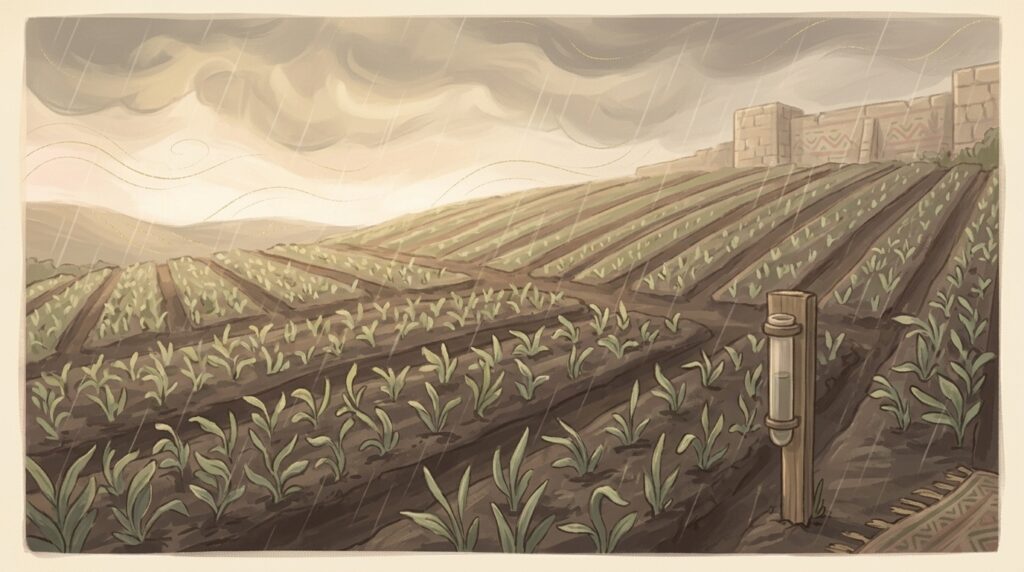
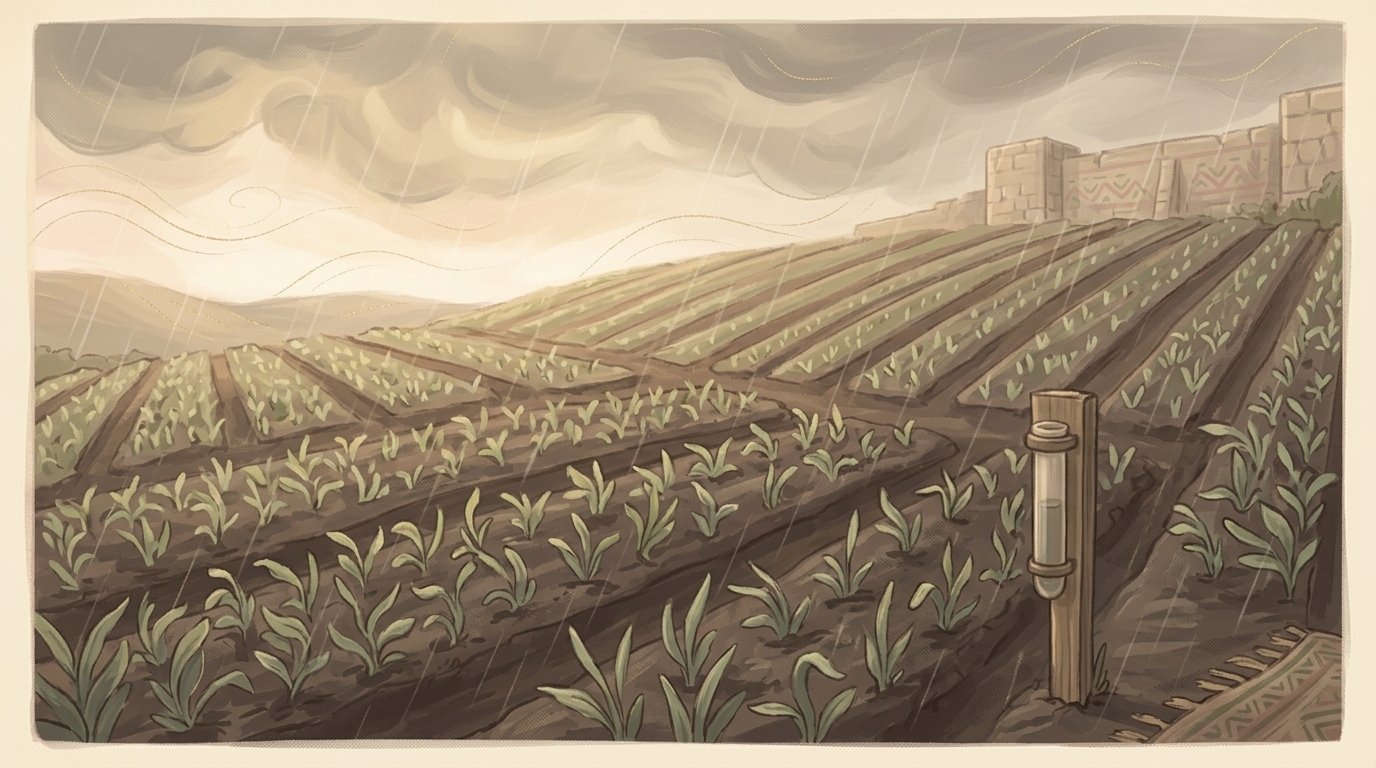
Rain that falls as showers goes into the ground. It arrives at a rate the soil can take, it soaks down slowly, and three days later the field is different in a way nobody watched happen. A flood arrives faster than the ground can absorb it, and what a flood mostly does is move dirt.
Both of them are water. Only one of them is farming, and only one of them is the words of his wisdom as showers.

So the Epistle is not simply praising a man who talks a great deal about God. It is praising a specific rate. God fills him with the spirit of understanding, and then—this is the sequence—he pours the words of his wisdom as showers, and in his prayer he confesses to the Lord. Wisdom comes down at a speed that lets it in.
And the confessing comes right after the pouring, which tells you the words of his wisdom as showers is not a performance. A man who is still praying about his own sins between sermons is not building a platform.
Now, the man we are honoring this morning. Bernard was born in 1090 at Fontaines near Dijon, third of seven children in a Burgundian noble house, and in 1113 he walked into the monastery at Cîteaux with roughly thirty young men he had personally persuaded to come with him. He was twenty-three. Two years later he was sent out to found Clairvaux, and by the time he died in 1153 the order that had been nearly empty when he joined it counted three hundred and forty-three houses.
That is all in the record of his life, and it is astonishing, and it is not actually the part I want.
Here is the part I want, because it is where the words of his wisdom as showers actually shows up in a calendar. He wrote eighty-six sermons on the Song of Songs. Eighty-six, on one short book of the Bible, preached across roughly eighteen years to the same room of monks who had heard the first one and stayed for the rest.
He never finished them. He died partway through the commentary, having spent nearly two decades on a text most people can read in twenty minutes.
That is what the words of his wisdom as showers looks like from the inside. Not one shattering address. Eighteen years of small weather over the same field.
And now the hard turn, because this day does not work if we skip it. The same voice that spent eighteen years on the Song of Songs stood up at Vézelay on the thirty-first of March, 1146, and preached a crusade. A king and a queen took the cross that day. Armies moved.
By July of 1148 those armies were retreating from the walls of Damascus after a siege of a few weeks, and the Church’s own account of what followed calls it flatly what it was: a defeat, and one that left bitterness across the West for a generation. Thousands of people died for it. Bernard, afterward, laid the failure on the conduct of the men who went.
I am not going to soften that, and I am not going to hand it off to somebody else’s tradition. That is our record. A canonized Doctor of the Church, one of the most persuasive human beings who ever lived, opened his mouth once and the result was mass death and a ruin nobody could repair.
So we have one man and two kinds of speech, and the Epistle gives us the vocabulary to tell them apart. Eighteen years of sermons to a room of forty monks was the words of his wisdom as showers. One afternoon at Vézelay that put an army on the road was a flood.
Which one moved more? The flood, obviously, and by a wide margin. Which one is the Epistle blessing? The words of his wisdom as showers, and only that, and it says so in the same breath as it says God filled him.
Every institution and every teaching is judged by what it grows, and this is the cleanest test case our own history offers. Same man, same gift, same century. One rate of pouring left eighty-six sermons still being read nine hundred years later. The other rate left a field of dead outside a city wall.
The difference between them was never the size of the gift. It was whether the gift came down as the words of his wisdom as showers or came down all at once.
Now let me say what harmful teaching this actually dismantles, because I did not come to give you a history lesson.
There is a teaching, loose everywhere and rarely stated out loud, that says real transformation is total and fast. That God shows up as a flood or not at all. That if the change in you is partial, gradual, or reversible, it has not really begun—and that the slow version is what people settle for when the real thing did not take.
That teaching has a specific set of casualties, and I will name them. People in recovery. People getting sober, or getting free of anything that has had its hand on them for years, are told constantly—by the culture, sometimes by churches, often by their own head at four in the morning—that a change that comes in increments does not count.
They are told the story of the man who walked out of the room one afternoon and never touched it again, and they are told that story as the standard rather than the exception. So a person eleven days in, who has had eleven days before, learns to describe eleven days as failure.
Nobody hands that person the words of his wisdom as showers. They should. It is in the Missal, on a Doctor’s feast day, in the Church’s own praise of a holy life.
Ecclesiasticus disagrees, and it disagrees in the exact language of weather. He will pour forth the words of his wisdom as showers. Small, repeated, absorbable, and adding up to something no single one of them could have carried alone.
Eleven days is not a failed flood. Eleven days is rain, and rain is what the words of his wisdom as showers is made of.
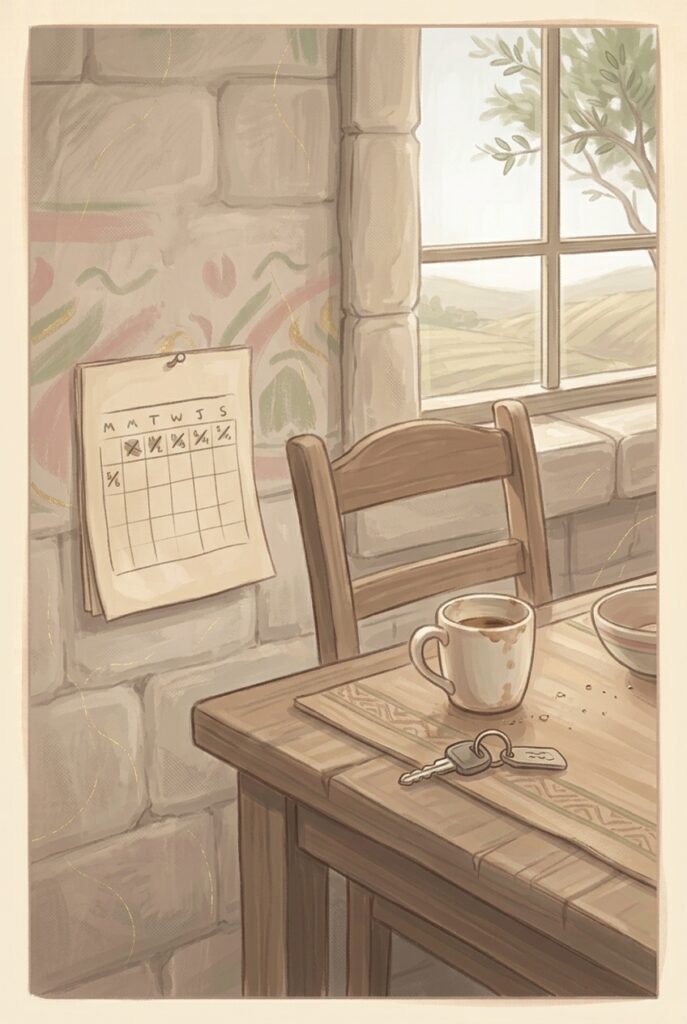
There is a story sometimes told of a woman who kept a paper calendar on her kitchen wall for the marks, because her phone was where the trouble lived and she wanted this somewhere the trouble could not get to. She marked a day when she got through it. The first run was four days, and then the page had a gap in it.
She started again on the eleventh and got nine. Then a longer gap. Then six, then a gap, then nineteen. The words of his wisdom as showers, written in ballpoint on a wall calendar by somebody who had never heard the phrase.
What she said later, when somebody asked how she finally did it, was that she never did finally do it. She said the calendar never got clean and she stopped needing it to be. She said what changed was that the gaps stopped meaning the marks were fake.
Four, nine, six, nineteen. Add them up and they are not much of a year. Keep pouring at that rate for a decade and you have a life, which is precisely the arithmetic of the words of his wisdom as showers and precisely the arithmetic nobody applauds in the moment.
That calendar is a rain gauge. Nobody frames a rain gauge, and the field still comes up.
And if you are not in recovery from anything with a name, this still lands on you, because the same teaching runs everywhere. Faith that came back in pieces after it broke. Grief that got survivable in inches. A marriage repaired over four years of unremarkable Tuesdays. The tradition’s own promise about a holy man is words of his wisdom as showers, and there is no shorter route in the text.
Which brings us to the Gospel we did not reprint, and here is why it matters differently today than it did in July. You are the salt of the earth. You are the light of the world. Then, immediately, Christ turns and says he came not to destroy the law but to fulfill it, that not one jot or one tittle shall pass—and that whoever keeps and teaches the least of the commandments shall be called great.
A jot is the smallest letter. A tittle is the little stroke that distinguishes one letter from another. Christ, given the chance to describe what endures, points at the smallest marks on the page.
That is the Gospel agreeing with the Epistle. The words of his wisdom as showers in one reading, the jot and the tittle in the other, and both of them are arguing that the small unit is where the permanence lives.
Sunday we sat with a letter that kills and a spirit that gives life, and this is not a contradiction of it. The letter kills when it is used to condemn. The jot and the tittle here are being used the other way—as proof that God’s attention goes all the way down to the smallest mark, and that greatness in the kingdom is assigned to whoever bothers with the least commandment rather than the grandest one.
Salt works the same way. Nobody is fed by salt. It goes in small, it disappears into the food, and it changes everything about it without ever being the thing you taste.
Salt, rain, and a stroke of ink. Small quantity, long duration, total effect—the words of his wisdom as showers in three different pictures.
For anyone here who does not hold the theology, the claim underneath translates without losing anything. Change that lasts is almost always slower than change that impresses. Anyone measuring their own life against the dramatic version is using a broken instrument, and the honest measure is whether the ground is different a year on, not whether the rain was memorable.
The Church prayed yesterday that God willed new religious families into being, households assembled rather than inherited. Today’s prayer is what keeps such a household alive once it exists. Founding is a decision made in an afternoon. Words of his wisdom as showers is what the next eleven years sound like, and most of it is unremarkable.
We also sat this week with staying put beside someone whose situation would not resolve, which is the same practice pointed outward. Staying is showers. It is the least dramatic thing a person can do and the hardest to sustain, and today’s Epistle says plainly that it is the form God’s own wisdom takes when it is working.
Bernard’s Collect, which we prayed a few minutes ago, asks something modest for a man of his stature. It does not ask for his eloquence and it does not ask for his influence. It asks that we who had him as a teacher of life might have him as an advocate—that the slow, ordinary, day-by-day instruction be what carries.
Not the afternoon that moved armies. The eighteen years that moved forty monks, one of whom wrote it down, which is the only place the words of his wisdom as showers was ever going to survive.
So here is the day. Whatever is actually growing in you right now is probably growing at a rate you find humiliating. The tradition’s own name for that rate is the words of his wisdom as showers, and it uses the phrase admiringly.
Do not wait for the flood. Do not measure the rain against it. Pour what you have at the speed the ground can take it, in the words of his wisdom as showers, and let the field be different in a year without your having watched it happen.
That is the assignment, and it is smaller than you were afraid it would be. The words of his wisdom as showers, today, on whatever ground is actually in front of you.
↑ The order resumes below.
VII
Secret
May the pious prayer of holy Bernard, Thy Abbot and illustrious Doctor, be not wanting to us, O Lord; but do Thou make our offerings acceptable to Thee, and ever win for us Thy mercy. Through our Lord Jesus Christ, Thy Son, Who liveth and reigneth with Thee in the unity of the Holy Ghost, God, world without end. Amen.
VIII
The Holding
(Benediction—two readings, one truth)
For those who hold this in faith:
Lord, You have never once been in a hurry with any of us. Pour into this house the words of his wisdom as showers—slow enough to be taken in, steady enough to be trusted, and long enough to outlast the seasons when nothing at all appears to be happening.
Bless the ones counting days. Bless the ones who have started again more times than they will admit, and let them see that the marks were never fake. Through Christ our Lord. Amen.
For those still finding their footing:
If the change you are working on is coming in increments, you are not doing a poor imitation of a real transformation. You are doing the only kind that holds.
The gaps do not cancel the marks. Four days, then nine, then six, then nineteen is not a failure to change—it is what change is, seen up close and honestly. Keep pouring at whatever rate you have got, because the words of his wisdom as showers was never a description of anyone impressive. It was a description of weather, and weather keeps going.
IX
Frequently Asked Questions
Scripture citations follow the Douay-Rheims Bible, Bishop Challoner revision—the standard English scripture translation used across traditional hand missals. Collect and Secret: the Missale Romanum (1962), feast of St. Bernard, Abbot and Doctor of the Church, with the Mass largely from the Common of a Doctor, following The New Marian Missal for Daily Mass by Sylvester P. Juergens, S.M., S.T.D. (Regina Press, Imprimatur 1961). Historical detail on St. Bernard of Clairvaux and on the Second Crusade follows the Catholic Encyclopedia.
Faith in Bloom offers this reflection in the spirit of the traditional Roman Rite—a daily offering, not a Mass—welcoming all people, of every faith background, into the shelter of the Word.
