
Daily Offering · 19 August 2026 · St. John Eudes
Daily Offering: August 19, 2026 | New Religious Families
New religious families—that is the Church’s own phrase, in today’s prayer, and I want to sit with it all morning. Beloved, grace and peace to you, however you come to this: rested or wrecked, sure of God or sure of nothing, held by the…
The order of this offering
Before the readings
The Word
Offering and Canon
I
Opening Address
New religious families—that is the Church’s own phrase, in today’s prayer, and I want to sit with it all morning. Beloved, grace and peace to you, however you come to this: rested or wrecked, sure of God or sure of nothing, held by the people you were born to or held by people you had to go out and find. Bloom is not a room you earn your way into. Stay a while, in the spirit of a low Mass—Word, prayer, and offering, and no pretense to more than that.
Because the prayer does not say God allowed new religious families. It says He willed them. Hold that verb, and we will come back to it.
II
A Word on Today’s Propers
Today is the feast of St. John Eudes, Confessor, third class, white vestments, and the Mass is taken from the Common of a Confessor Not a Bishop—the one that opens Os justi, “the mouth of the just man tells of wisdom.” That means every single proper except one is a text we have already prayed together twice this summer.
The Introit, Epistle, Gradual, Gospel, Offertory, and Communion are word for word the ones we sat with these same propers in July on the feast of St. Henry, and word for word the ones we prayed again on Monday for St. Hyacinth.
Three feasts, one Mass. That is how a Common works, and there is no reason to dress it up as new.
So we will not reprint the scripture a third time. The citations stand and the earlier readings are linked above: the Epistle is Ecclesiasticus 31:8-11, blessed is the rich man that is found without blemish, and the Gospel is Luke 12:35-40, let your loins be girt, and lamps burning in your hands.
What is genuinely new today is the Collect. One prayer, written for one man, and it contains a phrase the Church says out loud every August and almost nobody stops on. That phrase is new religious families, and the whole offering is built on it.
III
Collect
O God, Who wondrously enkindled St. John, Your Confessor, to promote the religious veneration of the Sacred Hearts of Jesus and Mary, and through him willed to found new religious families in the Church; grant, we beseech You, that we may honor his holy merits and may learn from the example of his virtues. Through the same Christ our Lord. Amen.
The Offering
Daily Homily | New Religious Families
New religious families. Read that clause again, slowly, because the grammar is doing something enormous.
New religious families. Read that clause again, slowly, because the grammar is doing something enormous.
Through him willed to found new religious families in the Church. The subject of that verb is God. The verb is willed. Not permitted, not tolerated, not made allowance for. Willed.
Now, the plain meaning first, because I am not going to build anything on a mistranslation. In the technical language of the Church, a religious family means a religious congregation—an order, a society, a community under vows. When the Collect thanks God for new religious families, it is thanking Him for the institutes this man founded.
He founded three. That is not legend and it is not a devotional flourish; it is in the record of his life.
So the plain sense is settled. And the plain sense is exactly where it gets interesting, because look at what the Church has decided to call these things.
A religious congregation is a group of adults who are not related to each other. They share a house. They share money. They eat at one table, keep one schedule, answer to one rule, and bind themselves to each other for the rest of their lives.
And the Church, in its own official prayer, does not call that an arrangement or a community or a fellowship. It calls it a family.
Not like a family. A family. New religious families, in the plural, willed by God.
I want that to land before we go anywhere else, because there is a teaching loose in the world that says a family is one thing only—the household you were born into, or the one you made by marriage and blood—and that everything else is an imitation of the real article. That teaching is old, it is confident, and today’s Collect does not support it.
The Church has been calling non-biological households families, in its own liturgy, for four hundred years.
And notice the word new. New religious families means these households did not exist before. Somebody made them. They were assembled out of people who came from somewhere else, and the prayer treats that assembly as divine initiative rather than human improvisation.
Now, the first of the three, and this is where the day turns. In 1641, at Caen, he founded a congregation whose entire purpose was the house he opened at Caen for women the town had written off—women described in the record as abandoned, living a life the respectable world had already finished judging.
That is the first of the new religious families the Collect is thanking God for.
Sit with the arithmetic of that. The Church’s official prayer for this day thanks God for willing into existence a household made entirely of women who could not stay where they had started, cared for by women who chose to bind themselves to them by vow. Nobody in that house was there by birth. Everybody in that house was there by decision.
And it is the Church, not me, that calls the result a family.
Two years later he founded a second, for the training of priests. Later, a third. Different work, same structure every time: strangers, a house, a rule, and a promise not to leave. New religious families, three of them, from one man who kept noticing that the existing households were not catching everyone.
Which brings us to the test this ministry keeps returning to. Any institution, including a church, is judged by its fruit and not its letterhead, and a teaching is judged the same way.
So put the two teachings side by side and ask what each one grows.
The first says only the household you were born into is truly a family, and every other configuration is a substitute standing in for the real thing. Ask what that produces in the life of a person whose birth household hurt them, or buried them in debt, or put them out at seventeen. It produces shame on top of injury. It tells someone who has already lost one family that whatever they build next will always be provisional.
The second is the one in today’s prayer. It says God wills new religious families into being, that a household of unrelated people bound by promise is a real family, and that founding one is holy work rather than a consolation prize.
One of those teachings has a body count of loneliness behind it. The other one built the Refuge at Caen. That is the fruit test, and it does not require a tie-breaker.
Now hear the Epistle we are not reprinting, because it applies the same standard to a person. He that could have transgressed, and hath not transgressed: and could do evil things, and hath not done them. Ecclesiasticus tests a man by what he did with what was in front of him. Not his lineage, not his household, not the name he inherited. What he did.
That is the same logic as the Collect, run on a single life instead of a house. And it is the logic underneath every one of these new religious families: you are assessed on what you build and how you keep it, not on the address you started from.
Here is where I want to name something specific, because today’s text asks for it and I would be dodging if I did not. Look again at the structure of a religious family: shared housing, pooled income, a schedule everyone depends on, mutual obligation, and permanence. Now ask which people in our own moment actually live like that, out of necessity rather than devotion.
Disabled adults do. Chronically ill adults do. People who need care every day and cannot get it from a nuclear household that was never designed to provide it build exactly this structure, and they build it constantly.
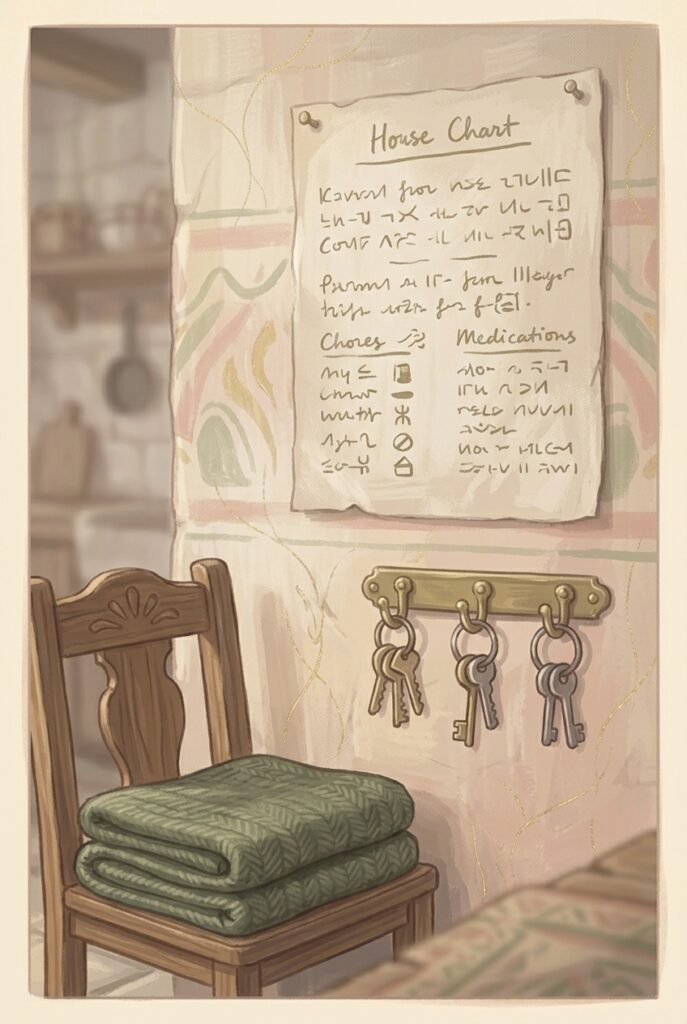
Three or four people, one lease, one calendar, medications tracked on a wall, somebody’s income covering somebody else’s gap this month, and an unwritten promise that nobody gets left holding it alone. Strip the habits and the chapel off a religious congregation and that is the identical shape.
The Church canonizes the man who founded houses like that in the seventeenth century. The same instinct, when disabled people do it now, gets called a living situation. A phase. Something to move on from once a person is properly settled.
That is a failure of recognition, and it is our own tradition’s failure, not somebody else’s. The vocabulary for honoring these households already exists inside our liturgy. We say it out loud once a year and then do not apply it to the people in front of us. New religious families is not a phrase Bloom invented to be generous; it is in the Missal.
There is a story sometimes told of three people who ended up in one rented house because none of them could manage a house alone. One had a condition that made mornings unreliable. One could not drive. One had the steadiest income and the least stable health.
They wrote a chart. Who cooks, whose appointment is when, which medications get counted on Sundays, who is on call if somebody wakes up unable to stand.
None of them would have said they were founding anything. They would have said the rent was too high and this was what worked. But they kept it for eleven years, and when one of them was hospitalized the other two took the shifts without discussing it, the way you do not discuss it in a family.
The neighbors never quite understood what the household was. Somebody once asked which of them was related, and one of them said none of us, and the question did not come up again.
Eleven years of a rule of life that nobody called a rule of life. What the Collect would call a family, and would call it without hesitating.
And this is why Bloom does not ask anyone at the door who they live with or how that came to be. A ministry that recognizes only one household shape has decided in advance which of its people are real, and it will be wrong about most of them.
Now the Gospel, which is the piece I have deliberately saved. Let your loins be girt, and lamps burning in your hands. Servants awake at an hour nobody chose, listening for a knock.
Notice that Christ does not describe a family in that parable. He describes a household—people who are not related, keeping one another awake, waiting together for something none of them can schedule. Which is precisely the structure of every one of these new religious families, and precisely the structure of that rented house.
And then comes the line that undoes the whole hierarchy. He will gird himself, and make them sit down to meat, and passing will minister unto them. The master comes home and serves the staff.
Whatever a household is for, in that parable, it is not for sorting people into who gets waited on. It is for staying awake together until somebody arrives who reverses the order entirely.
We prayed with a version of this in August already, with the women who kept oil in their vessels, and the wisdom there was preparation. Today the same watchfulness is being asked of a house rather than an individual, which is a different assignment, and a harder one. One person can stay ready alone. New religious families have to stay ready in shifts.
And yesterday’s prayer asked the Church to stand her ground—to stay put beside somebody whose situation would not resolve. Today’s prayer asks for something that comes after that. Staying is what one person does. Founding is what happens when staying gets organized, given a rule, and made survivable for the long haul.
That is the difference between a good instinct and new religious families. One of them is a decision. The other is a structure that outlives the person who decided.
We have sat with another founder who built houses for children nobody claimed this summer, and the pattern is consistent. The saints who founded households did not usually set out to found anything. They found a specific group of people falling through and built the smallest possible thing that would catch them, and the Church later called the result a family.
Which means the founding of new religious families almost never feels like founding. It feels like rent.
So here is the day, and it is short. The Church prays this morning that God willed new religious families into being. Not as an accommodation for people whose first families failed. As something He wanted.
If you are living in a household that does not look like the picture—if the people who show up for you are not the ones on your birth certificate, if your family is a group chat and a spare key and somebody who knows your medication schedule—the Missal has language for that, and it is not condescending language. It is the same word it uses for the congregations it canonizes founders over.
And if the household you have is not enough yet, hear the other half. New religious families get founded by ordinary people who notice a specific gap and build the smallest thing that closes it. Nobody in that first house at Caen had a plan for a religious order. They had a door.
Go find out who is not being caught. Then build the small thing. That is the whole assignment, and it is how every one of these new religious families started.
↑ The order resumes below.
V
Secret
We offer You sacrifices of praise, O Lord, in memory of Your Saints; trusting that by them we may be delivered from both present and future evils. Through our Lord Jesus Christ, Thy Son, Who liveth and reigneth with Thee in the unity of the Holy Ghost, God, world without end. Amen.
VI
The Holding
(Benediction—two readings, one truth)
For those who hold this in faith:
Lord, You have willed new religious families into being that nobody expected and no registry recorded. Bless the households in this room that were assembled rather than inherited—the spare rooms, the shared leases, the pooled money, the promises nobody wrote down.
Keep them from believing they are provisional. And for anyone still without one, send them three people and a reason to stay, and let what they build be counted among the new religious families You willed. Through Christ our Lord. Amen.
For those still finding their footing:
If the people who actually show up for you are not the people you were assigned, you have not settled for something lesser. You have built the thing that the oldest prayers in this tradition call a family, and they call it that without a qualifier.
It is allowed to be permanent. It is allowed to be the real one. And if you are the person keeping the chart on the wall and counting somebody else’s pills on a Sunday, that is not a chore you got stuck with. It is a founding, and it counts.
VII
Frequently Asked Questions
Scripture citations follow the Douay-Rheims Bible, Bishop Challoner revision—the standard English scripture translation used across traditional hand missals. Collect and Secret: the Missale Romanum (1962), feast of St. John Eudes, Confessor, from the Common of a Confessor Not a Bishop, following The New Marian Missal for Daily Mass by Sylvester P. Juergens, S.M., S.T.D. (Regina Press, Imprimatur 1961). Historical detail on St. John Eudes and the Congregation of Our Lady of Charity of the Refuge follows the Catholic Encyclopedia.
Faith in Bloom offers this reflection in the spirit of the traditional Roman Rite—a daily offering, not a Mass—welcoming all people, of every faith background, into the shelter of the Word.
