

Daily Offering · 31 August 2026 · St. Raymond Nonnatus
Daily Offering: August 31, 2026 | With Free Minds
With free minds. That is the phrase the Church hands us this morning, three words near the end of a prayer most people will never hear, and I want to spend the whole morning on it. Beloved, grace and peace to you, however today…
The order of this offering
Before the readings
The Word
Offering and Canon
I
Opening Address
With free minds. That is the phrase the Church hands us this morning, three words near the end of a prayer most people will never hear, and I want to spend the whole morning on it. Beloved, grace and peace to you, however today finds you. Rested or wrecked, certain of God or certain of nothing, in a life you chose or a life that was arranged around you by other people. Bloom is not a room you earn your way into.
Stay a while, in the spirit of a low Mass. Word, prayer, and offering, and no pretense to more than that.
The prayer does not ask God to change our circumstances so that we can be free. It asks that we be released from something else entirely, and then that we act with free minds. Hold that difference, because everything today turns on it. With free minds is not the same request as with a free life, and the gap between those two is the whole of this morning.
II
A Word on Today’s Propers
Today is the feast of St. Raymond Nonnatus, Confessor, third class, white vestments, no commemoration. The Mass comes from the Common of a Confessor Not a Bishop, the one that opens Os justi, “the mouth of the just man tells of wisdom.”
Which means almost every text in it is one we have prayed together three times already this summer.
The Introit, Epistle, Gradual, Gospel, Offertory, Communion and Postcommunion are word for word the ones we prayed this Mass in July on the feast of St. Henry, word for word the ones we prayed again a fortnight ago for St. Hyacinth, and word for word the ones we prayed and again on the nineteenth for St. John Eudes. Four feasts, one Mass. That is what a Common is for, and there is no honest way to dress it up as new.
So we will not reprint the scripture a fourth time. The citations stand and the earlier readings are linked above. The Epistle is Ecclesiasticus 31:8-11, blessed is the rich man that is found without blemish, and the Gospel is Luke 12:35-40, let your loins be girt, and lamps burning in your hands.
I checked this one carefully rather than assuming it, because this Common does not always repeat. Last Tuesday we kept a king who drew this same Introit and then broke the pattern with an Epistle and a Gospel of his own. Today there is no proper reading anywhere in the Mass.
One text is new. The Collect. One prayer, written for one man, and it ends in a phrase worth a whole morning.
III
Collect
O God, Who made blessed Raymund, Your Confessor, famous for delivering Your faithful from the captivity of the infidels, grant us by his intercession that, having been released from the bonds of our sins, we may with free minds do what is pleasing to You. Through our Lord Jesus Christ, Thy Son, Who liveth and reigneth with Thee in the unity of the Holy Ghost, God, world without end. Amen.
The Offering
Daily Homily | With Free Minds
With free minds. Read the whole prayer again and watch where it goes, because the turn in the middle of it is the entire day.
With free minds. Read the whole prayer again and watch where it goes, because the turn in the middle of it is the entire day.
It opens on history. A man who spent his life buying people out of captivity. Then it pivots, and what it asks for is not what you would expect a ransomer’s prayer to ask for.
It does not ask God to unlock any doors. It asks that we be released from the bonds of our sins, and that we then act with free minds. The ransom turns inward, and the thing it wants to buy back is not a body. A ransomer’s prayer, and what it ransoms is a mind.
First the man, because he is worth knowing and because the prayer is built on him. He was born in 1200 or 1204 at Portello, in the Diocese of Urgel in Catalonia. He was taken from the womb of his mother after her death, and that is where the name comes from. Nonnatus, the not-born.
He took the habit at Barcelona at the hands of St. Peter Nolasco, who had founded the order he entered in 1218 for the ransom of captives. He was sent to Algiers and liberated many of them. When the money ran out he stayed behind and gave himself as a hostage in their place.
Understand what that transaction actually is. He did not simply spend the fund and go home empty-handed. He put his own body into the ledger as the balancing entry, so that somebody else could walk. He went into the hold with free minds, which is the only sense in which that is not simply a man losing.
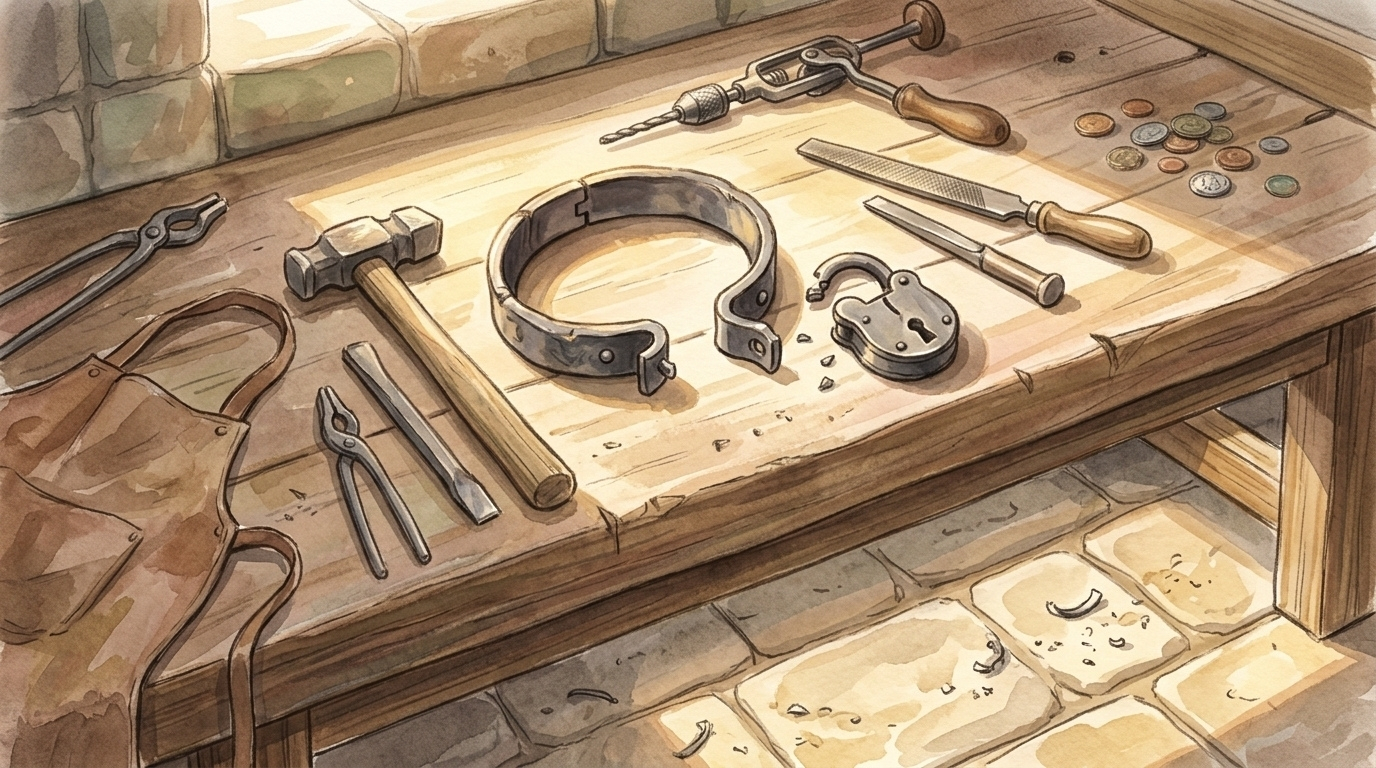
His own encyclopedia calls him the most famous of the monks who gave themselves up to that work. And in the record of his life there is one detail I cannot get past: while he was held, his lips were pierced with a red-hot iron and closed with a padlock.
Sit with that a moment before we go on. A padlock through a man’s mouth, to stop him speaking. And the prayer the Church built on top of that life asks God for with free minds, not for a key.
He was made a cardinal by Gregory IX in 1239. He was called to Rome and got as far as Cardona, about six miles from Barcelona, where he died on the thirty-first of August, 1240. In 1657 his name was placed in the Roman martyrology.
Now the hard part of the Collect, and I am not going to walk around it.
The prayer says he delivered the faithful from the captivity of the infidels. That word is a word Christians used for people who did not share their faith, and I want to be plain that Bloom does not use it that way and will not. We are not going to characterize anybody else’s religion this morning. The fruit test this ministry runs is judged by what it grows and not by what it claims, and it gets pointed at our own house first.
So point it there. In those same centuries, on those same waters, Christian powers held captives too, and Christians wrote the prayers. A word like that in a liturgy is a record of who was writing, not a finding about who was worse. A church can pray for with free minds in one breath and use a slur in the next, and ours did.
And here is what makes the Collect better than its own vocabulary. It names one captivity in the first clause and a completely different one in the second, and the second one is ours. The bonds of our sins. Not theirs, ours.
Those are the only chains the prayer actually asks God to strike off, and only after that does it dare to ask that we might act with free minds. That is a prayer that turns its accusation around halfway through. Whatever else is wrong with its century, that part is not wrong.
Before we go further I want to close a door that a sentence like the bonds of our sins can leave standing open. The prayer names one bondage and one only, and it is sin. It does not name a body. It does not name a diagnosis, a condition, a limitation, or a life that needs help to run.
The Collect draws that line cleanly and I want it drawn cleanly here too. Nothing about your body is what this prayer is asking God to release you from. It asks for the bonds of sin to come off and for the rest of you to go out and act with free minds exactly as you are. Not once you are better. As you are.
Now to the phrase itself, because this is where the day lives.
With free minds is not the same as with free lives. The prayer was written for a man who had a padlock through his lips. It was written to be prayed by people who could not leave, could not choose, could not schedule a single hour of their own day.
And it asks God for a free mind anyway. Right there. Inside the thing that has not lifted. With free minds, in a cell, is the actual petition.
That is a much stranger request than it looks, because there is a teaching loose in the world that says the exact opposite, and it is worth naming out loud.
The teaching goes like this. Real virtue requires real options. If you could not have done otherwise, then what you did was not obedience, it was just what happened. If you had nowhere else to go, your staying was not faithfulness. If you had no alternative, your patience was not patience, it was only endurance with a nicer name.
That teaching sounds like rigor. It is actually a machine for voiding people’s lives, and it voids some lives far more efficiently than others. Nobody who says it thinks they are denying anyone with free minds. They think they are being careful about what counts.
Ask who fails that test first. Not the person with money and mobility and a door they can walk out of. The person whose day is built by somebody else’s schedule. The person whose body sets the terms before anyone else gets a vote. The person who needs help to get up and cannot pick the hour it arrives.
So let me name it directly, because today’s own prayer forces the question. Disabled people, chronically ill people, and anyone whose life is organized around care they do not control. That teaching lands on them hardest, and it lands as a quiet verdict that their inner life is smaller than everybody else’s. It is a verdict on whether they get to be counted among those acting with free minds at all.
I want to be precise about what is new in that claim, because we have been near this ground twice this month and this is not the same argument. On the twenty-fourth we refused the idea that some gifts are worth less than others, which was a claim about worth. On the twenty-seventh we refused the idea that a disabled adult is a large child, which was a claim about status.
Today’s is neither of those. Today’s claim is about whether a constrained life can produce anything real at all. And the Collect answers it in three words: with free minds, asked on behalf of a man in chains.
Notice, too, that the Church is not asking this for him as a consolation. It is not saying that since his circumstances were hopeless he was granted an interior prize instead. It asks for with free minds as the ordinary condition of anybody praying the prayer, in any circumstance whatsoever, and the man in the padlock is offered as the proof that the request is not absurd.

There is a story sometimes told of a woman whose whole day was bracketed by two visits she did not arrange. Someone came at seven in the morning. Someone came again at six in the evening. The hours in between belonged to nobody, including, most people assumed, her.
Her family described her life to other people as limited. They did not mean it unkindly. It was simply the word that came, and nobody in the family ever asked what she did between the visits.
What she did was walk four streets to the public library every weekday afternoon and teach herself a language nobody in her family spoke. She was four years into it. She had filled eleven notebooks, and she was reading poetry in it slowly, badly, and with enormous pleasure.
She never called it coping. That is the part I want you to hear. When somebody finally asked, she did not say it helped her get through the day, or that it kept her mind occupied, or any of the other things people say when they are apologizing for wanting something.
She said she had always meant to, and now she had the afternoons. That is a sentence spoken with free minds if I have ever heard one. There is no apology anywhere in it.
Nobody had freed her from anything. The visits still came at seven and at six, and would keep coming. She simply did that with the hours that were hers, which is the whole of what the Collect is asking for.
And notice what the alternative reading would have to say about her. It would have to say those eleven notebooks are worth less because she had fewer places to be. It would have to price her afternoons against somebody else’s and mark hers down.
Say that out loud and it collapses on its own. Nobody defends it once it is stated plainly, which is exactly why it usually is not stated at all. It gets carried instead in a word like limited, and it does its work without ever having to argue for itself. One word, and a life lived with free minds gets filed as a life that did not have much in it.
Now the Epistle, which we are not reprinting, and which appears at first to argue the other side. Ecclesiasticus praises the man that could have transgressed, and hath not transgressed: and could do evil things, and hath not done them. That is a text about a man with options who did not use them badly.
So does the Epistle agree that virtue needs a menu? No, and the difference matters. Ecclesiasticus is not setting a floor below which nobody acts with free minds.
Ecclesiasticus is examining a rich man. It is not laying down a rule that only the unconstrained can be good. It is aiming a warning at the one person in the room with the most room to move, and telling him that having options is the test rather than the credential.
Put the two texts side by side and see what they cover between them. The Epistle takes the man with every door open and asks what he did with them. The Collect takes the man with a padlock through his mouth and asks God that he might act with free minds anyway.
Between them there is no life left over. Nobody is exempt from the question and nobody is disqualified from answering it. That is what it means to ask for this with free minds rather than with free circumstances.
The Alleluia verse sitting between them says the same thing in one line. It blesses the man who endures temptation, and promises that when he has been tried he will receive the crown of life. Endurance is not the runner-up prize in that sentence. It is the event, and it is done with free minds or it is not endurance at all.
And then the Gospel, which we are also not reprinting, and which is a household of servants. Girded, lamps lit, waiting for a return whose hour they do not get to know.
Look at their situation honestly. They did not pick the hour. They cannot leave. They are not free in any sense a philosopher would sign off on, and the parable never once treats their waiting as second-rate for it. It simply assumes they are keeping watch with free minds.
Then comes the line that turns the whole thing over. He will gird himself, and make them sit down to meat, and passing will minister unto them. The master comes home and serves the staff.
Whatever that household is for, it is not for ranking people by how much choice they had. It ends with the one person who had all the choice using it to wait on the ones who had none. If that is where the story lands, then a life spent waiting is not a lesser class of life, and those servants were with free minds the whole time whether anybody credited them or not.
That reversal is also the answer to the fear underneath all of this. The worry is not really about philosophy. It is that a life like that goes uncounted, that the hours disappear, that nobody at the end will know what it took. And the parable’s reply is that the one who arrives already knows, and sits them down, and serves. Every hour held with free minds is on that table.
Yesterday we heard Paul say that against such there is no law, naming the fruits the Spirit grows in a person. Set that beside today. Paul says nothing on that list can be legislated against, and the Collect says nothing on that list requires an unlocked door.
Same claim, two mornings running, from two directions. What grows in you is not held hostage by what is happening to you, and it is not held hostage by who is setting your schedule either. That is the plain sense of doing anything with free minds.
Which brings the practical end of it, and it is short.
If your life is arranged by other people, if the hours you actually hold are few and scattered and boxed in on both sides, the prayer this morning was written for you and not around you. It does not ask God to give you a different life before your life can count. It asks that the bonds of sin come off, and then that you act with free minds in the life you have got today.
And if your day is wide open, hear the Epistle instead, because that one is aimed squarely at you. Options are the test. They were never the proof, and a wide day spent badly is not closer to God than a narrow one spent with free minds.
So take whatever hours are yours today, however few of them there are and whoever else set the boundaries around them. Spend them on purpose. Not to get through them, and not to earn back a life somebody else would recognize.
Do one thing today because you have always meant to and now you have the afternoon. Not to cope. Because you want to, and it is yours. That is the whole assignment, and it is what it means to do anything at all with free minds.
↑ The order resumes below.
V
Secret
We offer You sacrifices of praise, O Lord, in memory of Your Saints; trusting that by them we may be delivered from both present and future evils. Through our Lord Jesus Christ, Thy Son, Who liveth and reigneth with Thee in the unity of the Holy Ghost, God, world without end. Amen.
VI
The Holding
(Benediction—two readings, one truth)
For those who hold this in faith:
Lord, You did not promise to unlock every door before You asked anything of us. Strike the bonds of sin off the people in this room and leave the rest of their circumstances in Your hands, and let them go out today and act with free minds inside whatever has not lifted.
Bless the hours they actually hold. Bless what they do with them when nobody thinks to ask. And where a life has been called limited by people who never counted it, count it Yourself, and let it be found among those who served You with free minds. Through Christ our Lord. Amen.
For those still finding their footing:
If your day is built around appointments you did not make, you are not living a smaller life than the people who made theirs. You are living a life with fewer hours in it that are yours, which is a different thing entirely, and the hours that are yours are not worth less for being fewer.
Spend them on something you actually want. Not to cope with the rest of it. Because you meant to, and now you have the afternoon. Nobody has to unlock anything first. That is what anybody means, in the end, by living with free minds.
VII
Frequently Asked Questions
Scripture citations follow the Douay-Rheims Bible, Bishop Challoner revision—the standard English scripture translation used across traditional hand missals. Collect and Secret: the Missale Romanum (1962), feast of St. Raymond Nonnatus, Confessor, from the Common of a Confessor Not a Bishop, following The New Marian Missal for Daily Mass by Sylvester P. Juergens, S.M., S.T.D. (Regina Press, Imprimatur 1961). Historical detail on St. Raymond Nonnatus and on the Order of Our Lady of Ransom follows the Catholic Encyclopedia.
Faith in Bloom offers this reflection in the spirit of the traditional Roman Rite—a daily offering, not a Mass—welcoming all people, of every faith background, into the shelter of the Word.
