


Sunday Mass · 30 August 2026 · XIV Sunday after Pentecost
Sunday Mass: August 30, 2026 | Against Such There Is No Law
Welcome to Bloom’s Sunday Mass for the fourteenth Sunday after Pentecost. Today’s Epistle ends with five words that almost nobody quotes, and the whole morning turns on them: against such there is no law. This is offered in the Independent Catholic tradition, from the…
The order of this offering
Before the readings
Communion and close
Offering and Canon
I
Opening Address
Welcome to Bloom’s Sunday Mass for the fourteenth Sunday after Pentecost. Today’s Epistle ends with five words that almost nobody quotes, and the whole morning turns on them: against such there is no law. This is offered in the Independent Catholic tradition, from the 1962 Roman Rite, and Bloom is not affiliated with or recognized by the Roman Catholic Church. We name that plainly, the way Old Catholic and Anglo-Catholic communities have named it for more than a century, because you deserve to know exactly whose table you are sitting at.
Wherever you are, you are welcome here. If you arrived measured and found wanting by somebody this week, you are welcome, and nobody here is going to take out the ruler again.
The vestments today are green. No feast is layered over this Sunday and no saint is commemorated in the prayers, so the Church hands us the plain temporal cycle and asks us to sit with it as it is.
II
The Penitential Rite
(The Confiteor and Kyrie are said here, from the Missal.)
We begin the way the Church has always begun, not with achievement but with an honest accounting. There is something clarifying about a liturgy that opens by admitting failure out loud, in company, before anyone has said a word about grace. Nobody in this room is here on merit. That is the point of starting here.
III
The Gloria
(The Gloria is said here, from the Missal.)
Then, immediately, praise. The order is deliberate. We tell the truth about ourselves and then we sing anyway, because the singing was never conditional on the accounting coming out clean.
IV
Introit
Ps 83:10-11; Ps 83:2-3
Behold, O God our protector: and look on the face of thy Christ. For better is one day in thy courts above thousands.
How lovely are thy tabernacles, O Lord of hosts! My soul longeth and fainteth for the courts of the Lord.
(Glory be to the Father, and to the Son, and to the Holy Ghost. As it was in the beginning, is now, and ever shall be, world without end. Amen. The antiphon is repeated.)
Notice what the Mass asks for first. Not a verdict, not a ruling, not an examination. It asks God to look, and it asks for one day in the courts rather than a thousand somewhere else, which is a request about where a person gets to stand.
V
Collect
Keep Thy Church, we beseech Thee, O Lord, with Thy perpetual mercy: and because without Thee the frailty of man cannot but fall, keep us ever by Thy help from all things hurtful, and lead us to all things profitable to our salvation. Through our Lord Jesus Christ, Thy Son, Who liveth and reigneth with Thee in the unity of the Holy Ghost, God, world without end. Amen.
Every active verb in that prayer belongs to God. Keep, help, lead. The people in the sentence are described only as frail, and the prayer does not ask that they be made less frail, only that they be kept.
VI
Epistle
Brethren: I say then, walk in the spirit, and you shall not fulfill the lusts of the flesh. For the flesh lusteth against the spirit: and the spirit against the flesh; for these are contrary one to another: so that you do not the things that you would. But if you are led by the spirit, you are not under the law.
Now the works of the flesh are manifest, which are fornication, uncleanness, immodesty, luxury, Idolatry, witchcrafts, enmities, contentions, emulations, wraths, quarrels, dissensions, sects, Envies, murders, drunkenness, revellings, and such like. Of the which I foretell you, as I have foretold to you, that they who do such things shall not obtain the kingdom of God.
But the fruit of the Spirit is, charity, joy, peace, patience, benignity, goodness, longanimity, Mildness, faith, modesty, continency, chastity. Against such there is no law.
And they that are Christ’s, have crucified their flesh, with the vices and concupiscences.
VII
Gradual and Alleluia
It is good to confide in the Lord, rather than to have confidence in man. It is good to trust in the Lord, rather than to trust in princes.
Alleluia, alleluia. Come let us praise the Lord with joy: let us joyfully sing to God our saviour. Alleluia.
VIII
Gospel
At that time Jesus said to his disciples: No man can serve two masters. For either he will hate the one, and love the other: or he will sustain the one, and despise the other. You cannot serve God and mammon.
Therefore I say to you, be not solicitous for your life, what you shall eat, nor for your body, what you shall put on. Is not the life more than the meat: and the body more than the raiment? Behold the birds of the air, for they neither sow, nor do they reap, nor gather into barns: and your heavenly Father feedeth them. Are not you of much more value than they? And which of you by taking thought, can add to his stature by one cubit?
And for raiment why are you solicitous? Consider the lilies of the field, how they grow: they labour not, neither do they spin. But I say to you, that not even Solomon in all his glory was arrayed as one of these. And if the grass of the field, which is today, and tomorrow is cast into the oven, God doth so clothe: how much more you, O ye of little faith?
Be not solicitous therefore, saying, What shall we eat: or what shall we drink, or wherewith shall we be clothed? For after all these things do the heathens seek. For your Father knoweth that you have need of all these things. Seek ye therefore first the kingdom of God, and his justice, and all these things shall be added unto you.
IX
The Creed
(The Nicene Creed is said here, from the Missal.)
We say it together, in the plural, because it was never meant to be a personal inventory of certainties. It is the faith of the whole body, held out loud, and on the mornings when you cannot manage a line of it the rest of us are still saying it around you.
The Offering
Sunday Homily | Against Such There Is No Law
Paul finishes his second list and then adds a sentence that hardly ever makes it into a sermon: against such there is no law. Five words, dropped at the end of twelve virtues, and…
Paul finishes his second list and then adds a sentence that hardly ever makes it into a sermon: against such there is no law. Five words, dropped at the end of twelve virtues, and they do something enormous. They do not say the law approves of these things. They say the law has nothing to say about them at all.

Sit with how strange that is. A law exists to draw a line and then check which side of it you are standing on. When Paul says against such there is no law, he is telling us that for charity, joy, peace and patience there is no line to check, no side to stand on, no instrument that measures them. The measuring stops.
Read the two lists side by side, because the Church puts them in one paragraph on purpose. Paul names the works of the flesh first, and there are fifteen of them, and the way that list gets preached is almost never the way it is written. Count what is actually in it.
Four are about appetite: fornication, uncleanness, immodesty, luxury. Two are about false worship. One is murder, two are about drink. And eight of the fifteen are what a community does to itself when it turns sour: enmities, contentions, emulations, wraths, quarrels, dissensions, sects, envies. More than half of Paul’s list is about people in a congregation going at each other, and that half almost never gets read aloud.
Think about what those eight have in common. Not one of them can be done alone. Drunkenness and revelling can be managed by a person in an empty room, while enmity, faction and envy all require a second person to aim at and usually a third to agree with you about it. Paul sets them in one list with the sins that are easier to preach, and then he turns to the fruit and says against such there is no law.
That matters, because a list used as a checklist gets used on whatever is easiest to see in somebody else. We sat with a version of this on Friday, when we said that mercy is not a reward for a counted record. A vice list turned into a checklist is the same instinct running the other direction, and the answer to it is the same sentence: against such there is no law.
Then Paul gives the second list, and it is not a list of behaviours at all. Charity, joy, peace, patience, benignity, goodness, longanimity, mildness, faith, modesty, continency, chastity. Not one of them is an action you can put on a form. They are all things that grow, which is why he calls them fruit and not works, and it is over that whole growing list that he says against such there is no law.
He does not promise the twelve arrive together or on schedule. Fruit ripens unevenly, and a person can be long on patience in August and short on joy, and the image Paul chose has room for that in a way a rule never does. A rule is met or it is not met. Fruit is a slow thing with weather in it, and against such there is no law.
This is the test we use here for every teaching and every institution, and we have named it before: by their fruits you shall know them. Paul is saying the same thing from the other end. Do not ask whether a life is on the correct side of a rule. Ask what has grown in it, and where the good things have grown, against such there is no law.
Hold onto that, because the Gospel is about to name the rule most of us are actually being measured by, and it is not a moral rule at all.
No man can serve two masters. Christ says it flatly and then gives the second master a name, and the name is mammon, which is money. He does not say money is evil. He says it is a master, that a person cannot have two of them, and that whichever one you are serving you are despising the other.
Then he hands us the diagnostic, and it is a gentle one. He does not tell us to examine our motives, which is a game anybody can rig in their own favour. He tells us to look at what we are anxious about, because anxiety points straight at whatever we have quietly put in charge. Over the birds and the lilies, which are anxious about nothing at all, against such there is no law.
We sat with money a few days ago, on the feast of a king told he had been faithful in a little. Today the claim is harder. There the question was what a person does with what they have been handed; here the question is which of the two is holding the leash. Against such there is no law is what Paul says about the fruit, and about the master Christ says only this: choose.
Now comes the verse that has done more harm in this Gospel than any other, and I want to handle it carefully. Be not solicitous for your life, what you shall eat, nor for your body, what you shall put on. Preached badly, that sentence tells a person their worry about the rent is a spiritual defect.
It says nothing of the kind, and the passage refutes the misuse eight verses later in Christ’s own words: your Father knoweth that you have need of all these things. The need is not denied. It is affirmed in the same breath as the command, by the one giving the command. Christ does not tell anybody they do not need food, drink and clothing; he tells them the need is already known.
So this is where I want to name who gets hurt by the bad reading, because today’s text needs it named. People who are poor, and people living one bad month away from being poor, are told constantly that anxiety about money is a failure of trust. The three things Christ actually names are food, drink and clothing, which is to say the three things a person short of money lies awake about. The passage treats that need as real rather than as a sin, and against such there is no law.
Say it the other way round, because the misuse has worn a groove. If the Father knows the need, the need is not the evidence of a defect. A person with an empty cupboard is not further from God than a person with a full one, and no sentence in this Gospel can be bent to say otherwise. Against such there is no law, and against being short of money there is no verdict either.
We have sat with this before, on the feast of a man remembered as a father of orphans and the poor, and today’s claim is narrower than that one. Then the question was who takes responsibility for people with nothing. Today the question is whether their fear is itself a moral failing, and the Gospel answers no, twice over. The Father knows the need, and the anxiety, Christ says, cannot add a cubit to anybody.
Read that second answer slowly, because it is kinder than it looks. The worry is not called wicked. It is called useless, which is what you say about a thing that is exhausting somebody to no purpose, and it is the sort of thing said by someone who wants you to put a weight down rather than answer for it.
Apply the fruit test to Christianity’s own record here, since that is the only record any of us is answerable for. Contentment has been preached at people with nothing by people with a great deal, for a very long time, and the fruit of that particular sermon is not hard to see. It grew acquiescence in the pews and comfort in the pulpit, and on Paul’s second list it grew almost nothing at all. Against such there is no law is the line that sermon has to leave out in order to work.
It has to leave it out because the sermon needs a ruler. If you cannot measure charity, joy, peace and patience, you cannot rank the people who have them. And if you cannot rank them, you cannot inform a person with an empty cupboard that their spiritual standing is lower than yours, which is the load-bearing move in the whole performance. Against such there is no law takes the instrument out of the room.
I want to give you a household, because this is where the argument stops being a paragraph and starts being somebody’s Tuesday.
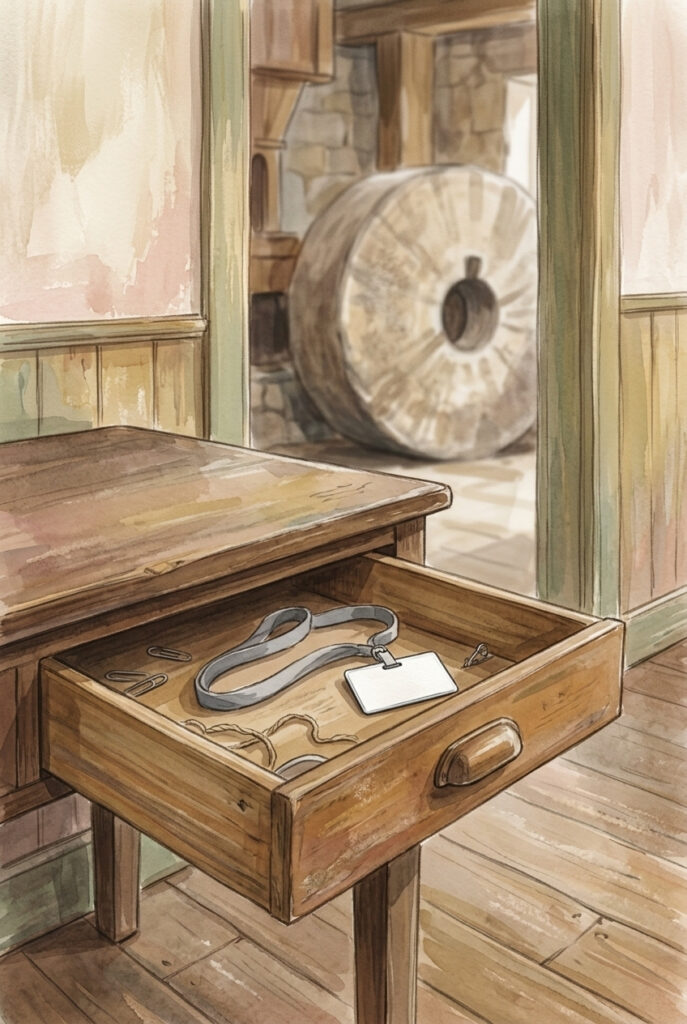
There is a story sometimes told of four adults on one lease, none of them related to any of the others. A woman in her sixties keeps a hand-ruled paper chart on the refrigerator door, pinned up with four mismatched magnets, showing who is doing which of the week’s jobs. She has kept it for eleven years. When one of them lost work for five months, nobody in that house held a meeting about it; the chart simply changed, and it stayed changed until it did not need to be.
When another of them lost a mother, three of them drove eleven hours through the night to a funeral where not one of them had standing to sign a single form. They sat in the second row. Somebody at the door asked, kindly and with no malice in it at all, what their relationship to the deceased had been, and there was a pause, and then somebody said, we live with her.
I am not going to tell you the man at the door found a box to tick. There isn’t one. Eleven years on, the lease still lists four unrelated adults, no word has yet been invented for what they are to each other, and nothing in this story gets solved.
But run the two lists over that house. Patience, benignity, longanimity, mildness. Every one of them is growing on that refrigerator door, and by the only test Paul gives us, against such there is no law.
We said something close to this on the feast of a man who kept making new religious families, and today’s claim is the plainer one. There the question was whether a new kind of household could be legitimate. Here it is not even asked. That house is not legitimate by any definition currently on offer, it grows the entire second list regardless, and against such there is no law.
If you do not believe in God, the whole of this still holds and you can test it against your own week. Some good things in a life can be checked against a rule, and the best ones cannot. Kindness, patience and steadiness have no legal category, no certificate and no threshold, so you can neither prove them nor be disqualified from them. Nobody gets to rank you on them either, which is the plain version of against such there is no law.
Last Sunday we heard that a law cannot give life, and that faith hath made thee whole is a sentence no procedure has ever managed to say to anybody. Today Paul comes at the same wall from the other side. Last week the point was that the law cannot reach far enough down; this week the point is that where the fruit is actually growing, against such there is no law, because the law was never pointed at that ground in the first place.
Two Sundays, one claim, and the claim is not that rules are bad. Rules do real work, and this Mass is full of them. It is that they are the wrong instrument for the only things that finally matter about a person, and against such there is no law is the Church’s own admission of it, read aloud in green vestments on an ordinary Sunday morning.
Which is why this Sunday is not an invitation to relax. It is harder than a rule, not easier. A rule can be satisfied on a Tuesday and forgotten by Thursday. Against such there is no law leaves you with nothing to satisfy and nothing to forget, only the question of what is actually growing in you and in the people nearest you.
So here is what I would ask you to carry out of this Mass. Look at your own week and find the one relationship in it that no rule requires you to keep. The one nobody would blame you for dropping, that appears on no form and earns you no credit anywhere. That is the ground this Gospel is talking about, and against such there is no law.
Then do the small thing that keeps it. Send the message, make the drive, take the shift. Nothing will certify that you did it and nothing will record it, and against such there is no law is the reason that is a feature rather than a loss.
And if the honest answer this morning is that you are too tired and too short of money to think about growing anything at all, then take the Gospel’s own order of operations. Your Father knoweth that you have need of all these things. The knowing comes first, before the seeking, before any of it. Against such there is no law, and against you there is no verdict.
↑ The order resumes below.
XI
Offertory
Ps 33:8-9
Taste, and see. The verse asks for the one form of knowing that no examination can conduct on your behalf, and it is the right thing to bring to the altar on a morning about fruit.
XII
Secret
Grant us, we beseech Thee, O Lord, that this saving offering may both cleanse us of our sins and win for us the favour of Thy divine power. Through our Lord Jesus Christ, Thy Son, Who liveth and reigneth with Thee in the unity of the Holy Ghost, God, world without end. Amen.
XIII
The Canon and Consecration
(The Preface of the Most Holy Trinity is sung here, followed by the Sanctus, the Canon of the Mass and the words of Consecration, all from the Missal.)
This is the oldest and quietest part of the rite, and it is not a performance. What the Church has always claimed happens here does not depend on how anyone in the room is feeling about it this morning. That is a mercy on the mornings when you feel nothing at all.
XIV
Act of Spiritual Communion
(Said by all who are not receiving sacramentally.)
My Jesus, I believe that Thou art present in the Most Holy Sacrament. I love Thee above all things and I desire to receive Thee into my soul. Since I cannot now receive Thee sacramentally, come at least spiritually into my heart. I embrace Thee as if Thou wert already there, and I unite myself wholly to Thee. Never permit me to be separated from Thee.
If you are homebound, or in a hospital bed, or in a body that could not get to a church building today, that prayer is not a lesser version of anything. It is the door the Church left open on purpose.
XV
Communion
Matt 6:33
Seek ye first the kingdom of God, and all these things shall be added unto you, saith the Lord.
XVI
Postcommunion
May Thy sacraments, O God, ever cleanse and strengthen us: and bring us to the reward of everlasting salvation. Through our Lord Jesus Christ, Thy Son, Who liveth and reigneth with Thee in the unity of the Holy Ghost, God, world without end. Amen.
XVII
The Closing Blessing
Go out and stop measuring. Look at what has grown in the people around you this week, in the ones with no title to any of it, and let that be the whole of your report.
And to anyone carrying a shortage into this week, or a household that fits nowhere, or a fear about money that somebody has told you is a failure of faith: it is not, the need is known before you name it, and over everything you are quietly growing, against such there is no law. May the Almighty God bless you, the Father, and the Son, and the Holy Ghost. Amen.
Propers for the XIV Sunday after Pentecost are taken from the 1962 Roman Missal. Scripture is quoted from the Douay-Rheims Bible. The liturgical spine of Faith in Bloom is The New Marian Missal for Daily Mass by Sylvester P. Juergens, S.M., S.T.D., Regina Press, Imprimatur 1961.
Faith in Bloom is offered by Bloom Ministries in the Independent Catholic tradition and is not affiliated with or recognized by the Roman Catholic Church.
