
Daily Offering · 5 September 2026 · St. Lawrence Justinian
Daily Offering: September 5, 2026 | Increase Our Devotion
Welcome to Bloom’s Daily Offering for Saturday, September 5, 2026. Today is the feast of St. Lawrence Justinian, Bishop and Confessor, third class, and the vestments are white. There is no commemoration and nothing displaced. Every reading appointed for today has been read here…
The order of this offering
Before the readings
The Word
Offering and Canon
I
Opening Address
Welcome to Bloom’s Daily Offering for Saturday, September 5, 2026. Today is the feast of St. Lawrence Justinian, Bishop and Confessor, third class, and the vestments are white. There is no commemoration and nothing displaced. Every reading appointed for today has been read here before, and the whole of what is new is one short prayer that asks this feast to increase our devotion.
That is a smaller inheritance than it sounds, and a stranger one. The prayer does not ask that we be given devotion. It asks that something already in our possession be made larger, and it asks a recurring day in September to do the enlarging. So we are going to spend this morning on one verb, and the verb is increase.
Hold the shape of that request. Somebody wrote this sentence for a congregation they would never meet, and the one thing they were willing to assume about every person in the room was that there would be something there already. The prayer to increase our devotion is built entirely on that assumption and never once stops to check it.
Wherever you are, you are welcome here. If you arrived this morning with very little, the prayer to increase our devotion is still exactly your prayer, because it never once says how much you were supposed to bring.
II
A Word on Today’s Propers
Today is the Mass the Church keeps for a great priest, and this ministry has been here before. The Introit, the Lesson, the Gradual, the Gospel and the Secret are the texts we printed on the feast of St. Charles Borromeo last November, word for word, with nothing altered. The Gospel came round a second time in December, on the feast of St. Nicholas, and the Introit with it.
So this is the third time through much of this Mass, and the second time through the rest of it. The one text on the table that no one here has ever prayed is the Collect, which belongs to Lawrence Justinian alone and to no other day in the year.
That decides the shape of the morning. Printing the same Lesson and the same parable again inside ten months would be length pretending to be reverence, and this ministry keeps telling you it will not do that. The citations stand where the propers would, each one carrying its own onward reference, and then the Collect and the Secret in full, because a day still has to be prayed and those are the prayers actually said at this Mass. The Collect carries the day’s one new request, which is to increase our devotion.
Which leaves a great deal more room than it looks like. Nobody has preached this Collect, and it is the only sentence in the day that has never had a hearing, and its entire request is to increase our devotion. Everything after this is about three words at the middle of it: increase our devotion.
One more note on the calendar. Underneath today sits the Saturday of the fourteenth week after Pentecost, and a third-class feast takes the day from it outright, which is why the vestments are white this morning rather than green.
III
Introit
Ecclus 45:30; Ps 131:1
(The Statuit antiphon, on the covenant and the dignity of priesthood, printed in full in November and again in December.)
IV
Collect
Grant, we beseech Thee, almighty God, that the venerable feast of Lawrence, Thy blessed Confessor and Bishop, may increase our devotion and promote our salvation. Through our Lord Jesus Christ, Thy Son, Who liveth and reigneth with Thee in the unity of the Holy Ghost, God, world without end. Amen.
V
Epistle
Ecclesiasticus 44:16-27; 45:3-20
The Lesson for a great priest, which the Missal draws together out of verses from two chapters rather than reading either straight through, given whole in November.
VI
Gradual
Ecclus 44:16, 44:20; Ps 109:4
(Behold a great priest, with the Alleluia verse on the order of Melchisedech, printed in November.)
VII
Gospel
The parable of the talents, read in full in November and preached again in December on the handing out that opens it.
The Offering
Daily Homily | Increase Our Devotion
Read the Collect once more and stop on the verb.
Increase our devotion, not begin it
Read the Collect once more and stop on the verb.
That the venerable feast of Lawrence, Thy blessed Confessor and Bishop, may increase our devotion and promote our salvation.

Increase. Not kindle, not create, not restore, not give. Increase, which is a word you can only use about something that is already there. To increase our devotion presupposes devotion.
That is a large assumption to make about a room full of strangers, and the prayer makes it without hesitating. It does not ask God to put devotion into people who have none. It asks that whatever quantity is already present be made larger, and it says this on behalf of everybody at once.
I want to stay on that a while, because most religious sentences about the interior life are starting sentences. They assume you are at nothing and need to be got going. Conversion language, the language of starting over, the language of beginning again from zero on a Monday. This prayer does none of it. It walks into the room, takes it as read that there is something there in every single person, and asks only that it increase our devotion from wherever it stands.
Notice what that does to the arithmetic. If the request is for increase, then the starting amount is not the point of the sentence. A person at a very great deal and a person at almost nothing are asking for the identical thing, and they are asking for it in the same breath, in the plural, out loud, in a room together.
And it changes what the sentence is for. A prayer asking God to create devotion would be a prayer about a lack. A prayer asking a feast to increase our devotion is a prayer about a quantity, and quantities do not have to be dramatic to be real. Four is not a lack. Four is a number you can add to.
The prayer names no amount
Here is the second feature, and it is an absence rather than a presence. The prayer never says how much.
It does not ask that our devotion be increased to a sufficient level. It does not name a threshold, a target, a minimum, or a mark that would count as having arrived. It asks that this feast increase our devotion, full stop, and it leaves the sentence there without a number in it anywhere.
That is unusual and it is deliberate. A prayer with a threshold in it would be a prayer you could fail, and this one cannot be failed by anybody, because there is no line drawn across it. The request to increase our devotion has no pass mark in it. To increase our devotion by a very little is to have had the prayer answered exactly.
Let me put the same thing the other way round, because it matters more in that direction. If the sentence contains no required amount, then nobody in the room is behind. There is no standard quantity of devotion against which yours is short. There is only whatever you have, and the request that it increase our devotion from there.
Compare that with nearly every other measurement you have been handed. Work sets a target. Study sets a pass mark. Even the kindest advice about health or money names a figure you are meant to reach. This Collect is said at an altar by an institution with centuries of practice in setting standards, and on the one occasion it asks to increase our devotion it declines to set one.
Let me also say plainly what this is not saying, since a prayer this generous is easy to mishear. It is not telling you to work up more feeling. Devotion here is not an emotion you are being instructed to produce on demand, and the prayer never grades what you walked in with. If you have felt nothing in church for years, the request to increase our devotion still covers you, word for word, with no adjustment.
And let me be exact about the difference from yesterday, since two mornings running on nearby ground can blur. Yesterday’s question was where help comes from, and the answer was that it arrives rather than being produced. Today’s question is not about the source at all. It is about the starting point, and about the fact that the prayer never states one. Yesterday’s prayer asked to be led; today’s asks to increase our devotion, and that is the difference between a road and an amount.
The tax on being ordinary
Now the teaching I want to test against this, and it operates inside churches and well outside them. The teaching says that real faith is demonstrable. It shows. There is a story you can tell, a change people noticed, an intensity that marks you out, and a religion that produced none of those is a religion you were only pretending to have.
Apply the fruit test, the way we test everything here: by their fruits you shall know them. Ask what the demonstrable-faith teaching has actually grown where it ran. It grew congregations where the articulate did well and the quiet were suspected. It grew people performing a certainty they did not have, because the alternative was being counted out. It grew a Church very good at collecting testimony and very bad at asking a prayer to increase our devotion in people who had nothing to report.
It also falls unevenly, and that is the part worth naming. The demand to be demonstrable is not made of everybody equally. Some people are simply assumed to belong and are never examined at all. Others are asked to be exceptional before they are allowed to be ordinary, and to keep being exceptional afterwards.
I will name who carries that most heavily in our own decade, because this prayer needs it named. Trans people in religious settings are routinely asked to clear a bar nobody else is held to: be twice as devout, twice as useful, twice as quiet, and then perhaps your presence will not be a question. Set that beside this morning’s Collect. There is no bar in the sentence. It asks that this feast increase our devotion for everyone saying it, from any starting quantity, with nothing required in advance.
That is a different claim from the last two times this ministry named that group, and the difference is the whole point. In August we read a Sunday on law used as a weapon, and later that month on the assumption that a body keeps its integrity by subtraction. Today is neither. Today is about the exceptionalism tax, and about a prayer that declines to charge it.
Notice as well how badly an exceptional standard fits the actual request. Nobody can be exceptionally increased. Increase is a comparison between a thing and its own earlier self rather than between one person and another, so a prayer to increase our devotion carries no rank order anywhere inside it and cannot be used to sort a room into the sufficient and the rest.
And the fruit test cuts back on Christianity’s own record here, which is the record we are obliged to examine. Wherever a church has demanded extraordinary holiness from the people it was least sure about, it has tended to produce two things at once: the least secure working hardest and leaving first, and the comfortable never being asked anything at all.
Four inches of topsoil
I want to give you a person, because a claim about quantities stays abstract until somebody’s Saturday is in it.
There is a story sometimes told of a man who has worked the same allotment plot for thirty-four years, in full view of about forty other plots, where nothing anybody does goes unremarked upon by the person on the next bed. He grows three things and has never had a good year with all three at once. He has believed the same handful of things for the whole of that time and has never found any of it exciting.
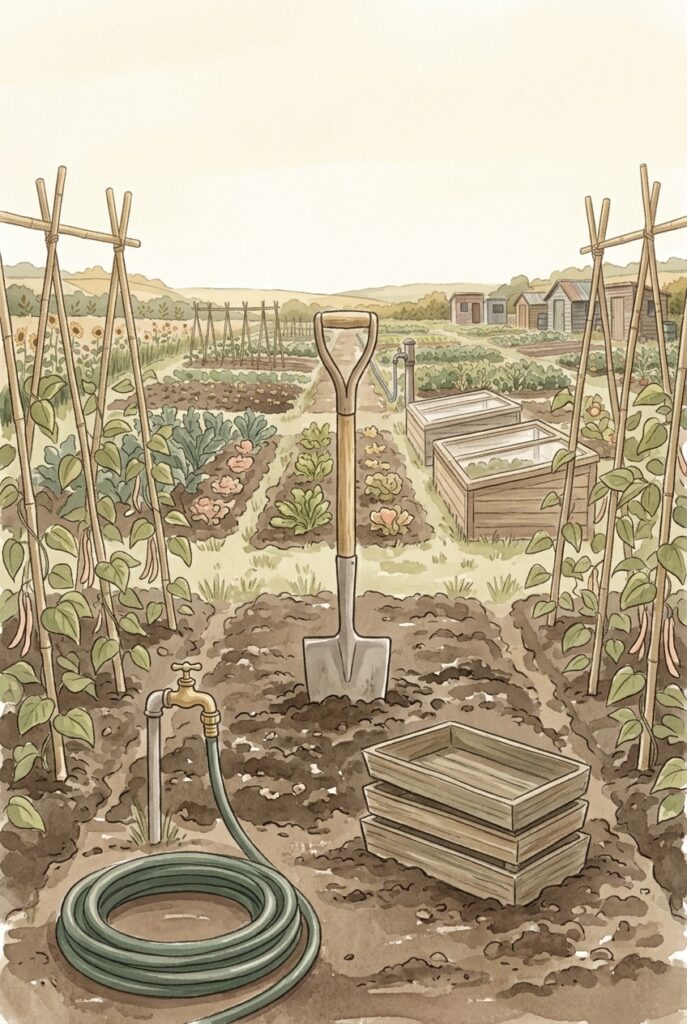
Ask him what he has learned in thirty-four years and he will tell you nothing he could pass on. He has no method. He has never read a book about it. People who arrive with a plan and a spreadsheet tend to last about four seasons, and he has stopped predicting which ones will stay.
Then he will correct himself, because he does have one figure. The ground on that plot carries something like four more inches of topsoil than it did when he took it on, and every one of those inches went in a barrowful at a time, over three decades, on Saturdays. He can walk you to the boundary and show you where his plot stops and the thin stuff starts.
He is not sentimental about any of it. He will tell you the plot is ordinary, that two of his neighbours grow better beans, and that he has never won a thing. What he has instead is a measurable difference in the ground, and it is the closest physical object I know to what this Collect means when it asks a feast to increase our devotion.
The part he says people find hardest is that he cannot show you a year in which it happened. There was no season where the soil turned. There is only the difference between the two sides of a line, and thirty-four years of Saturdays in between, and he would tell you the same about the rest of it. Whatever a lifetime of the same undramatic religion has done to him is exactly as undetectable in any single year and exactly as real at the boundary, which is what it means to increase our devotion.
We stood near this ground once before, in August, with a woman whose congregation split and who refused to stop praying with either half. That story was about loyalty under pressure, about what a person will not do. This one is about accumulation, about what a person keeps doing when there is no pressure at all and nothing to show for a decade.
I do not want the story to carry more than it can. Four inches of soil is not a life’s meaning, and he would say so first and without drama. What it is, is a quantity that only exists because something came back weekly for thirty-four years, which is the only mechanism this Collect names for how to increase our devotion.
If you do not believe in God, none of this collapses, and you can check it against your own life without borrowing an article of faith. Almost nothing that made you who you are arrived as an event. It came as a repeated small deposit you could not feel going in, and you noticed it years later by comparing two edges. To increase our devotion is the religious word for a process everyone has already lived through and mostly failed to notice.
The third time is not the thin time
Look at the day’s own structure now, because the calendar is making the argument in a second language. The Church had a feast to fill and gave it a Mass we already know. Same Lesson, same parable, same antiphons, third time round.
If devotion were a thing you begin, that would be a waste of a Saturday. Nothing here is new material, and a person who comes to church for new material has been badly served this morning. But the prayer does not ask for beginning. It asks for increase, and increase has only one mechanism in it, which is return.
That is the answer this feast gives to its own repetition, and it is the sharpest thing in the day. A returning text is not a thin text. It is the same barrowful arriving again, and the reason the Church puts the identical Lesson in front of us for a third time is that she is not trying to inform us. She is trying to increase our devotion, and you cannot increase a quantity by telling it something once.
The Lesson we are not reprinting today says of its great priest that the Lord made him to increase among his people, which is the same word arriving from the other direction. The man in that reading is not described as having begun from nothing. He is described as growing where he already stood.
The Secret keeps the same shape and it is the other prayer we say. It asks that the Saints make us joyful, and that while we reflect on their merits we may enjoy their help. Reflect, again, is a returning verb rather than a starting one, and the help is the increase.
Put the two prayers side by side and they agree on the mechanism. Neither asks for an event. Both ask that something already begun be added to, and both hand the adding over to a day that comes round again. To increase our devotion is a good part of what a calendar is for, and it is why the Church would rather repeat herself than entertain you.
Lawrence Justinian himself is a life shaped like this Collect, though the Church says almost nothing about him in the prayer. He came out of the Giustiniani, a Venetian patrician family, and at about nineteen he went to the Canons Regular of St. Augustine on the island of Alga, which the Catholic Encyclopedia puts in the year 1400. Ordained in 1406. Prior, then general of his congregation, then Bishop of Castello in 1433, and in 1451 the first Patriarch of Venice.
Half a century between the island and the patriarchate, and not one of those offices is mentioned in the prayer the Church actually assigns him. The Collect does not ask that his career make us ambitious. It asks that his feast increase our devotion, which is the smallest possible request to make out of a very large life.
So if you do one thing with this before the weekend closes, do not resolve anything, and do not go looking for a feeling. Find the one thing you already do that is worth more of, and add one more of it. That is the whole of the instruction, and it is what it means to increase our devotion.
↑ The order resumes below.
IX
Secret
May Thy Saints, we beseech Thee, O Lord, everywhere make us joyful: that, while we reflect upon their merits, we may enjoy their help. Through our Lord Jesus Christ, Thy Son, Who liveth and reigneth with Thee in the unity of the Holy Ghost, God, world without end. Amen.
X
The Holding
May God take whatever you brought here this morning, at whatever size it is, and increase our devotion in every one of us without once asking how much we arrived with. You are not behind. There is no amount you were supposed to have by now. May Almighty God bless you, the Father, and the Son, and the Holy Ghost. Amen.
And if none of that language belongs to you, take it plainly. Add one more of the good thing you already do. That is the plain version of increase our devotion, and the years will do the arithmetic whether or not you can feel them working.
XI
Frequently Asked Questions
Because today uses the Common of a Confessor Bishop, the Mass the 1962 Missal keeps for a bishop who was not a martyr, and this ministry has printed those texts before on the feasts of St. Charles Borromeo and St. Nicholas. The Introit, Lesson, Gradual, Gospel and Secret are identical. Only the Collect belongs to St. Lawrence Justinian alone.
Because they were given in full in November and the citations carry their own onward references, so a third copy inside ten months would add length without adding anything else. Only the Collect and the Secret appear today, since those are the prayers actually said at this Mass and the day still has to be prayed. It is the same choice this ministry made on the feasts of St. Raymond Nonnatus and St. Stephen of Hungary.
No, and there is a real trap in the question. A St. Lawrence vigil is one of only seven that survived the reforms of 1955, but it belongs to St. Lawrence the deacon and martyr and is kept on August 9. Neither today nor tomorrow is a surviving vigil, no surviving octave reaches early September, and nothing here is the eve of anything.
It is the request at the middle of today’s Collect, and the operative word is increase. The prayer assumes that something is already present in the person praying and asks that it be made larger, rather than asking that it be created. It names no required amount anywhere in the sentence, which is why nobody saying it can be behind.
There are three in the calendar and they are easily run together. St. Lawrence the deacon and martyr is kept on August 10, with his vigil the day before. St. Lawrence of Brindisi is kept on July 21, and this ministry marked him in July. Today is St. Lawrence Justinian, whose feast the Catholic Encyclopedia gives as September 5, and who was made the first Patriarch of Venice in 1451.
No, and the prayer does not say that. It asks that a returning feast increase our devotion, which is a claim about the mechanism rather than a claim about worth. You still turn up, and the turning up is the mechanism working. What the sentence refuses to do is set a quantity you were supposed to have reached by now.
No. The logic stands with no theology attached at all. Almost nothing that formed you arrived as an event, and you cannot point to the year it happened; it came as a small deposit repeated until the difference was measurable. In one plain sentence: add one more of the good thing you already do, and stop grading yourself against an amount nobody ever named.
Faith in Bloom is the daily liturgical work of Bloom Ministries, a 501(c)(3) nonprofit, and it is free to read and always will be. If it has been worth something to you and you are able, you can give once or give monthly below. Sending a post to one person who needs it does real work too.
Propers for the feast of St. Lawrence Justinian are taken from the Common of a Confessor Bishop in the 1962 Roman Missal, with the proper Collect of the saint. Scripture citations follow the Douay-Rheims Bible. The liturgical spine of Faith in Bloom is The New Marian Missal for Daily Mass by Sylvester P. Juergens, S.M., S.T.D., Regina Press, Imprimatur 1961. Faith in Bloom is offered by Bloom Ministries in the Independent Catholic tradition and is not affiliated with or recognized by the Roman Catholic Church.
