


Daily Offering · 4 September 2026 · Feria
Daily Offering: September 4, 2026 | All Things Profitable
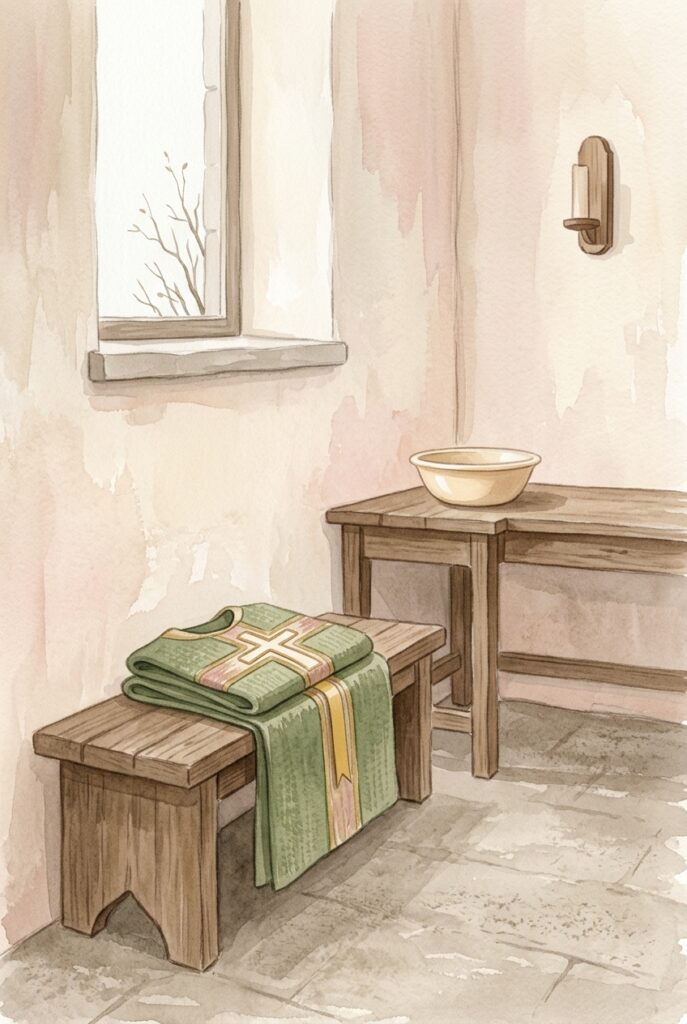
Welcome to Bloom’s Daily Offering for Friday, September 4, 2026. Today is a feria of the fourteenth week after Pentecost, fourth class, and the vestments are green. There is no feast on the calendar, no saint commemorated in the prayers, and not one word…
The order of this offering
Before the readings
The Word
Offering and Canon
I
Opening Address
Welcome to Bloom’s Daily Offering for Friday, September 4, 2026. Today is a feria of the fourteenth week after Pentecost, fourth class, and the vestments are green. There is no feast on the calendar, no saint commemorated in the prayers, and not one word in today’s Mass that we have not already prayed twice this week. So we are going to spend the whole morning inside a single clause the Church has now handed us three times and that nobody here has yet stopped on: lead us to all things profitable to our salvation.
Wherever you are, you are welcome here. If you came into this Friday with no capacity to generate anything at all, you are in the right room, because the prayer we are saying does not ask you to generate anything. It asks that you be led to all things profitable, and the leading is somebody else’s work.
II
A Word on Today’s Propers
Today’s Mass is last Sunday’s Mass, for the third time in six days. The Introit, the Collect, the Epistle, the Gradual, the Gospel, the Offertory, the Secret and the Communion are the texts of the fourteenth Sunday after Pentecost, carried forward without a word changed. We did the same thing on Tuesday. That is what a ferial day is: the Church does not write a new Mass for every weekday, and she lets the Sunday go on speaking, exactly as she did on the feria that carried the thirteenth Sunday forward.
Today goes one step further than Tuesday did. There is no commemoration. On Tuesday two saints brought six prayers this ministry had never printed, so the day had something of its own even while the readings repeated. Today there is nothing. Not a phrase, not an oration, not a name.
So I am going to print two texts and no more. Tuesday gave you the Introit, the Collect and the Gradual and sent you to Sunday for the Epistle and the Gospel. A third printing of the same antiphons inside one week would be padding dressed up as reverence, and you deserve better than that from a ministry that keeps telling you it will not pad. Below are the citations, linked, and then the Collect and the Secret in full, because those are the prayers of the day and a day still has to be prayed.
Here is what makes this a rich morning rather than a thin one. Nobody has yet preached this Collect. Sunday’s homily was built on Paul’s two lists and Tuesday’s on the two commemorations, so the prayer sitting at the centre of all three days has been said aloud three times and read closely not once. That is where all things profitable comes from, and it is the only thing on the table today.
III
Introit
Ps 83:10-11; Ps 83:2-3
(Sunday’s Introit, printed in full on Sunday and again on Tuesday. Behold, O God our protector, and one day in thy courts above thousands.)
IV
The Collect: Led to All Things Profitable
Keep Thy Church, we beseech Thee, O Lord, with Thy perpetual mercy: and because without Thee the frailty of man cannot but fall, keep us ever by Thy help from all things hurtful, and lead us to all things profitable to our salvation. Through our Lord Jesus Christ, Thy Son, Who liveth and reigneth with Thee in the unity of the Holy Ghost, God, world without end. Amen.
V
Epistle
Paul’s two lists, the works of the flesh and the fruit of the Spirit, read in full on Sunday.
VI
Gradual
It is good to confide in the Lord, rather than to have confidence in man, printed whole with its verse on Sunday.
VII
Gospel
Two masters, the birds, the lilies, and seeking the kingdom first, read in full on Sunday.
The Offering
Daily Homily | All Things Profitable
Read the Collect again, slowly, and count who is doing the work in it.
Read the Collect again, slowly, and count who is doing the work in it.
Keep Thy Church. Keep us ever by Thy help. Lead us to all things profitable to our salvation. Three verbs, and every one of them belongs to God.
The people in that sentence get exactly one adjective, which is frail, and they are never asked to stop being it. All things profitable arrive in this prayer. They are not produced in it.
Now look at the order, because the order is the whole argument. The frailty clause comes first, before either petition, and it is stated as a general fact rather than a diagnosis: the frailty of man cannot but fall. Man. Everybody. The prayer establishes that the whole room falls before it asks for a single thing, so by the time all things profitable are requested, nobody in the room is a special case.
I want to sit on that, because it is doing something unusual. Most religious sentences about falling are sorting sentences. They exist to separate the ones who fall from the ones who do not, and to tell you which group you are in. This one refuses to sort. It puts every person saying it on the same side of the line and then asks, on behalf of all of them together, for all things profitable.
And then it asks for two things rather than one, which is the second feature of the sentence. Keep us from all things hurtful and lead us to all things profitable. A negative and a positive, and they are not the same request wearing two coats.
Think about what is missing between them. The prayer never asks that we be made stronger. It never asks for resolve, or grit, or a firmer grip, or a better week’s effort. It asks that the hurtful things be kept away from us and that we be walked toward all things profitable, and it treats both of those as changes in our surroundings rather than changes in our character.
That is a claim about where help lives. On this prayer’s account, help is not a quality you find inside yourself under pressure. Help is a hand on your elbow and a road you were put on. All things profitable are a destination somebody else knows the way to.
The Gradual we are not reprinting today says the same thing in a different key, and it says it twice in one breath. It is good to confide in the Lord, rather than to have confidence in man; it is good to trust in the Lord, rather than to trust in princes. Two ranks of person are named, the ordinary one and the powerful one, and both are ruled out as the place to put your weight.
The psalm is not insulting anybody. It is telling you that the thing holding you up is not in the room, and all things profitable come from outside it.
I would add the obvious third case the psalm leaves unsaid, because it is the one that hurts. Not in man, not in princes, and not in yourself either. Anyone who has tried to be their own foundation on a bad week knows exactly how that ends, and it is the reason the Collect asks for all things profitable rather than asking for a stronger person.
Here is the teaching I want to test against it, and it is everywhere, inside churches and well outside them. The teaching says that a person who keeps falling has a wanting problem. If they truly wanted it, they would have it. Every relapse is a referendum on the sincerity of the last resolution, and the prescription is always the same: want it harder.
Apply the fruit test to that, the way we test everything here: by their fruits you shall know them. Ask what the want-it-harder teaching has actually grown in the places that ran it. It grew people who hid their falls instead of reporting them, because a fall was evidence about the soul rather than information about the week.
It grew rooms where the honest were punished and the quiet looked healthy. It grew a Church that was very good at explaining a collapse after the fact and very bad at putting anybody in the way of all things profitable beforehand.
I will name who pays the most for that teaching, because today’s prayer needs it named. People in recovery from addiction carry the want-it-harder doctrine more heavily than almost anyone, and they carry it in a specific form: that the substance is a will problem, that a return to it is a verdict on the person, and that the remedy is therefore internal, private and permanently their own responsibility.
Set that beside this morning’s Collect. The prayer does not ask that anybody’s will be reinforced. It asks that they be kept from what harms and led to all things profitable, and it makes that request out loud, in company, for everyone at once.
Let me be exact about the difference from something we said last Friday. That day the question was whether your past is an invoice, and the answer was that mercy is not a payout on a counted record. Today’s question is not about the record at all. It is about the mechanism: where the help comes from, and in what order it arrives. All things profitable come to you before you have earned the right to want them, which is a different claim and, I think, a harder one to accept.
And I want to be equally exact about the difference from yesterday, since this is two mornings running on adjacent ground. Yesterday the argument was about who the word burden gets assigned to, and it was a question about language. Today’s is a question about sequence.
Nothing here is about whether anybody has to prove a need before receiving; that is not what this Collect is doing, and I am not going to make it do it. All things profitable are asked for on behalf of a room that has already been described as frail, with no application form anywhere in the sentence.
Let me also say plainly what the prayer does not claim, because a prayer this generous can be misheard. It does not say that nothing you do matters, and it does not say that your effort is a waste of a morning. It says that the effort is not the engine. You still walk; you are simply not the one who chose the road, and all things profitable were on it before you arrived.
If you have ever tried to get better at something by force of resolution, you already know how the arithmetic goes wrong. Resolve is a resource you spend, and it is lowest at exactly the hour you need it most. A plan that runs on it is a plan that fails on your worst day by design, which is why the prayer does not ask for more of it. It asks for all things profitable to be brought within reach on the worst day, when you have nothing left to bring.
I want to give you a person, because an argument stays an argument until somebody’s Tuesday morning is in it.

There is a story sometimes told of a woman who swims thirty lengths in the slow lane of a municipal pool at seven in the morning, twice a week, and who cannot tell you when she decided to. She had been through something some years earlier that she does not narrate, and afterwards there was a long stretch where getting through a day took everything she had and left nothing over.
She did not choose the pool. A woman she worked with had a month’s pass she was not going to use, and handed it over in a corridor without making a speech about it.
Ask her what helped and she will not give you a decision, because she does not have one to give. She will tell you that somebody else’s pass ran out after four weeks, and that she renewed it, and that the renewal was the first choice she made in the whole business. Everything before it was arranged for her by a colleague who did not explain herself. All things profitable reached her in the shape of a laminated card handed over near a photocopier.
The part she says is hardest to explain is that the water asks nothing of her. It does not require an account of the years, it does not want to know how she is doing, and it is exactly the same temperature every week whether she arrives strong or arrives hollow. She has said that the fixed hour did more for her than any resolution she ever made, because a resolution has to be renewed each morning and a Tuesday simply comes round again. All things profitable, in her case, had a timetable.
We stood near this ground once before, on the feast of the Immaculate Heart, when the Epistle told us to come with confidence to the throne of grace. That day the argument was about permission, about who is allowed to approach at all. This one is about transport, about who gets you there, and the honest answer for most of us is a person who handed us something in a corridor. All things profitable tend to arrive by hand.
I do not want to make her story do more than it can. A pass in a corridor did not fix a life, and she would be the first to say so, plainly and without drama. What it did was put one fixed hour into a week that had none, and everything else she has built since is standing on that hour. All things profitable, in her account and in this Collect, are less like a rescue and more like a first foothold.
If you do not believe in God, none of this falls apart, and you can check it against your own life without borrowing a single article of faith. The things that actually changed your direction were mostly not decisions. They were a person who kept including you, a routine somebody else set up, a room that was already arranged before you walked into it.
The plain version of all things profitable is that circumstances do far more of the work than willpower does, and building your life as though the reverse were true is how people end up ashamed of ordinary human limits.
Which turns the practical question around completely. The useful thing to ask is not what you should resolve today. It is what you are standing in, who is next to you on a Tuesday, and what would have to be true for the good option to be the easy one at six in the evening when you are tired. All things profitable are usually a matter of arrangement, and arrangements can be made by other people on your behalf.
That is also the instruction this gives the rest of us, and it is a small one. You cannot install resolve in anybody. You can hand over a pass, keep a seat, name a time, and go on expecting somebody whether or not they came last week, and every one of those is a way of putting all things profitable in somebody’s path.
There is one more thing in this Collect I would not want you to miss, and it is in the first four words. Keep Thy Church. The prayer is corporate before it is personal. It does not begin with me and my difficulties; it begins with a body, and only then does it get round to the frailty of the people in it, and the request for all things profitable is made in the plural throughout.
That matters for anyone who has been handed their falling as a private matter to be sorted out privately. In this prayer there is no private column. The whole body asks, the whole body is called frail, and all things profitable are requested for everybody in one breath, which means the person struggling hardest this morning is not petitioning from outside the group.
The Secret keeps the same shape, and it is the other prayer printed below. It asks that the offering cleanse us of our sins and win for us the favour of Thy divine power, which is again a negative and a positive, again in that order, and again with the work belonging to God rather than to us. Something is taken away and something is brought near. That is all things profitable described from the altar instead of from the road.
Notice that neither prayer promises a feeling. Nobody is told they will wake up wanting the right things, and nothing in either text suggests that the frailty gets edited out along the way. What is promised is direction, which is a much smaller claim and a far more usable one. All things profitable can reach a person who is not enjoying the week at all.
And now look at the day itself, because the calendar is making the same point in a different medium. The Church had a completely free Friday. She wrote nothing new for it, gave it no saint, invented no fresh prayer, and simply led us back to a Mass we already had. A day with nothing of its own is a day that receives everything, which is exactly what Tuesday said too, and today the point is made even more sharply because today there is not even a commemoration to soften it.
So take a Friday that produced nothing and let it teach you the shape of the thing. Nothing was manufactured here. All things profitable were carried over from Sunday and handed to you again, and the only reason you have them this morning is that somebody older than all of us decided you should not have to make your own.
If you do one thing with this before the weekend, make it structural rather than emotional. Do not resolve anything. Change one arrangement instead: move the thing that harms you further from your hand, move one good thing closer to it, and put a standing hour in the week for something that helps. Kept from all things hurtful, led to all things profitable, and those are the two petitions in the prayer, in that order, on purpose.
↑ The order resumes below.
IX
Secret
Grant us, we beseech Thee, O Lord, that this saving offering may both cleanse us of our sins and win for us the favour of Thy divine power. Through our Lord Jesus Christ, Thy Son, Who liveth and reigneth with Thee in the unity of the Holy Ghost, God, world without end. Amen.
X
The Holding
May God keep you this Friday from every hurtful thing that has your address, and lead you to all things profitable by whatever ordinary hand He chooses to use. You are not asked to stop being frail, and nothing you have to do today depends on your having more resolve than you woke up with. May Almighty God bless you, the Father, and the Son, and the Holy Ghost. Amen.
And if none of that language belongs to you, take it plainly. Your direction has always been set more by what surrounds you than by what you can summon, so put one good thing within arm’s reach this weekend and move one harmful thing further off. That is the whole instruction, and it does not require you to feel differently about anything.
XI
FAQ
Because it is a ferial day, the sixth day of the week following the fourteenth Sunday after Pentecost. In the 1962 Roman Rite most weekdays carry no propers of their own and the preceding Sunday’s Mass is said again unchanged. This is the third time this week those texts have been prayed, which is ordinary rather than unusual.
Because they were printed in full on Sunday and the citations are linked above, so a third copy in six days would add length without adding anything else. Only the Collect and the Secret appear in full today, since those are the prayers actually said at this Mass and the day still has to be prayed. It is the same decision this ministry made on the feast of St. Raymond Nonnatus.
No. Only seven vigils survived the reforms of 1955 into the 1962 Missal, and neither today nor tomorrow is one of them, so this is not the eve of anything. Only three octaves survived, and none of them reaches early September. A green fourth-class feria is the whole of what today is.
It is the second of the Collect’s two petitions, and it means whatever genuinely helps a person toward God. The prayer pairs it with its opposite, asking to be kept from all things hurtful, so the two together describe a life being steered rather than a person being improved. Neither half asks the person praying to supply anything.
No, and the prayer does not say that. It says the effort is not the engine, which is a claim about order rather than about worth. You still walk the road; the Collect simply asks God to choose it, clear it, and get you onto it, and it makes that request for everybody in the room at once.
No. The logic stands with no theology attached at all. What changes a life is mostly arrangement rather than willpower, so the useful question is what you are standing in and who is beside you, not how sincerely you resolved. In one plain sentence: move the good thing closer and the harmful thing further away, and stop grading yourself on how much you wanted it.
Faith in Bloom is the daily liturgical work of Bloom Ministries, a 501(c)(3) nonprofit, and it is free to read and always will be. If it has been worth something to you, you can give at bloomministries.org/give. Sending a post to one person who needs it does real work too.
Propers for the feria of the fourteenth week after Pentecost are taken from the 1962 Roman Missal. Scripture is quoted from the Douay-Rheims Bible. The liturgical spine of Faith in Bloom is The New Marian Missal for Daily Mass by Sylvester P. Juergens, S.M., S.T.D., Regina Press, Imprimatur 1961.
Faith in Bloom is offered by Bloom Ministries in the Independent Catholic tradition and is not affiliated with or recognized by the Roman Catholic Church.
