
Daily Offering · 5 November 2025 · Feria
Daily Offering: November 5, 2025 | Not Against Flesh and Blood
Paul spends four verses handing out equipment and one verse saying what the equipment is for, and almost everyone reads the four and skips the one. The armour of God is famous. The sentence that tells you who you are wearing it against is…
The order of this offering
Before the readings
The Word
Offering and Canon
I
Opening Address
Paul spends four verses handing out equipment and one verse saying what the equipment is for, and almost everyone reads the four and skips the one. The armour of God is famous. The sentence that tells you who you are wearing it against is not famous at all, and it says, flatly, that our wrestling is not against flesh and blood. Read that clause first and the rest of the passage changes hands.
Today is a plain Wednesday. It is the fourth feria after the Twenty-First Sunday after Pentecost, fourth class, kept in green, with no saint attached to it and nothing commemorated. The Mass is the Sunday’s, read through again from the top, which is what a green weekday in this season does.
Yesterday two servants were told they had been faithful over a few things, and the parable turned out to hinge on a line nobody remembers hearing. Today has the same architecture. The famous half of the Lesson is the armour, and the half that decides what the armour is for is the enemy list, and the enemy list says not against flesh and blood.
I want to say at the outset what this offering intends to do, because this passage has a long service record and much of it is ugly. It has been used to turn disagreements into campaigns and neighbours into targets. Paul’s own sentence rules that out, and it rules it out in one clause.
The equipment here is real, and it is issued to everybody, and none of it is issued against a person. Once that lands, the list itself starts to look different, and so does every verb attached to it.
II
A Word on Today’s Propers
Today’s Mass is the Mass of the Twenty-First Sunday after Pentecost, kept again on the Wednesday following. That is not an oversight and it is not a shortage. A fourth-class feria in this stretch of the year has no propers of its own; it takes the Sunday’s, and the Church plainly expects these texts to be heard more than once.
Every proper is identical. The Introit from Esther, the Collect for the household, the Lesson from Ephesians, the Gradual from the eighty-ninth psalm, the Gospel of the two debts, the Offertory from Job, the Communion antiphon from the hundred and eighteenth. One thing does differ: Sunday took the Preface of the Most Holy Trinity, and a feria takes the Common Preface.
So the Lesson and the Gospel are not printed again below. They were given in full on Sunday, in the Mass where a man on his knees said have patience with me and then would not say it back. Today the offering goes where Sunday did not go, into the Lesson, and into one clause of it: our wrestling is not against flesh and blood.
III
Introit
In Thy will, O Lord, are all things, and there is none that can resist Thy will: for Thou hast made all things, heaven and earth, and all things that are under the cope of heaven: Thou art Lord of all. (Esther 13:9-11)
Happy are they whose way is blameless, who walk in the law of the Lord. (Ps. 118:1)
Glory be to the Father, and to the Son, and to the Holy Ghost. As it was in the beginning, is now, and ever shall be, world without end. Amen.
IV
Collect
Guard Thy household, we beseech Thee, O Lord, with unceasing care: that under Thy protection it may be free from all harm, and serve Thee by good deeds. Through our Lord Jesus Christ, Thy Son, who liveth and reigneth with Thee in the unity of the Holy Ghost, God, world without end. Amen.
Household. Not empire, not campaign, not front. Household.
V
Epistle
The Lesson is Sunday’s, unchanged: be strengthened in the Lord, put on the armour of God, and then the clause that governs everything after it, our wrestling is not against flesh and blood.
VI
Gradual
Lord, Thou hast been our refuge from generation to generation. (Ps. 89:1)
Before the mountains were made, or the earth and the world was formed: from eternity and to eternity Thou art God. (Ps. 89:2)
Alleluia, alleluia.
When Israel went out of Egypt, the house of Jacob from a barbarous people. (Ps. 113:1)
Alleluia.
VII
Gospel
The Gospel is Sunday’s, unchanged: the king who takes account of his servants, the man forgiven ten thousand talents, and the fellow servant throttled in the yard over a hundred pence.
The Offering
Daily Homily | Not Against Flesh and Blood
Begin with verse twelve, because verse twelve is the instruction manual and everything else is hardware.
Begin with verse twelve, because verse twelve is the instruction manual and everything else is hardware.

For our wrestling is not against flesh and blood; but against principalities and powers, against the rulers of the world of this darkness, against the spirits of wickedness in the high places.
Notice what that sentence does before it does anything else. It subtracts. Before Paul tells you a single thing the enemy is, he tells you what the enemy is not, and what the enemy is not is people. Flesh and blood is the plainest phrase in the whole letter for a human being, and it is the first thing ruled out. Not against flesh and blood is a subtraction before it is ever a battle plan.
That matters because of where it sits. Paul has just spent five chapters on how to live with actual human beings, at close range, under the same roof. Speak the truth to your neighbour. Do not let the sun go down on your anger. Be kind to one another.
Bear with each other, he says. Then he hands out armour, and the first thing he tells you about it is that the wrestling is not against flesh and blood.
He is not changing the subject. He is protecting the five chapters he just wrote. The armour is issued so that the household survives, and the clause is there so that nobody in the household gets mistaken for the thing the armour is for. Not against flesh and blood is the fence he puts around his own house rules.
Now count the verbs, because they are the tell.
Stand against. Resist in the evil day, and stand in all things perfect. Stand therefore. Three commands to stand and one to resist, and then the list. There is no verb of pursuit anywhere in the passage. Nobody is told to advance, to hunt, to root out, to purge, or to take ground. The whole grammar of the thing is a person planted where they are, not moving. That is what an army looks like when the wrestling is not against flesh and blood.
That is a strange way to arm a raiding party, and a very sensible way to arm a household. Which is precisely what the Collect asked for a moment ago: guard Thy household, that it may be free from harm and serve Thee by good deeds. Guard. Not conquer. The equipment matches the prayer, and both of them assume the wrestling is not against flesh and blood.
Then look at what is actually in the kit, one piece at a time.
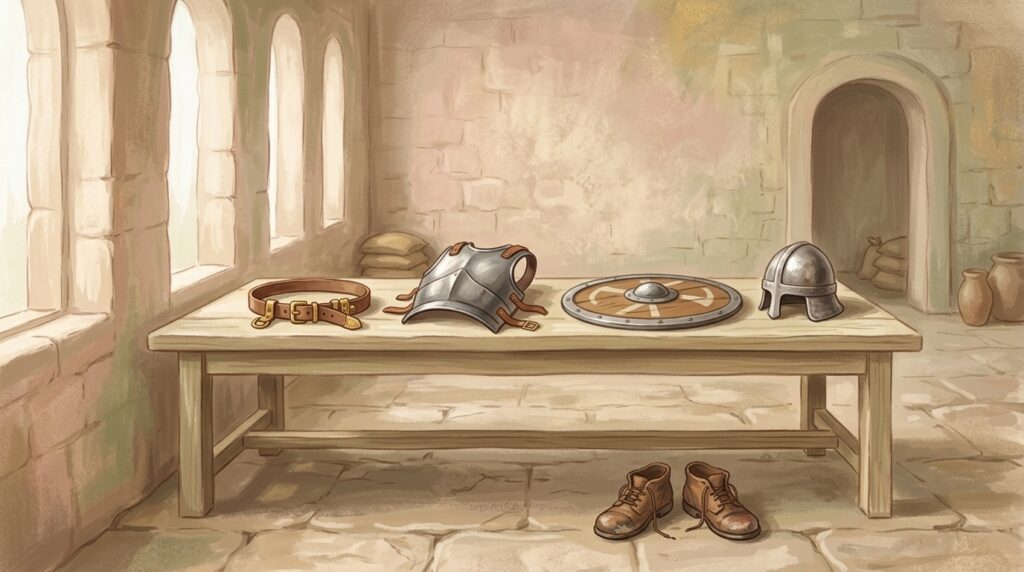
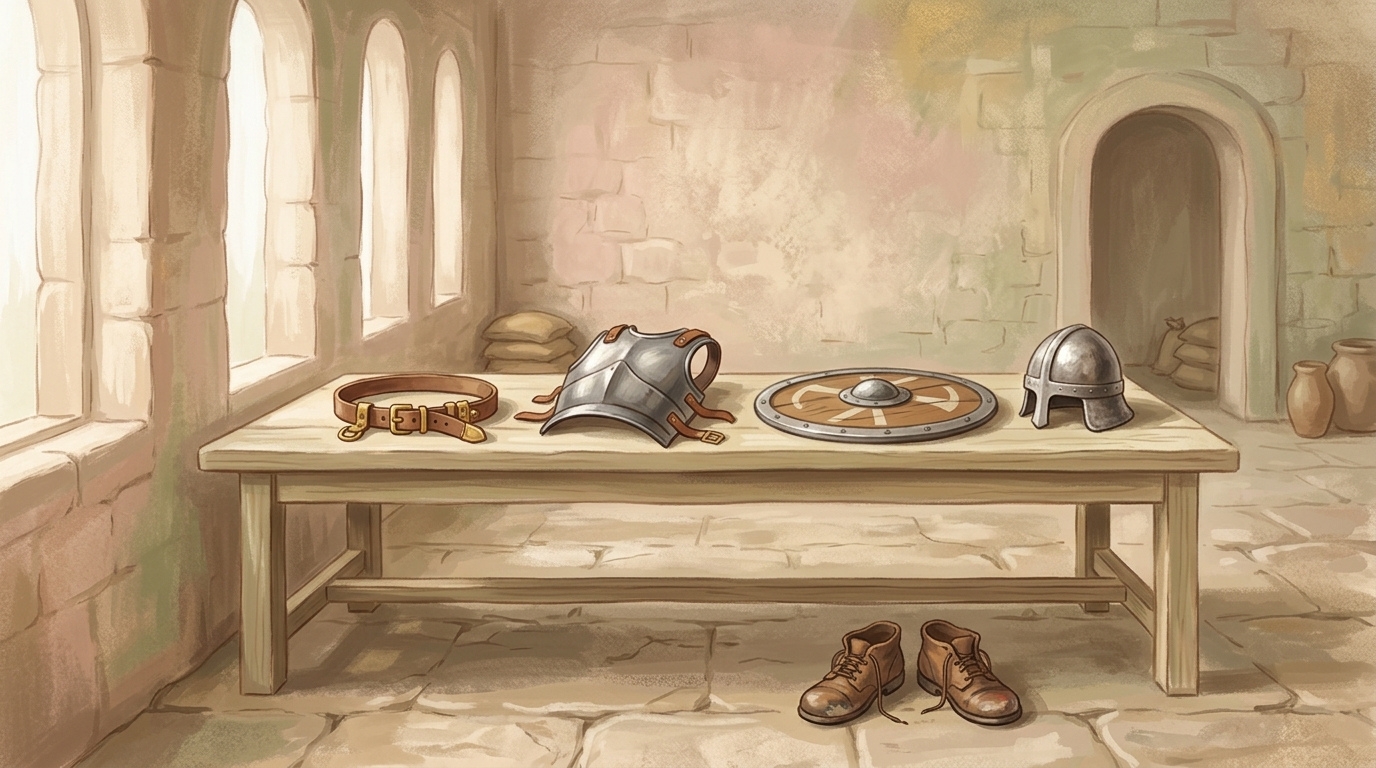
A belt, of truth. A breastplate, of justice. Shoes. A shield, of faith. A helmet, of salvation.
Five items, and every one of them is armour in the ordinary sense, meaning it does nothing at all unless somebody is coming at you. You cannot attack a man with a helmet. That is the shape of equipment issued on the understanding that the wrestling is not against flesh and blood.
There is exactly one thing in the list that has an edge on it, and Paul names it before you can get any ideas: the sword of the Spirit, which is the word of God. Not your argument. Not your position. Not the thing you were about to say to that person. The one offensive item in the whole inventory is explicitly not yours, which is exactly what you would expect in a fight that is not against flesh and blood.
The shoes give the game away completely. And your feet shod with the preparation of the gospel of peace. Read that as a quartermaster would. Somebody is being issued footwear, and the footwear is peace. You do not put peace on the feet of an army you are sending out after people. Whatever this equipment is for, the ground it is meant to cover is ground you arrive on peaceably, because the wrestling is not against flesh and blood.
So the passage arms you, tells you not to move, hands you a defensive kit, gives you one weapon that belongs to God, and puts peace on your feet. And then people have taken it and gone hunting. Every one of those choices only makes sense if the wrestling is not against flesh and blood.
Here is the fruit-test, and it applies where it belongs, which is to Christianity’s own record with this text. When not against flesh and blood is dropped out of the reading, the language of this passage gets pointed at human beings, and it always has. Heretics. Witches. Neighbours.
Whole peoples, in some centuries. The armour comes off the wall and somebody in particular gets called the darkness. That is not a misuse at the margins of the text; it is a flat contradiction of the one clause in it that names the target, and the clause says not against flesh and blood.
I want to name who is on the receiving end of that reading right now, because the clause itself makes the naming necessary. Trans people are described, routinely and in the language of this very passage, as a spiritual battle, an agenda, a darkness to be resisted. The words come straight out of Ephesians six. The clause in the middle of Ephesians six forbids exactly that, because a trans person is flesh and blood, and the wrestling is not against flesh and blood.
That is not a soft reading imported from outside. It is the sentence Paul wrote, in the position he wrote it, doing the job he gave it. Anyone using this armour on a person has picked up the equipment and thrown away the instruction.
And if none of the theology here is yours, the ethical claim stands on its own and it is short. A moral fight that has found itself a human target has already gone wrong, whatever it says it is about. Cruelty toward a specific person is not a side effect of the good fight; it is the evidence that the fight stopped being good. You do not need to believe in principalities to accept that the wrestling is not against flesh and blood, because the whole moral use of the phrase is to keep you from turning a person into an abstraction.
There is a story sometimes told of a woman who transitioned in her fifties and went back to the same small church she had attended for thirty years. On her second Sunday a man she had known for two decades met her at the door and told her, in front of other people, that she was what was wrong with the world. She went in and sat where she always sat.
She kept coming. Not weekly at first, and never comfortably, but she kept coming, and she kept sitting in the same place, and after a while so did he, two rows back. Nothing was resolved. There was no conversation, no apology, no scene of reconciliation that anybody could point to afterward.
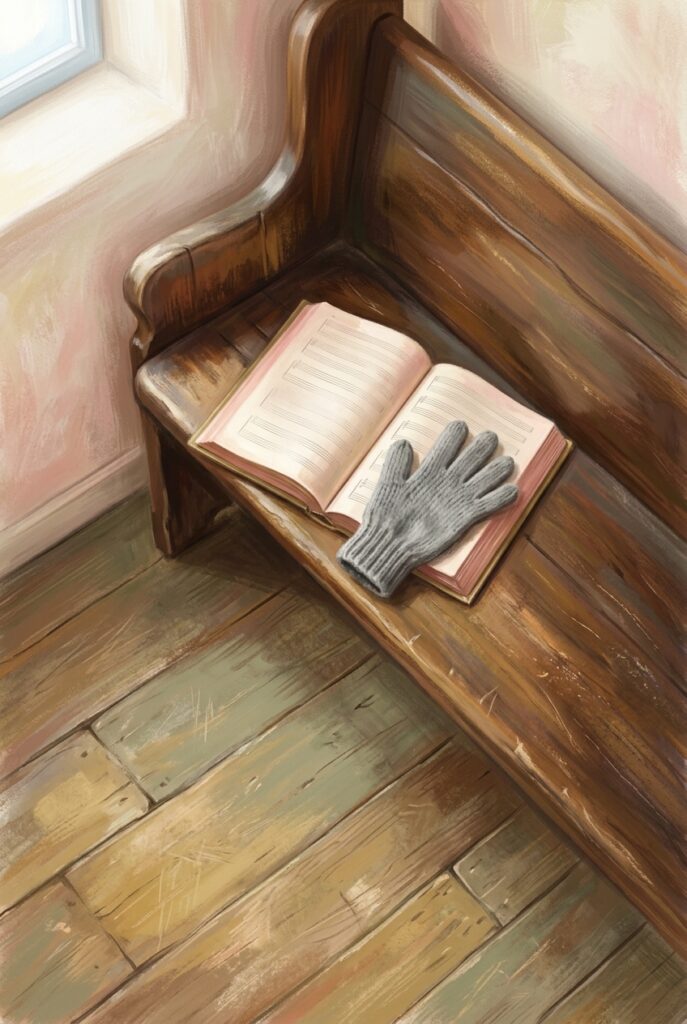
What happened instead took years and was almost invisible. One winter morning she came in late and her book was already open on the seat, at the right page, with somebody’s glove laid across it to hold it flat. He never said anything about it, and neither did she, and it happened again the following week.
That is what the passage is describing. He had been treating her as the enemy, and one day, without announcement, he stopped. He did not surrender a conviction in public. He put down a weapon he should never have been holding, because the wrestling is not against flesh and blood, and what was left over was a man who could reach a hymn book before somebody else got there.
Look at Sunday’s Gospel again through that clause, because it is the same lesson from the other end. The servant is forgiven ten thousand talents and walks straight out and throttles a man over a hundred pence. His mistake is not that he fought. It is his choice of opponent, and the rule he broke is the one that says not against flesh and blood. Shouldst not thou then have had compassion also on thy fellow servant, even as I had compassion on thee? He had just been handed everything, and he went looking for the smallest human being in reach.
Monday the whole Church prayed eternal rest give to them over every one of its dead without sorting them into deserving and undeserving first. That refusal to sort is the same instinct as this clause. Both of them decline to make a category of people into the problem, and both of them do it on purpose, in the liturgy, where it is hardest to wriggle out of. Not against flesh and blood does the same work in a single clause.
The Offertory today is a single verse about Job. There was a man in the land of Hus, whose name was Job, simple, and upright, and fearing God. The Church puts that verse here, on this Mass, and it fits the clause exactly.
Job’s real injury in that book is not the weather or the boils. It is three friends who arrive, decide he must be the guilty party, and spend thirty chapters on him. They had the wrong opponent. Their wrestling was not against flesh and blood either, and they never worked it out.
The Gradual then says something worth holding onto if you are the one being wrestled with. Lord, Thou hast been our refuge from generation to generation. Refuge, not fortress. A refuge is a building measured by who gets in, not by who gets kept out, and generation to generation means that whoever has been treated as the darkness this century will not be the last person to need the door. A refuge only makes sense to people who already grant that the wrestling is not against flesh and blood.
And the Alleluia verse, on a Wednesday with nothing else going on, is Israel walking out of Egypt. The people in that sentence had a real oppressor, an actual state, an actual army. The verse does not name a single Egyptian. It names the going out. Even there, at the one place where flesh and blood genuinely was in the way, the liturgy keeps the sentence pointed at deliverance rather than at a person, because the wrestling is not against flesh and blood.
The <a href=”https://www.newadvent.org/cathen/05485a.htm?utm_source=bloomministries.org” target=”_blank” rel=”noopener”>Catholic Encyclopedia</a> records something about this letter that makes the clause land harder. Ephesians was written from prison, most likely at Rome, and the article notes that it reads as a circular letter rather than mail to one congregation. The man handing out armour was in custody. He had flesh and blood opponents, with keys.
He does not mention them. He had every excuse to name a jailer, an informer, a magistrate, and he writes instead that our wrestling is not against flesh and blood. That is not a man who has never met an enemy. That is a man in chains declining to give the word enemy to a person who could have earned it.
Which is why the clause holds on an ordinary Wednesday, and why it needs to. Nothing is being celebrated today. Fourth class, green, no feast, no commemoration, the Sunday’s texts read out again to whoever showed up. The armour is not issued for great occasions; it is issued for the Wednesdays, when the temptation is not to fight a war but to be small and hard with one particular person who is easy to be small and hard with. Not against flesh and blood is a Wednesday rule before it is a doctrine.
Stand there. That is the whole instruction. Keep the belt and the breastplate and the peace on your feet, keep the sword in the hands it belongs to, and keep the clause in the middle of the passage where Paul put it, because our wrestling is not against flesh and blood and the moment you forget that you have started fighting something you are supposed to be protecting.
↑ The order resumes below.
IX
Secret
Graciously accept these sacrificial gifts, O Lord, with which Thou hast willed us to find favour with Thee: and by Thy mighty love restore salvation unto us. Through our Lord Jesus Christ, Thy Son, who liveth and reigneth with Thee in the unity of the Holy Ghost, God, world without end. Amen.
X
The Holding
Go out today and stand where you are. May God, who guards the household and asks you to guard nothing but the door, keep your equipment on and your hands empty, and may you remember before you open your mouth that your wrestling is not against flesh and blood. In the name of the Father, and of the Son, and of the Holy Ghost. Amen.
And if that language is not yours, take it plainly. Whatever you are up against today, the person in front of you is not it. Do the small, unglamorous work of holding your ground without making a target out of somebody who bleeds, and let not against flesh and blood be the rule you keep even on the day it costs you the argument.
XI
Frequently Asked Questions
The propers for this Mass are those of the Twenty-First Sunday after Pentecost, repeated on the fourth feria following it, as assigned in the 1962 Roman Missal, with the Common Preface in place of the Preface of the Most Holy Trinity. Scripture is given in the Douay-Rheims.
The liturgical spine of Faith in Bloom is The New Marian Missal for Daily Mass, Sylvester P. Juergens, S.M., S.T.D., Regina Press. Bloom Ministries is an Independent Catholic ministry, not affiliated with or recognized by the Roman Catholic Church.
