


Daily Offering · 11 August 2026 · Feria
Daily Offering: August 11, 2026 | Of More Value Than Many Sparrows
Of more value than many sparrows — that’s Christ’s own measure of worth, spoken to people who had every reason to fear their worth was about to be tested by death itself, and it’s worth carrying into this morning before anything else is said.…
The order of this offering
Before the readings
Offering and Canon
I
Opening Address
Of more value than many sparrows — that’s Christ’s own measure of worth, spoken to people who had every reason to fear their worth was about to be tested by death itself, and it’s worth carrying into this morning before anything else is said. Beloved, grace and peace to you: however you arrive here, tired or hopeful, certain or doubting, welcomed elsewhere or shut out elsewhere. Bloom is not a room you have to earn your way into. Sit with us a moment, offered today in the spirit of a low Mass — Word, prayer, and offering, without pretense to more than that.
II
Introit
(Ps. 36:39, 1)
The salvation of the just is from the Lord: and He is their protector in the time of trouble. Be not emulous of evildoers; nor envy them that work iniquity.
III
Collect
(Confirmed, directly sourced — Missale Romanum 1962, proper to Ss. Tiburtius and Susanna, not adapted)
May the constant protection of Thy holy martyrs, Tiburtius and Susanna, support us, O Lord, for Thou dost never cease mercifully to regard those to whom Thou hast granted such assistance. Through our Lord…
IV
Epistle
Hebrews 11:33-39, Douay-Rheims
Brethren: The Saints by faith conquered kingdoms, wrought justice, obtained promises, stopped the mouths of lions, quenched the violence of fire, escaped the edge of the sword, recovered strength from weakness, became valiant in battle, put to flight the armies of foreigners. Women received their dead raised to life again. But others were racked, not accepting deliverance, that they might find a better resurrection. And others had trial of mockeries and stripes, moreover also of bands and prisons. They were stoned, they were cut asunder, they were tempted, they were put to death by the sword, they wandered about in sheepskins, in goatskins, being in want, distressed, afflicted: of whom the world was not worthy: wandering in deserts, in mountains, and in dens, and in caves of the earth. And all these being approved by the testimony of faith, received not the promise.
V
Gradual
(Ps. 33:18-19)
The just cried, and the Lord heard them, and delivered them out of all their troubles. The Lord is nigh unto them that are of a contrite heart; and He will save the humble of spirit.
VI
Alleluia
Alleluia, alleluia. The white-robed army of martyrs praiseth Thee, O Lord. Alleluia.
VII
Gospel
Luke 12:1-8, Douay-Rheims
At that time, Jesus said to His disciples: Beware ye of the leaven of the Pharisees, which is hypocrisy. There is nothing covered that shall not be revealed: nor hidden, that shall not be known. For whatsoever things you have spoken in darkness, shall be published in the light; and that which you have spoken in the ear in chambers shall be preached on the housetops. And I say to you, My friends, be not afraid of them who kill the body, and after that have no more that they can do. But I will show you Whom you shall fear: fear ye Him Who, after He hath killed, hath power to cast into hell. Yea, I say to you, fear Him. Are not five sparrows sold for two farthings, and not one of them is forgotten before God? Yea, the very hairs of your head are all numbered. Fear not, therefore: you are of more value than many sparrows. And I say to you: whosoever shall confess Me before men, him shall the Son of Man also confess before the angels of God.
The Offering (Homily)
Daily Homily | Of More Value Than Many Sparrows
Read the end of today’s Epistle carefully, because it’s easy to skip past the hardest line in it. After the entire roll call of faith — kingdoms conquered, lions silenced, fire quenched, the sword…
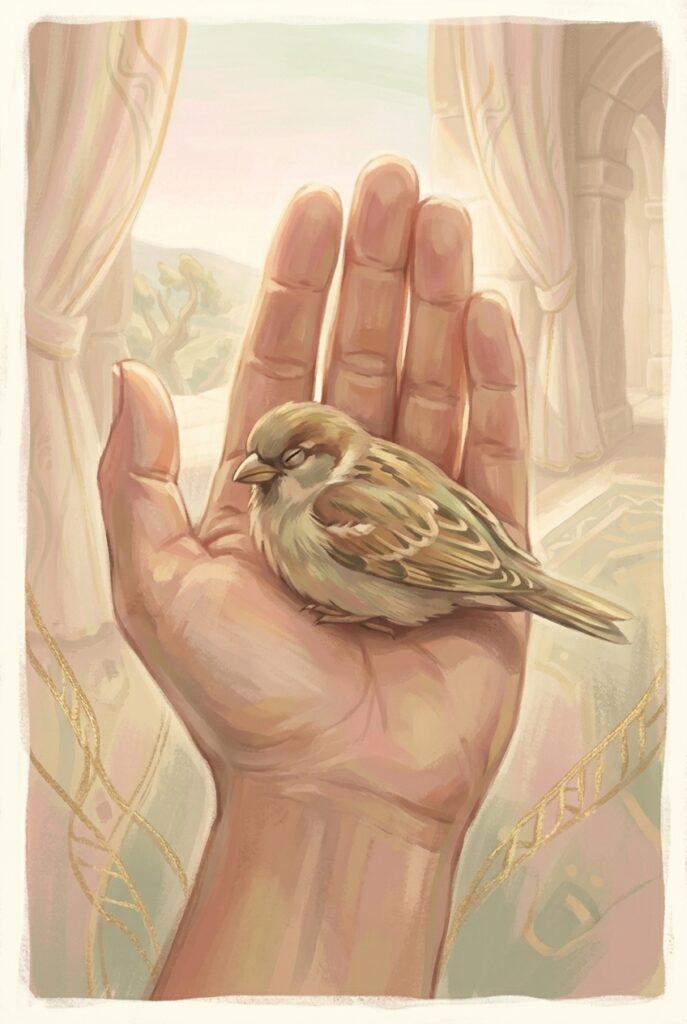
Read the end of today’s Epistle carefully, because it’s easy to skip past the hardest line in it. After the entire roll call of faith — kingdoms conquered, lions silenced, fire quenched, the sword escaped — Paul’s summary isn’t triumphant. “And all these being approved by the testimony of faith, received not the promise.” They didn’t get to see it work out. Whatever they were faithful toward, most of them died without the reward ever visibly arriving. Faith, in this accounting, was never a guarantee that things would resolve neatly within a person’s own lifetime.
That detail matters enormously for reading today’s Gospel rightly. Of more value than many sparrows isn’t a promise that nothing bad will happen to you. Christ says this immediately after telling His friends plainly not to fear “them who kill the body” — because some of them, He already knows, will in fact be killed. The comfort isn’t “you’ll be spared.” It’s narrower and, in its way, more durable: nothing about you, not even something as small as a sparrow’s fall, goes unnoticed or unaccounted for, regardless of how the story ends visibly.
Today’s Gradual sits between the Epistle and Gospel like a hinge connecting both halves: “the just cried, and the Lord heard them, and delivered them out of all their troubles.” Read in isolation, that sounds like a promise of rescue. Read alongside Hebrews’ own honest admission that many of the faithful “received not the promise,” it becomes something more precise: being heard and being delivered were never guaranteed to happen on the same timeline, or within the same lifetime, as the crying out itself.
St. Tiburtius tested this specific principle against something almost absurdly concrete. Accused of practicing Christianity, tradition holds he was made to prove or disprove his faith by walking barefoot across burning coals — and he did, unharmed, protected, he said, only by the sign of the cross. A watching world that wanted evidence got exactly that: a genuine, visible sign. And the response wasn’t belief. It was a new accusation — that what they’d just seen must have been sorcery rather than faith — and he was executed regardless of the miracle he’d just performed in front of them. Even direct, undeniable proof didn’t guarantee the outcome he might reasonably have hoped for.
It’s worth sitting with how strange that sequence actually is. Most people, faced with unbelief, assume the problem is insufficient evidence — if only the doubters could see something undeniable, they’d finally be convinced. Tiburtius’s story argues the opposite: sometimes people who’ve already decided what they will and won’t believe simply relabel the evidence rather than update the belief. The coals didn’t burn him, and it changed nothing about the verdict already waiting for him. His worth, and the truth of what he’d shown them, didn’t depend on whether that verdict ever caught up to reality.
St. Susanna’s story tests the same principle from an entirely different angle. Of noble birth in Rome, she was sought in marriage by a relative of the emperor himself — a match that would have secured her family enormous status and protection, the kind of offer few people in her position would have found easy to decline. She refused, on account of a vow she’d already made, and was killed for the refusal, in her own home. Nobody forced that outcome on her except her own insistence that who she already was mattered more than what marrying well could have bought her, her family, or her own physical safety. She wasn’t defending her life. She was defending the truth of something no one else had the right to renegotiate on her behalf, even when the person doing the asking held the power of an empire behind the request.
We’ve sat with a related refusal before, in Unrecognized By Your Own Family — St. Alexius, who let go of every worldly claim his own household would have gladly restored to him, rather than abandon who he’d actually become. Susanna’s refusal runs on the same current: a family, or an empire, offering something that looked like elevation, and a person choosing instead to hold onto a truth about themselves that nobody else was willing to honor on its own terms.

There is a story sometimes told of a trans woman whose family offered, more than once, to fully welcome her back — on the explicit condition that she present and live as the person she’d been raised to be rather than the one she actually was. It would have cost her nothing financially to accept; if anything, it would have restored considerable material comfort and family standing she’d lost. She has said the offer was never really about her identity being unclear to anyone, including them. It was about whether she would let someone else’s comfort renegotiate a truth that was never actually theirs to bargain over. She said no, the way Susanna said no, for the same underlying reason: some things aren’t actually available for trade, whatever they’re offered in exchange.
Whether or not the specific language of martyrdom or sainthood carries weight for you, the plain principle in today’s readings holds regardless: your worth was never contingent on whether the people around you chose to recognize it, reward it, or even survive to see it vindicated. Tiburtius performed the miracle and was killed anyway. Susanna refused the marriage and was killed anyway. Neither outcome was evidence that they’d been wrong about their own worth. It was evidence about the world’s willingness, in that moment, to see it.
We’ve also touched a related promise before, in God Is Faithful — the feast of Ss. Abdon and Sennen, on the assurance that no pressure exceeds what a person can bear. Today’s readings add the harder, more honest half of that same promise: sometimes bearing it doesn’t end in rescue within this life at all. It ends, as the Epistle says plainly, in not receiving the promise — and being counted faithful anyway.
So beloved, whatever cost you’re currently weighing for holding onto something true about yourself — a refusal nobody else will validate, a truth nobody else seems willing to see even when it’s right in front of them — today’s feast doesn’t promise the outcome will look like vindication. It promises something quieter and, in the end, more reliable: not one sparrow forgotten before God, and you, by Christ’s own accounting, of considerably more value than many.
↑ The order resumes below.
IX
Secret
Receive, O Lord, this small offering made in memory of two people who held to the truth of themselves at the cost of everything else, and grant that whatever we’re holding onto that nobody else will validate might still be counted, by You, as faithful.
X
The Holding
(Benediction — two readings, one truth)
For those who hold this in faith: Lord, You told Your friends not one sparrow falls unnoticed by You. Give us the same trust Tiburtius and Susanna held — that our worth was never contingent on whether anyone else recognized it in time. Amen.
For those still finding their footing: If you’ve ever held onto a truth about yourself that cost you everything someone else was offering instead, that choice was never proof you’d miscalculated. Some things were simply never available for trade.
XI
Frequently Asked Questions
Epistle and Gospel text: Douay-Rheims Bible, Bishop Challoner revision, fetched directly from drbo.org. Collect (confirmed, directly sourced, not adapted) and liturgical structure: the Missale Romanum (1962), feast of Ss. Tiburtius and Susanna, Martyrs, following The New Marian Missal for Daily Mass by Sylvester P. Juergens, S.M., S.T.D. (Regina Press, Imprimatur 1961).
Faith in Bloom offers this reflection in the spirit of the traditional Roman Rite — a daily offering, not a Mass — welcoming all people, of every faith background, into the shelter of the Word.
