


Sunday Mass · 9 November 2025 · Dedication of the Archbasilica of Our Holy Savior
Sunday Mass: November 9, 2025 | Could Not for the Crowd
Bloom’s Sunday Mass, and today the Gospel says plainly why one man could not see Christ: he could not for the crowd. We offer this Mass in the Independent Catholic tradition—not affiliated with or recognized by the Roman Catholic Church, but standing in the…
The order of this offering
Before the readings
Communion and close
Offering and Canon
I
Opening Address
Bloom’s Sunday Mass, and today the Gospel says plainly why one man could not see Christ: he could not for the crowd. We offer this Mass in the Independent Catholic tradition—not affiliated with or recognized by the Roman Catholic Church, but standing in the same Roman Rite, held by a pastor for whom this tradition has always been home. Beloved, grace and peace to you this morning, however you arrived and whatever it cost you to arrive. There is no step at this door.
Today is the Dedication of the Archbasilica of Our Holy Savior, and we are in white. It is a second-class feast, and because it belongs to Our Lord rather than to a saint, it takes the whole day: the Twenty-Second Sunday after Pentecost yields to it and is not even commemorated. So this morning the Church keeps the anniversary of a building.
Hold those two facts side by side, because they are going to do all the work. A feast for a stone building, and a Gospel about a man who could not for the crowd.
One more thing before we begin. You do not need to believe anything in particular for the next half hour to be worth your time. If you have ever stood at the back of a room and understood that the room was not built for you, you already know the whole argument.
II
The Penitential Rite
(The Confiteor and Kyrie are said here, from the Missal.)
We begin the way the Church has always begun, and notice where it sits: before the Gloria, before the readings, before anything is asked of anybody. Each of us names what we have done and left undone, in the plainest words we have, and nobody is required to say any of it out loud.
Take the pause. If you have ever been made to confess in front of an audience as the price of being let in, that is not what this is.
III
The Gloria
(The Gloria is sung or said here, from the Missal.)
And then praise, straight after the honesty, in that order and never the other way round. It is not a reward for having done well. It is simply what comes next.
IV
Introit
(Genesis 28:17; Ps. 83:2-3)
How terrible is this place! This is no other but the house of God, and the gate of heaven: and it shall be called the court of God.
℣. How lovely are thy tabernacles, O Lord of hosts! My soul longeth and fainteth for the courts of the Lord. Glory be to the Father, and to the Son, and to the Holy Ghost.
Jacob says that sentence when he wakes up outdoors, on stones, with nothing built anywhere near him. The first house of God in scripture has no walls at all.
V
Collect
O God, who dost every year bring round unto us again the day whereon this Thine holy temple was hallowed, and bringest us again in soundness of body and mind to be present at Thine holy worship, graciously hear the supplications of Thy people, and grant that whosoever shall come into this Thine house to ask good at Thine hand, may be rejoiced in the obtaining of all his request. Through our Lord Jesus Christ, Thy Son, who liveth and reigneth with Thee in the unity of the Holy Ghost, God, world without end.
Whosoever shall come in. Not whoever gets in easily, and not whoever the crowd makes room for.
VI
Epistle
Apocalypse 21:2-5, Douay-Rheims
And I John saw the holy city, the new Jerusalem, coming down out of heaven from God, prepared as a bride adorned for her husband. And I heard a great voice from the throne, saying: Behold the tabernacle of God with men, and he will dwell with them. And they shall be his people; and God himself with them shall be their God.
And God shall wipe away all tears from their eyes: and death shall be no more, nor mourning, nor crying, nor sorrow shall be any more, for the former things are passed away. And he that sat on the throne, said: Behold, I make all things new. And he said to me: Write, for these words are most faithful and true.
On the day we keep a building’s anniversary, the Lesson gives the address as with men. Keep that in your ear.
VII
Gradual
(The Roman Missal, the Common of the Dedication of a Church; the antiphon and its verse are liturgical texts rather than scripture)
This place was made by God, a priceless mystery; it is without reproof. ℣. O God, before whom standeth the choir of angels, give ear to the prayers of thy servants.
VIII
Alleluia
(Ps. 137:2)
Alleluia, alleluia. ℣. I will worship towards thy holy temple, and I will give glory to thy name. Alleluia.
IX
Gospel
Luke 19:1-10, Douay-Rheims
At that time: And entering in, he walked through Jericho. And behold, there was a man named Zacheus, who was the chief of the publicans, and he was rich. And he sought to see Jesus who he was, and he could not for the crowd, because he was low of stature.
And running before, he climbed up into a sycamore tree, that he might see him; for he was to pass that way. And when Jesus was come to the place, looking up, he saw him, and said to him: Zacheus, make haste and come down; for this day I must abide in thy house. And he made haste and came down; and received him with joy.
And when all saw it, they murmured, saying, that he was gone to be a guest with a man that was a sinner. But Zacheus standing, said to the Lord: Behold, Lord, the half of my goods I give to the poor; and if I have wronged any man of any thing, I restore him fourfold.
Jesus said to him: This day is salvation come to this house, because he also is a son of Abraham. For the Son of man is come to seek and to save that which was lost.
X
The Creed
(The Nicene Creed is said here, from the Missal.)
We say it together and out loud, in the same words and at the same speed, whatever each of us is privately able to mean by it this morning. Some of you will say every line as fact. Some of you will say it the way you would carry a friend’s bag up a flight of stairs. Both of you are saying it.
The Offering
Sunday Homily | Could Not for the Crowd
Luke gives us the reason in the same breath as the desire, and it is not the reason anyone would guess.
Luke gives us the reason in the same breath as the desire, and it is not the reason anyone would guess.

And he sought to see Jesus who he was, and he could not for the crowd, because he was low of stature.
Read it slowly. A man wants to see Christ. He could not for the crowd. And the clause Luke attaches to explain it is about the measurement of a body. Eleven words to say he could not for the crowd, and not one of them accuses him of anything.
There is no sin anywhere in that sentence. No hardness of heart, no refusal, no unbelief, no unworthiness, no failure of desire—the desire is the first thing stated. Luke could have written that he was too proud to push through, or too hated to be let past, and Luke wrote neither. He could not for the crowd, because he was low of stature, and that is the entire diagnosis the Gospel offers. Every other explanation for why he could not for the crowd is one we bring with us.
Nobody in Jericho did anything wrong
Now look at the crowd, because the crowd is us.
They are not a mob. Not one person in that street set out that morning to stop a short man from seeing anything. They came to see Christ, which is exactly the right thing to want. They stood in the road, which is where you stand. They stood at their own height, which is the only height anybody has.
Every person in that crowd was behaving well, and he could not for the crowd. That is the hardest kind of exclusion to see from the inside, because it has no author. Nobody decided it. It is simply what happens when a space fills up with people who all happen to fit.
And here is the part I want to be honest about: a crowd like that will never notice. It cannot. The information that somebody at the back can see nothing is precisely the information a crowd is built not to carry. Nobody in that street knew he could not for the crowd, and nobody had to lie about it.
What he does, and what he does not do
Watch his solution, because it tells you what he had already ruled out.
He does not grow. That is not available and he does not waste a second wishing for it. He does not ask anyone to move, which tells you something about how long he has been living in that town. He does not appeal to his rank, and he had rank—Luke says he was chief of the publicans and rich, so this is a man with standing who has evidently learned that standing does not buy a sightline. He has worked out already that asking will not change the fact that he could not for the crowd.
What he does is run ahead and get above it. He could not for the crowd, so he leaves the crowd entirely, goes down the road to a place nobody is standing yet, and climbs a tree. The tree is not a symbol. It is the only place in Jericho from which he could see, and he could not for the crowd anywhere else.
Count what that cost him. He had to leave the spot where everyone else was allowed to stand. He had to work out the route in advance, which means he has done this arithmetic before, in other streets, for other things. And he had to be undignified in public, a wealthy man running and climbing in front of the whole town, because the alternative was seeing nothing at all. Everyone who could not for the crowd pays that surcharge, and nobody in the crowd is ever billed for it.
That is a workaround. Every person who has ever needed one recognizes it instantly. It works, and it costs, and it has to be invented again tomorrow, because he could not for the crowd yesterday and the crowd has not changed.
The teaching this text will not support
Now the hard part, and I am not going to step around it.
There is a teaching that takes a man who could not for the crowd and makes him the problem. It says: he should have tried harder, spoken up, asked properly, had more faith, made more effort. It locates the failure in the person who cannot see rather than in the arrangement that prevents seeing. And the moment you say it out loud beside Luke 19:3 it falls apart, because Luke has already told us where the obstruction was, and it was not inside him.
I am naming who this is aimed at, because the verse names it first. This teaching lands on disabled people, and it lands hardest on people whose bodies simply do not match the rooms that worship gets held in—the step at the front door, the pew that does not move, the sanctuary you reach by stairs, the microphone nobody thought to switch on. Every one of those is a way of saying could not for the crowd in the language of a floor plan. Told often enough that the barrier is a personal shortfall, a person stops going. That is the fruit, and by the fruit-test it is the only evidence that matters.
Yesterday I stood on a Collect that asks to be delivered from present sorrow and spoke about duration—about a sorrow that does not lift, and the lie that says persistence proves you did not try. Today the claim is a different one and I want the difference on the record. That was about time. This is about architecture.
Yesterday’s harm says you should have healed by now; today’s says you should have been able to reach it. They are not the same sentence and they do not get the same answer. One is answered by patience; the other is answered by moving the furniture, and a man who could not for the crowd needs the second one.
The first thing Christ does is look up
And when Jesus was come to the place, looking up, he saw him.
Before a word is spoken, a sightline gets reversed. The man who could not for the crowd is the man who gets seen, and Christ has to lift his eyes to do it, because by then Zacheus is above the whole street.
Then: make haste and come down. Notice that the workaround is not praised and it is not left in place. Nobody who could not for the crowd should have to be clever forever. He does not have to keep being ingenious, keep arriving early, keep finding the one branch with a view. He can come down and stand in the road like everybody else, because the thing he was straining to see has stopped and is now addressing him by name.
And then the sentence that decides the day: for this day I must abide in thy house. Not may. Not would like to. Must. On the feast of the grandest church in Christendom, the Gospel’s holy place is a private house down a side street in Jericho, and Christ says he is under some necessity to stay there.
A row of people sliding down
There is a story sometimes told of a woman who came back to church after a long absence, and not because her faith had come back.
Her mother had died in the spring and by autumn she had run out of places to sit with it. So she went on a Sunday morning to the nearest church with its lights on, arrived late, and stopped in the doorway at the back, where what she could see was the backs of about two hundred heads and a strip of ceiling. She had not come to follow the service. She had come to be in a room where somebody else was doing the talking.
A man in the last pew noticed her standing there. He did not hand her a book, and he did not lean over to explain what page they were on, which she said afterwards she had been braced for. He slid along the bench. Then the two people next to him slid along, and then the row did what a row does once it has started, and by the end of it there was a gap at the aisle end with a clear line to the altar.
Nobody asked her what she believed. Nobody has asked her since. She could see, and that was the whole of what was done for her, and she has told the story for years as though something enormous happened, because something did.
That is the entire remedy the Gospel is interested in. Not a lecture for the woman in the doorway. A crowd that moves. She could not for the crowd, and the crowd repaired it without ever once discussing it.
The building falls down and the feast survives
Then set the Lesson beside all of it.
The church we are keeping the anniversary of is the cathedral of Rome, and its own walls carry an inscription calling it the mother and head of all churches of the city and the world. It was raised on ground Constantine handed over to the Church around the year 311. An earthquake in 896 brought it down from the altar to the doors. It burned, and was rebuilt. It burned again in 1360, and was rebuilt again.
So the most senior building in Latin Christianity has been a heap of rubble more than once, and the feast kept going anyway. Which is what the Lesson has been saying from the beginning: Behold the tabernacle of God with men, and he will dwell with them. Not among the stones—with men. The dwelling is portable, and the stones never were. And if the dwelling is people, then a man who could not for the crowd was shut out of the dwelling itself and not merely out of a room.
If you take nothing theological out of this room, take the plain version: a group of people is the thing that is holy, and the building is a tool. Tools get judged by whether they work for the person using them. A church that a man could not for the crowd get into is a tool that is failing, however old it is and however beautiful.
And the Lesson goes further, into the only promise that would matter to somebody carrying real grief: God shall wipe away all tears from their eyes: and death shall be no more, nor mourning, nor crying, nor sorrow shall be any more. Six days ago we prayed eternal rest give to them over the whole company of the dead. Today the same hope arrives from the other end, as an announcement rather than a petition: Behold, I make all things new.
The murmur, and the fourfold
And when all saw it, they murmured.
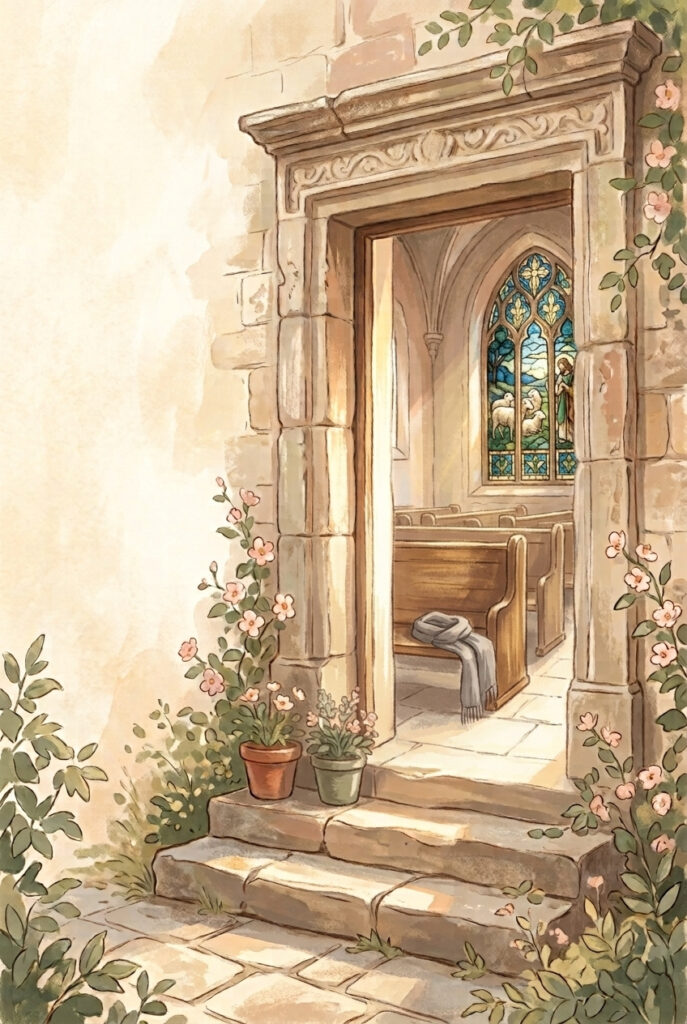
Look who is murmuring. The same crowd. He could not for the crowd, and now that same crowd is unhappy that Christ found him anyway—and the objection is not about the man’s trade, it is about where Christ has chosen to stay the night. They can accept a Jericho where a short man sees nothing. They cannot accept a Jericho where the house on the side street is the one that gets the guest.
And then Zacheus stands up and says something nobody asked him for. The half of my goods I give to the poor; and if I have wronged any man of any thing, I restore him fourfold. He is not buying the visit, which has already happened. He is releasing every claim he holds on everybody in that street, including the ones who stood in front of him.
Last Sunday we sat with a servant who was released from an unpayable sum and then went out and would not release a hundred pence, a man who could not recognize have patience with me coming out of somebody else’s mouth. Here is the photograph negative of him. Zacheus is a creditor too. Nobody has demanded a thing. He opens his own ledger and tears it up in the street, and the man who could not for the crowd is the only person in the chapter who gives anything away.
Where this leaves us
So here is what I would ask you to carry out.
You are in a crowd this week. Several of them. A meeting, a queue, a kitchen, a group chat, a pew. In every one of them there is someone who could not for the crowd, and the odds are very good that you will not be able to see who, because that is the nature of the problem.
So do not try to identify them and then help. Just make the room bigger than it needs to be. Leave the seat on the aisle. Slide down the bench before anyone asks.
Say the thing out loud that everybody in the room already knows, in case one person does not. Ask where the door without the step is, even on a day when you do not need it, because asking on an easy day is what makes it possible to ask on a hard one.
On the first of this month we heard about a multitude which no man could number, and I said then that heaven does not run a gate that counts people. This is the same claim, standing on the ground: the Collect this morning asks that whosoever shall come into this Thine house to ask good at Thine hand be rejoiced in obtaining all his request. Whosoever. The prayer contains no clause about height.
Christ looked up. He could not for the crowd, and so the Lord of the house raised his eyes. That is the posture the whole feast is recommending. Not stooping, not reaching down—looking up, at a man who had gone to a great deal of trouble to be visible, and calling him by his name and going home with him.
↑ The order resumes below.
XII
Offertory
(1 Paralipomenon 29:17-18)
O Lord God, in the simplicity of my heart I have joyfully offered all these things: and I have seen with great joy thy people, which are here present: O God of Israel, keep for ever this will, alleluia.
XIII
Secret
Look with favour upon our prayers, we beseech Thee, O Lord, that as we offer our prayers before Thee, we may with Thy help attain eternal rewards. Through our Lord Jesus Christ.
XIV
The Canon and Consecration
(The Preface, the Sanctus, and the Canon through the Consecration are prayed here, from the Missal, and the Consecration made within Bloom’s own Independent Catholic tradition.)
We come to the part of the Mass that is not a lesson. The Church stops explaining and simply does what it was given to do, in words it has used for centuries, offered as a real celebration within our own tradition and not a claim on anybody else’s.
Whatever you brought in with you—the room you cannot get into, the name you have stopped saying, the thing you have worked around for so long that you no longer call it a workaround—put it on the altar now. What happens here is a house being made out of ordinary material. Bread, wine, a table, people.
XV
Act of Spiritual Communion
No livestream can hand anyone a host. That is true of every Mass offered over video, anywhere, by anyone. So the Church’s own long-standing practice stands in, the same one bishops recommended to their own parishes watching from home.
My Jesus, I believe that Thou art truly present in the Most Holy Sacrament. I love Thee above all things and I desire to receive Thee into my soul. Since I cannot now receive Thee sacramentally, come at least spiritually into my heart. I embrace Thee as if Thou wert already there, and unite myself wholly to Thee. Never permit me to be separated from Thee. Amen.
If you cannot say that this morning, sit quietly through it. Nobody watching this is at the back of the room.
XVI
Communion Antiphon
(Matthew 21:13; Matthew 7:8)
My house shall be called the house of prayer, saith the Lord: in it every one that asketh, receiveth; and he that seeketh, findeth; and to him that knocketh, it shall be opened.
Hear what the Church puts in your ear on the way out of a Mass about a building. Not in it the worthy are admitted. Every one that asketh.
XVII
Postcommunion
We beseech Thee, almighty God, that in this place, which we, all unworthy, have dedicated to Thy name, Thou wilt give a favourable hearing to all who petition Thee. Through our Lord Jesus Christ.
XVIII
The Closing Blessing
(Given as Bloom’s own pastor, within Bloom’s own tradition)
Go now, and go looking up.
If you believe this morning: the house was never the point and the stones were never holy on their own. God’s chosen address in today’s Lesson is with men, and Christ’s chosen address in today’s Gospel is a side street in Jericho. You are the building. You have been consecrated ground since before you could get up the steps.
And if you believe none of it, the same thing holds with the theology taken out. Rooms are made by people, and a room is only as good as its worst seat. Somebody near you this week could not for the crowd, and you will probably never find out who they were, and you can move anyway.
May God, who dwells with us and not merely near us, keep this household in soundness of body and mind, hear whosoever comes asking, and make all things new. And may the crowd move for you when it is your turn to be at the back.
In the name of the Father, and of the Son, and of the Holy Spirit. Amen.
Go, and slide down the bench.
XIX
Frequently Asked Questions
Epistle and Gospel text: Douay-Rheims Bible, Bishop Challoner revision—the standard English scripture translation used across traditional hand missals. Introit, Collect, Gradual, Alleluia, Offertory, Secret, Communion antiphon, and Postcommunion: the Missale Romanum (1962), the Dedication of the Archbasilica of Our Holy Savior, following The New Marian Missal for Daily Mass by Sylvester P. Juergens, S.M., S.T.D. (Regina Press, Imprimatur 1961). Historical detail on the Lateran basilica: the Catholic Encyclopedia.
Bloom’s Sunday Mass is offered in the Independent Catholic tradition, welcoming all people, of every faith background, into the shelter of the Word.
