

Daily Offering · 6 November 2026 · Feria
Daily Offering: November 6, 2026 | Released from the Net
Some of you are ending this week caught. Caught in the news, in an argument you keep replaying, in a habit you promised to break by now. Today’s Collect was written for exactly that. It asks God that by His goodness we may be…
The order of this offering
Before the readings
The Word
Offering and Canon
I
Opening Address
Some of you are ending this week caught. Caught in the news, in an argument you keep replaying, in a habit you promised to break by now. Today’s Collect was written for exactly that. It asks God that by His goodness we may be released from the net of sin in which we have been caught by our own weakness.
Welcome to Bloom’s Daily Offering for Friday, November 6, 2026. It is a feria of the fourth class, in green, with the Mass of the XXIII Sunday after Pentecost for the third time this week. There is no commemoration, no Gloria and no Creed, and the Preface is the Common Preface.
This week the Offering has stayed with Paul’s letter to the Philippians: on Tuesday with our citizenship in heaven, and yesterday with his command to stand fast. Today the homily turns to the short prayer the priest says before the Lesson, the one no homily on this Mass has opened yet.
It is Friday, the day Christians have kept since the beginning in memory of the Cross. That makes this Collect fit the day like a key in a lock. It speaks of sin plainly, and it never once calls you wicked. It says you were caught, and it asks that you be released from the net.
II
A Word on Today’s Propers
This is the fourth printing here of the XXIII Sunday’s Mass. It was first printed on Sunday, November 16, 2025, whose homily preached the Introit and the woman in the Gospel; on Tuesday, when the homily preached Paul’s tears and our citizenship in heaven; and yesterday, when it preached Philippians 4:1. Each proper was checked against yesterday’s printing one at a time, and they match.
Every proper is printed in full again, in Latin and English. One prayer in this Mass has now been printed four times here and preached in none of them: the Collect, with its petition to be released from the net of sin. The homily stays there. There is no vigil and no octave today.
III
Introit
Jeremias 29:11-12, 14; Psalm 84:2
English
The Lord saith: I think thoughts of peace, and not of affliction: you shall call upon Me, and I will hear you; and I will bring back your captivity from all places.
Ps. 84:2. Lord, Thou hast blessed Thy land: Thou hast turned away the captivity of Jacob.
Glory be to the Father, and to the Son, and to the Holy Ghost. As it was in the beginning, is now, and ever shall be, world without end. Amen.
The Lord saith: I think thoughts of peace, and not of affliction: you shall call upon Me, and I will hear you; and I will bring back your captivity from all places.
Latin
Dicit Dóminus: Ego cógito cogitatiónes pacis, et non afflictiónis: invocábitis me, et ego exáudiam vos: et redúcam captivitátem vestram de cunctis locis.
Ps. 84:2. Benedixísti, Dómine, terram tuam: avertísti captivitátem Jacob.
Glória Patri…
Dicit Dóminus: Ego cógito cogitatiónes pacis, et non afflictiónis: invocábitis me, et ego exáudiam vos: et redúcam captivitátem vestram de cunctis locis.
IV
Collect
(℣. marks what the priest says. ℟. marks the answer of the server and the people.)
English
Let us pray.
Forgive, we beseech Thee, O Lord, the sins of Thy faithful people: that by Thy goodness we may be released from the net of sin in which we have been caught by our own weakness. Through our Lord.
℟. Amen.
Latin
Orémus.
Absólve, quǽsumus, Dómine, tuórum delícta populórum: ut a peccatórum néxibus, quæ pro nostra fragilitáte contráximus, tua benignitáte liberémur. Per Dóminum…
℟. Amen.
V
Epistle
English
Lesson from the Epistle of blessed Paul the Apostle to the Philippians.
Brethren: Be ye followers of me, and observe them who walk so as you have our model. For many walk, of whom I have told you often (and now tell you weeping), that they are enemies of the cross of Christ; whose end is destruction; whose God is their belly; and whose glory is in their shame; who mind earthly things.
But our conversation is in heaven; from whence also we look for the Saviour, our Lord Jesus Christ, who will reform the body of our lowness, made like to the body of His glory, according to the operation whereby also He is able to subdue all things unto Himself.
Therefore, my dearly beloved brethren, and most desired, my joy and my crown; so stand fast in the Lord, my dearly beloved. I beg of Evodia, and I beseech Syntyche, to be of one mind in the Lord. And I entreat thee also, my sincere companion, help those women who have laboured with me in the gospel, with Clement and the rest of my fellow labourers, whose names are in the book of life.
℟. Thanks be to God.
Latin
Léctio Epístolæ beáti Pauli Apóstoli ad Philippénses.
Fratres: Imitatóres mei estóte, et observáte eos, qui ita ámbulant, sicut habétis formam nostram. Multi enim ámbulant, quos sæpe dicébam vobis (nunc autem et flens dico) inimícos Crucis Christi: quorum finis intéritus: quorum Deus venter est: et glória in confusióne ipsórum, qui terréna sápiunt.
Nostra autem conversátio in cœlis est: unde étiam Salvatórem exspectámus, Dóminum nostrum Jesum Christum, qui reformábit corpus humilitátis nostræ, configurátum córpori claritátis suæ, secúndum operatiónem, qua étiam possit subjícere sibi ómnia.
Itaque, fratres mei caríssimi et desideratíssimi, gáudium meum et coróna mea: sic state in Dómino, caríssimi. Evódiam rogo et Sýntychen déprecor idípsum sápere in Dómino. Etiam rogo et te, germáne compar, ádjuva illas, quæ mecum laboravérunt in Evangélio cum Cleménte et céteris adjutóribus meis, quorum nómina sunt in libro vitæ.
℟. Deo gratias.
VI
Gradual
English
Thou hast saved us, O Lord, from them that afflict us: and hast put them to shame that hate us.
℣. In God shall we glory all the day long: and in Thy name we will give praise for ever.
Alleluia, alleluia. ℣. Out of the depths I have cried to Thee, O Lord: Lord, hear my prayer. Alleluia.
Latin
Liberásti nos, Dómine, ex affligéntibus nos: et eos, qui nos odérunt, confudísti.
℣. In Deo laudábimur tota die, et in nómine tuo confitébimur in sǽcula.
Allelúja, allelúja. ℣. De profúndis clamávi ad te, Dómine: Dómine, exáudi oratiónem meam. Allelúja.
VII
Gospel
English
℣. Continuation ☩ of the holy Gospel according to Matthew.
℟. Glory be to Thee, O Lord.
At that time, as Jesus was speaking to the multitudes, behold a certain ruler came up, and adored Him, saying: Lord, my daughter is even now dead; but come, lay Thy hand upon her, and she shall live. And Jesus rising up followed him, with His disciples.
And behold a woman who was troubled with an issue of blood twelve years, came behind Him, and touched the hem of His garment. For she said within herself: If I shall touch only His garment, I shall be healed. But Jesus turning and seeing her, said: Be of good heart, daughter, thy faith hath made thee whole. And the woman was made whole from that hour.
And when Jesus was come into the house of the ruler, and saw the minstrels and the multitude making a rout, He said: Give place, for the girl is not dead, but sleepeth. And they laughed Him to scorn. And when the multitude was put forth, He went in, and took her by the hand. And the maid arose. And the fame hereof went abroad into all that country.
℟. Praise be to Thee, O Christ.
Latin
℣. Sequéntia ☩ sancti Evangélii secúndum Matthǽum.
℟. Gloria tibi, Domine.
In illo témpore: Loquénte Jesu ad turbas, ecce, princeps unus accéssit et adorábat eum, dicens: Dómine, fília mea modo defúncta est: sed veni, impóne manum tuam super eam, et vivet. Et surgens Jesus sequebátur eum et discípuli ejus.
Et ecce múlier, quæ sánguinis fluxum patiebátur duódecim annis, accéssit retro et tétigit fímbriam vestiménti ejus. Dicébat enim intra se: Si tetígero tantum vestiméntum ejus, salva ero. At Jesus convérsus et videns eam, dixit: Confíde, fília, fides tua te salvam fecit. Et salva facta est múlier ex illa hora.
Et cum venísset Jesus in domum príncipis, et vidísset tibícines et turbam tumultuántem, dicebat: Recédite: non est enim mórtua puélla, sed dormit. Et deridébant eum. Et cum ejécta esset turba, intrávit et ténuit manum ejus. Et surréxit puélla. Et éxiit fama hæc in univérsam terram illam.
℟. Laus tibi, Christe.

The Offering
Daily Homily | Released from the Net
The Collect is one sentence, and it is easy to say it without hearing it: Forgive, we beseech Thee, O Lord, the sins of Thy faithful people: that by Thy goodness we may be…
What does “released from the net” mean?
The Collect is one sentence, and it is easy to say it without hearing it: Forgive, we beseech Thee, O Lord, the sins of Thy faithful people: that by Thy goodness we may be released from the net of sin in which we have been caught by our own weakness. Slow down and it opens like a door.
The Latin speaks of peccatórum néxibus, the bonds of sins, and of bonds quæ pro nostra fragilitáte contráximus, which we drew tight through our own frailty. The picture is a net, and every net is made of knots. We are not born inside one. It is tied around us, strand by strand.
Hear what the prayer does not say. It does not say we were caught by our wickedness, or by malice, or because we are bad people at the root. It says fragilitáte, frailty. The Church assumes that most of what holds us was not chosen in one great act of rebellion, but tied a strand at a time by people who were tired, or frightened, or lonely, or hurting.
Then hear who does the untying: tua benignitáte, by Thy goodness. Not by our effort, our record, or how sorry we can make ourselves feel. We ask to be released from the net by the kindness of God, and that is the whole hope of this Friday.
If you are caught today, you are in the right Mass. This prayer was written for you.
How does a net get tied?
St. Augustine knew this net from the inside. In the eighth book of his Confessions he describes himself in Milan, wanting God and unable to move, bound, not with the irons of another, but my own iron will. This Offering kept his feast in August and told his life briefly; today is about the chain.
He explains how the chain was made, in one of the clearest sentences anyone has written about a habit: custom not resisted became necessity. A wrong want, indulged, becomes a custom, and a custom left alone becomes a need. By which links, as it were, joined together, he wrote, did a hard bondage hold me enthralled.
That is the net of sin in the Collect, tied knot by knot by our own weakness. It is rarely one dramatic choice. It is the same small yes, said on a hundred tired evenings, until the yes no longer feels like a choice at all.
He also describes what it feels like to be held there. His thoughts of God, he says, were like the efforts of those desiring to awake, who, still overpowered with a heavy drowsiness, are again steeped therein. When God called, Awake, you that sleep, he had one answer: Presently, lo, presently; Leave me a little while.
Then comes the most honest sentence in the book: But presently, presently, had no present; and my leave me a little while went on for a long while. If you have said “next week” to God about the same thing for years, Augustine is telling your story. He wanted to be released from the net, and he kept asking for it tomorrow.
Who unties the knots?
Augustine could not cut himself free, and he says so. In a garden at Milan in September of 386, as he opened Paul’s letters and read in silence the lines his eyes first fell on, which told him to put on the Lord Jesus Christ. No further would I read, nor did I need, he wrote, and all the gloom of doubt vanished away.
He told that story years later, as a bishop, and the same Encyclopedia records that some critics think he read the bishop’s feelings back into it. It still calls that moment the grand stroke of grace. That is the shape of today’s Collect: knots tied over years, loosened by a goodness that was not his own. Augustine was released from the net by grace.
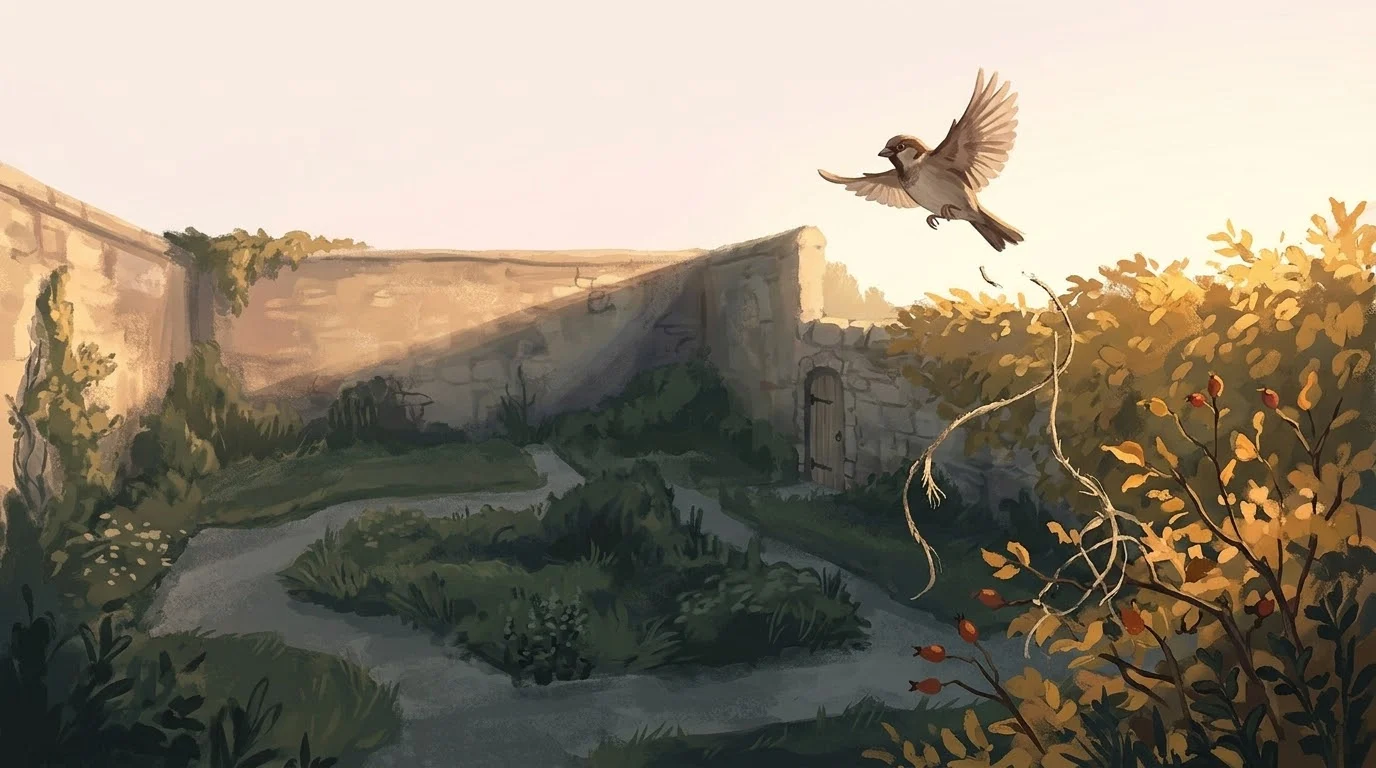
The Psalms sang it long before him. Psalm 123: Our soul hath been delivered as a sparrow out of the snare of the fowlers. The snare is broken, and we are delivered. In the Vulgate the last words are nos liberati sumus, we are set free, from the same verb as the Collect’s liberémur. The sparrow does not break the snare. Someone else does, and the bird simply flies.
Today’s Gospel ends the same way. Augustine called his state a heavy drowsiness, and in the ruler’s house Christ says the girl is not dead, but sleepeth. While the crowd laughs, He went in, and took her by the hand. And the maid arose. He does not ask her to rise first. He takes her hand, and she rises.
That is how anyone is released from the net: a hand that is not ours, and then we stand.
What nets did this week tie?
This has been a hard week for a lot of people, and nets get tied fastest when we are frightened. Bloom does not support or oppose any candidate or party, and this is not about how anyone voted. It is about what the week has done to us.
Some of us are caught in anger we keep feeding, replaying the same argument at two in the morning. Some are caught in contempt for neighbours who chose differently, in the endless scroll, or in resentment toward someone at our own table. None of it began as a great sin. Each began as a small yes said by a tired person, and custom not resisted became necessity.
Friday is the right day to loosen what has tightened. The Catholic Encyclopedia’s article on abstinence says that From the dawn of Christianity, Friday has been signalized as an abstinence day, in order to do homage to the memory of Christ suffering and dying on that day of the week. And it says that the sick, the infirm, beggars and labourers are not bound: Friday penance was never meant to add weight to anyone already carrying too much.
So ask today to be released from the net this week has tied. You do not have to untie all of it by tonight. You only have to stop pulling it tighter, and hand the rest to the goodness of God.
Forgiveness belongs here too. The Collect asks pardon for the sins of Thy faithful people, all of us together, so if you are asking to be released from the net, release someone else today. The cousin, the coworker, the neighbour whose yard sign you could not stand: let one of them go.
How do we live released from the net?
Start with one knot, not all of them. Tell God about it tonight in plain words. If your church offers confession, today is a good day to go.
Then stop pulling. If the knot is anger, do not feed it for one day. If it is the scroll, put the phone in another room for one evening. If it is a grudge, pray once, out loud, for the person you resent. If it is a habit you have been meaning to break presently, Augustine would tell you that presently never comes; today is the present.
And pray today’s Secret with the priest. It asks God that what Thou hast bestowed upon us, who are unworthy of it, Thou wouldst graciously bring to completion. Paul told these same Philippians that he, who hath begun a good work in you, will perfect it unto the day of Christ Jesus. The One who began to set you free will finish it.
You do not have to do this alone. Joining the Bloom Network is free and opens the door to everything Bloom does; find people who will pray with you while the knots come loose, or tell us you want to start a Bloom gathering where you live. A new Offering publishes every morning, and if you would like it in your inbox at six, sign up on the Faith in Bloom page.
If none of this is yours as faith, the plain half still stands. Pick one habit that tightened this week and loosen it for a day, let go of one grudge, and be gentle with your own weakness.
You were caught by weakness. You are released from the net by goodness, and that goodness is not yours to earn. It is God’s to give, and today He is giving it.
↑ The order resumes below.
IX
Secret
English
For the increase of our service, O Lord, we offer Thee the sacrifice of praise: that what Thou hast bestowed upon us, who are unworthy of it, Thou wouldst graciously bring to completion. Through our Lord.
℣. World without end.
℟. Amen.
Latin
Pro nostræ servitútis augménto sacrifícium tibi, Dómine, laudis offérimus: ut, quod imméritis contulísti, propítius exsequáris. Per Dóminum…
℣. Per omnia saecula saeculorum.
℟. Amen.
X
The Holding
If you believe, hold this. The net was tied by weakness, and it is untied by the goodness of God. Ask today to be released from the net, and release someone else as you are released.
English
May Almighty God bless you: the Father, ☩ the Son, and the Holy Ghost.
℟. Amen.
Latin
Benedícat vos omnípotens Deus, Pater, et Fílius, ☩ et Spíritus Sanctus.
℟. Amen.
If that language is not yours, take the plain half. Loosen one habit for a day, let go of one grudge, and be gentle with your own weakness.
XI
Frequently Asked Questions
Today is a weekday of the fourth class with no feast or commemoration of its own, so it takes the Mass of the XXIII Sunday after Pentecost, which gave way to All Saints on 1 November. This is its fourth printing here, after 16 November 2025 and Tuesday and Thursday of this week. Each proper matches yesterday’s printing, and today’s homily preaches the one prayer none of those homilies opened, the Collect.
The Collect asks God that by Thy goodness we may be released from the net of sin in which we have been caught by our own weakness. The Latin speaks of the bonds of sins quæ pro nostra fragilitáte contráximus, drawn tight through our frailty, and asks to be set free tua benignitáte, by the goodness of God. To be released from the net is to be freed by God’s kindness from habits and sins that were tied around us a strand at a time, not by our own strength.
It is the Collect’s picture of how sin holds a person: not usually one great act, but many small knots tied by weakness until they hold. St. Augustine described the same thing in his Confessions: custom not resisted became necessity. Psalm 123 uses a related image, a snare, and sings that The snare is broken, and we are delivered. The net of sin is real, and the Collect treats it as something God unties, not something you must escape alone.
In Book VIII of his Confessions he wrote that he was bound, not with the irons of another, but my own iron will, and that custom not resisted became necessity. He described putting God off with Presently, lo, presently; Leave me a little while, and admitted that presently, presently, had no present. The Catholic Encyclopedia dates his release to a garden at Milan in September 386 and calls it the grand stroke of grace.
Because Christ suffered and died on a Friday. The Catholic Encyclopedia says that From the dawn of Christianity, Friday has been signalized as an abstinence day, in order to do homage to the memory of Christ suffering and dying on that day of the week. The same article notes that the sick, the infirm and others in hardship are not bound. Friday penance is meant to loosen what holds us, never to crush anyone.
Start with one knot. Tell God plainly what you are angry about, stop feeding it for one day, and pray once for the person you resent. The Collect asks forgiveness for the sins of Thy faithful people, all of us together, so forgiving one person today is part of asking to be released yourself. If anger or anxiety is keeping you from sleeping, eating or working, talk with someone you trust, a doctor or a counsellor.
Yes. Sign up on the Faith in Bloom page at bloomministries.org/faith. The Offering publishes at five each morning and the email leaves at six, and you can choose the Daily Offering, the Sunday Mass or both. Your address is never shared or sold, and unsubscribing takes one click.
No. Bloom Ministries does not support or oppose any candidate or political party, before an election or after it. We ask every reader to pray for everyone who holds office, to forgive neighbours who voted differently, and to hold every officeholder to the same standard of truth and mercy, whatever their party.
No. The plain version works for anyone: pick one habit that tightened this week and loosen it for a day, let go of one grudge, and be gentle with your own weakness. Faith in Bloom offers the liturgy to anyone and asks nothing of you in exchange.
Faith in Bloom is the daily liturgical work of Bloom Ministries, a 501(c)(3) nonprofit, and it is free to read and always will be. If it has been worth something to you and you are able, you can give once or give monthly below. Sending a post to one person who needs it does real work too.
Propers for the Friday after the XXIII Sunday after Pentecost are taken from the 1962 Roman Missal, in the Missal’s Latin and in English. Scripture is quoted from the Douay-Rheims Bible.
The liturgical spine of Faith in Bloom is The New Marian Missal for Daily Mass by Sylvester P. Juergens, S.M., S.T.D., Regina Press, Imprimatur 1961. Faith in Bloom is offered by Bloom Ministries in the Independent Catholic tradition and is not affiliated with or recognized by the Roman Catholic Church.
